
Hello everyone and welcome back! In this blog I want to dig a little deeper into the current theories about torcs that have been found in Staffordshire. I need to do this now because I do not believe the current theory – of two distinct styles of torcs, one from East Anglia and one from Staffordshire – to be entirely supported by the evidence. As such, I think it would be useful to explain to you why I believe this theory to be wrong, before we can start examining what the unusual pattern of Staffordshire torc finds might *actually* represent. This blog will look at the theories and the next at why I feel we need to re-think them. So, grab yourself a cuppa, get set for a bit of a read, and I’ll begin…
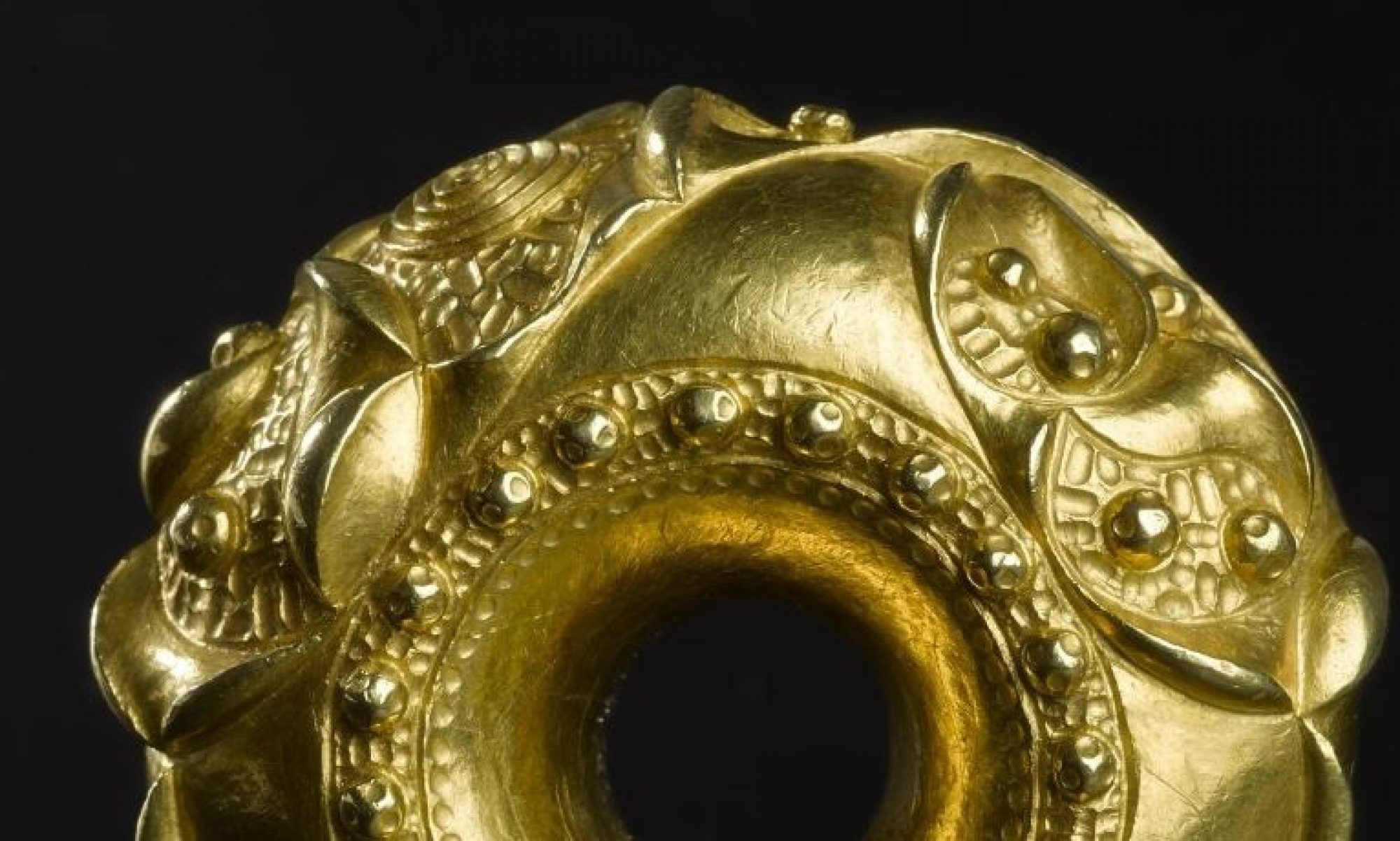
In Iron Age gold torc studies, there is a current theory that there are two schools of gold torc making/concentrations of torcs found in Southern Britain. The first in East Anglia of ‘Snettisham Style’, and the second group identified by the ‘cushion terminal’ torcs of Staffordshire (La Niece et al 2018, 416). This idea appears to have originated in 1970s scholarship but, despite additional torcs having been discovered in the early 21st century, has continued to be propagated – and indeed developed – despite there now being evidence to the contrary. To understand how this theory came about we need to trawl through over one hundred years’ of writing about these torcs.
The first written material regarding the Needwood Forest torc, by Henry Ellis in 1849 and then Hawkes in 1936, does not venture to guess at the origins of the torc, choosing to describe it as merely ‘Gaulish’ (Ellis 1849, 176). Hawkes does however compare the Needwood torc to that found in Ulceby, Lincolnshire: a theme that would be developed by our next writer.
In 1958, Cyril Fox published his book ‘Pattern and Purpose: A Survey of Early Celtic Art in Britain‘, one of the first overviews of British ‘Celtic’ artefacts and perhaps still the most influential, and most loved. As the Glascote torc – and indeed many of the other torc finds we now have today – had yet to have been recognised or discovered, Fox concentrated on the Needwood Forest torc, describing it as “the earliest gold torc of Celtic character” (Fox 1958, 37). Fox saw this torc as being indicative of goldsmiths “working in or near the middle Trent valley” and believed that the Ulceby torcs – found in Lincolnshire – “should derive from the same region” (Fox 1958, 37). Fox did not accept that that the Snettisham material (at this stage comprising of only the Great torc and associated finds, plus Hoards B/C) was made in East Anglia, instead suggesting “a centre of the manufacture of…these lovely objects somewhere beside the Jurassic Way” (Fox 1958, 56).
By 1971, the Glascote torc had been identified and the six Ipswich torcs had been found. In her paper about the Ipswich torcs, Elizabeth Owles built on Fox’s idea and suggested that the Ipswich torcs, with their overcast terminals, had their closest parallels with Glascote and Ulceby (Owles 1971). However, in a further paper of that year, on the Glascote torc, Kenneth Painter would distance himself from the previous theories, instead suggesting that “stylistically the Glascote torc is matched closely only by the fine gold torc found in Needwood Forest” (Painter 1971, 3) and that it was “made in the area that it was found” there being “one craftsman at Ipswich and another at Glascote” (Painter 1971, 4). As such, the Staffordshire ‘group’ started to emerge in earnest.
Edward Jope’s ‘Early Celtic Art‘, although published in 2000, was mainly written in the 1970s and it is to this time period that we should ascribe his thoughts. Jope, echoing Painter, thought there were “a few influential centres of the craft, the finest and most ancient represented by the opulent finds at and around Snettisham in Norfolk; another near Ipswich and a third producing much plainer work in the Tamworth-Needwood Forest area of south Staffordshire” (Jope 2000, 86)
Contrasting slightly with Jope, but agreeing with Owles, in 1975, John Brailsford suggested that there might be a link between the Ipswich hoard with “the form of the terminals on number 6 … generically similar to those on the Iron Age torcs from Glascote and Needwood Forest, both in Staffordshire. This feature distinguishes number 6 from Ipswich torcs numbers 1 to 5, which are all at home in East Anglia” (Brailsford 1975, 52).
By 1996, and having dug the hoards at Snettisham in 1990, Ian Stead emphasised just the two groups: “East Anglia is not the only source of gold torques, but the only other marked concentration is in Staffordshire, where they have been found on four sites within twenty miles of one another” (Stead 1985, 51). It is worth remembering that, at this stage, although the entirety of the Snettisham hoards had now been found, other torc hoards and single torc finds (such as Leekfrith, Newark, Blair Drummond, South West Norfolk and Near Stowmarket) and other pieces from around the country had not yet been made.
By 2012 the Newark torc, the South West Norfolk torc and the Blair Drummond hoard had all been discovered and there were several interim reports on the Snettisham hoards and other overviews of torcs published (e.g. Clarke 1954 & 1956, Eluère 1987, Fitzpatrick 1992, Garrow et al 2008 & 2009, Hautenauve 2004 & 2005, Hutcheson 2004, Meeks et al 2014, Stead 1991 & 1996).
In a book chapter from 2012, Duncan Garrow and Chris Gosden again proposed the two typological groups and, like Fox before them, linked the Staffordshire finds to those from Ulceby: “The British evidence for torcs is dominated by the finds from Snettisham…which in turn are part of a broader concentration of finds in East Anglia…these form a typological group linked by form and decorative motif…A second group is concentrated in the Midlands, exemplified by Glascote and Middleton in Warwickshire, Needwood and Stoke-on-Trent in Staffordshire, and Ulceby in Lincolnshire.” (Garrow & Gosden 2012, 11).
By 2016, the Leekfrith torcs had been added to the torc ensemble for these islands, and the picture of torc finds, as it stands today, was largely set. There have been no major torc finds since this date.
In ‘Gold in Iron Age Britain‘ (La Niece et al 2018) the most recent publication on Iron Age gold (which was written between 2014 and 2016, but published – with a few late editorial additions – in 2018) the two schools are again described: “Aside from a small group of twisted wire torcs with distinct ‘cushion’ terminals, centred on Staffordshire in the West Midlands, most torcs from the rest of Southern Britain are of broadly the same type as those found in East Anglia” (La Niece et al 2018, 415). A later quote refers to there being only “West Midlands and East Anglian styles” (La Niece et al 2018, 416).
In a 2016 paper on the Newark torc – referencing the La Niece paper above as ‘forthcoming’ – Rachel Atherton identified “two distinct groups of wire twisted torcs; the East Anglian types… and a small group of torcs centred on the Staffordshire area that have stylistically distinct ‘cushion’ torcs” (Atherton 2016, 47). Again from 2016, in the Leekfrith torc hoard Portable Antiquities Scheme/Treasure Report, Julia Farley suggested “there are two main distributions of precious metal torcs in Britain: an eastern group centred around East Anglia, and a smaller western group centred around Staffordshire. The latter include a type with a distinctive form of ring-terminals, known as ‘cushion terminals'” (Farley 2016).
As such, the most recently published overview of Iron Age gold, ‘Gold in Iron Age Britain‘ (La Niece et al 2018) maintains the two regional distribution groups in East Anglia and Staffordshire, does not acknowledge Fox and other writers’ thoughts about a relationship with Lincolnshire and appears to have originated the idea that the Staffordshire group could be defined as “a small group of twisted wire torcs with distinct ‘cushion’ terminals” (La Niece et al 2018, 416) .
But does this stand up to scrutiny?
In the next blog, I’ll be discussing why I don’t think it does and looking at what tentative theories might be emerging from the evidence so far.
…and if you agree it’s good to torc, don’t forget to click ‘Subcribe’ below. Until next time!
References:
Atherton, R. 2016. The Newark Iron Age torc. Transactions of the Thoroton Society of Nottinghamshire. 120, 43-53
Brailsford, J. 1975. Early Celtic masterpieces from Britain in the British Museum. London: British Museum Publications.
Clarke, R.R. 1954. The early Iron Age treasure from Snettisham, Norfolk. Proceedings of the Prehistoric Society 20, 27–86
Clarke, R.R., 1956. ‘The Snettisham treasure’, in Bruce-Mitford, R.L.S. (ed.), Recent Archaeological Excavations in Britain, 21-42
Ellis, H. 1849. Account of a Gold Torquis found in Needwood Forest in Staffordshire, in a Letter to the Viscount Mahon, President, from Sir Henry Ellis, K.H. Secretary. Archaeologia. 1849, 33(1), 175-176
Eluère, C. 1987. Celtic gold torcs. Gold Bulletin 20, 22–37.
Farley, J. 2016. The Leekfrith Torcs. Portable Antiquities Scheme. Available HERE
Fitzpatrick, A.P. 1992. The Snettisham, Norfolk, hoards of Iron Age torques: sacred or profane?. Antiquity, 66, pp 395-398
Fox, C. 1958. Pattern and Purpose: A Survey of Early Celtic Art in Britain. Cardiff: The National Museum of Wales.
Garrow, D. & Gosden, C. 2012. Technologies of Enchantment? Exploring Celtic Art: 400BC to AD 100. Oxford: Oxford University Press
Garrow, D., Gosden, C. & Hill, J.D. 2008. Rethinking Celtic Art. London: Oxbow.
Garrow, D., Gosden, C., Hill, J.D. and Bronk Ramsey, C. 2009. Dating Celtic Art: a Major Radiocarbon Dating Programme of Iron Age and Early Roman Metalwork in Britain. Archaeological Journal 166:1, 79-123
Hautenauve, H. 2004. Technical and metallurgical aspects of Celtic gold torcs in the British Isles (3rd–1st c. BC). In A. Perea, I. Montero & Ó. García-Vuelta (eds), Tecnología del oro antiguo: Europa y América [Ancient Gold Technology: Europe and America], 119–26. Anejos de Aespa 32. Madrid, Consejo Superior de Investigaciones Científicas, Instituto de Historia, Departamento de Historia Antigua y Arqueología.
Hautenauve, H. 2005. Les Torcs D’Or du Second Âge du Fer en Europe: techniques, typologie et symbolique. Rennes: Association du Travaux du Laboratoire d’Anthropologie de l’Université de Rennes 1
Hawkes, C. F. C. 1936. The Needwood Forest Torc. The British Museum Quarterly 11(1), 3-4
Hutcheson, N. 2004. Later Iron Age Norfolk: Metalwork, Landscape and Society. British Archaeological Reports, British Series 361
La Niece, S; Farley, J; Meeks, N & Joy, J. 2018. Gold in Iron Age Britain. In Schwab, R; Milcent, P-Y; Armbruster, B & Pernicka, E (eds), Early Iron Age Gold in Celtic Europe: Science, technology and Archaeometry. Proceedings of the International Congress held in Toulouse, France, 11-14 March 2015, 407-430. Rahden: Verlag Marie Leidorf GmbH
Meeks, N., Mongiatti, A. & Joy, J. 2014. Precious metal torcs from the Iron Age Snettisham treasure: Metallurgy and analysis. In E. Pernicka & R. Schwab (eds), Under the Volcano: Proceedings of the International Symposium on the Metallurgy of the European Iron Age (SMEIA), 135–56. Rahden: Verlag Marie Leidorf GmbH
Painter, K. S. 1971. An Iron Age gold-alloy torc from Glascote, Tamworth, Staffs. Transactions of the South Staffordshire Archaeological and Historical Society 11, 1969-70, 1-6.
Stead, I.M. 1991. The Snettisham treasure: Excavations in 1990. Antiquity 65, 447–64
Stead, I. M. 1996. Celtic Art in Britain before the Roman Conquest. 2nd ed. London: British Museum Press
 The Big Book of Torcs
2 Replies to “The Staffordshire Torc Odyssey: 7 Two ‘groups’ and a knotty problem”