Hello torc fanciers, long time no see!
Since I last wrote, I have been to see both the Middleton Hall and Needwood Forest torcs at the British Museum. I am awaiting permission to share the images of the Needwood Forest torc (as an item within the Royal Collection – despite being on loan to the British Museum – it has some very strict conditions attached), but in the meantime I can tell you about the Middleton Hall torc (British Museum 1977,0401.1).
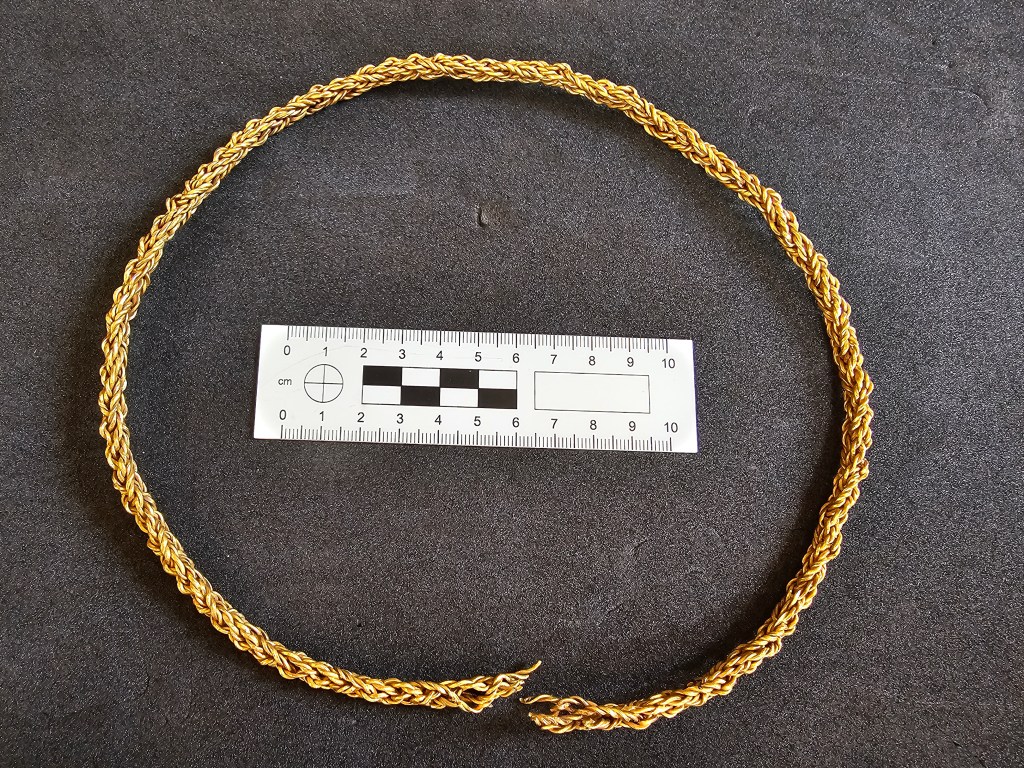
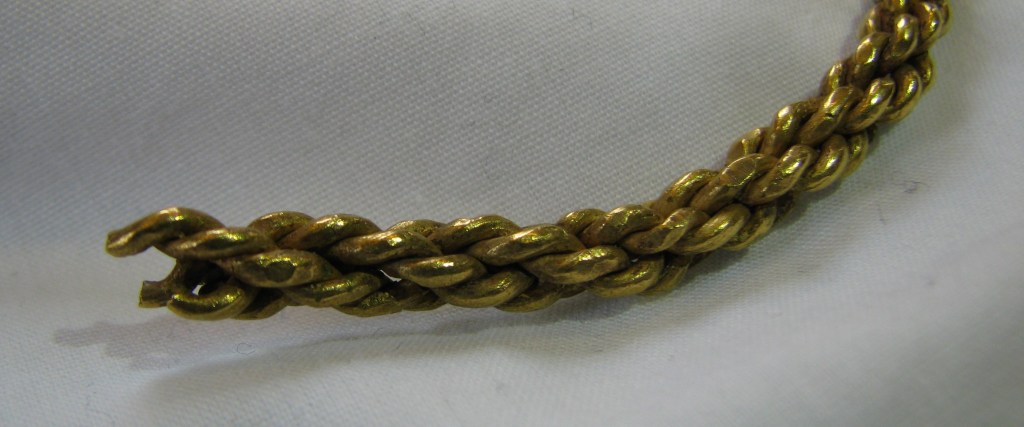
The Middleton Hall torc weights 87g. The internal diameter of the wire ring is c.180mm x c.160mm and so would work as a neck ring, rather than an arm ring or bracelet. It is without terminals (there is no evidence of previous attachment on the wires) and may originally have been part of a larger neck ring of multiple strands, which was broken up at some point is the past. Alternatively, if it was originally a torc like the Blair Drummond wire torc, which has a single braided strand and a not dissimilar neck ring width, the Middleton Hall torc may just be missing its terminals.
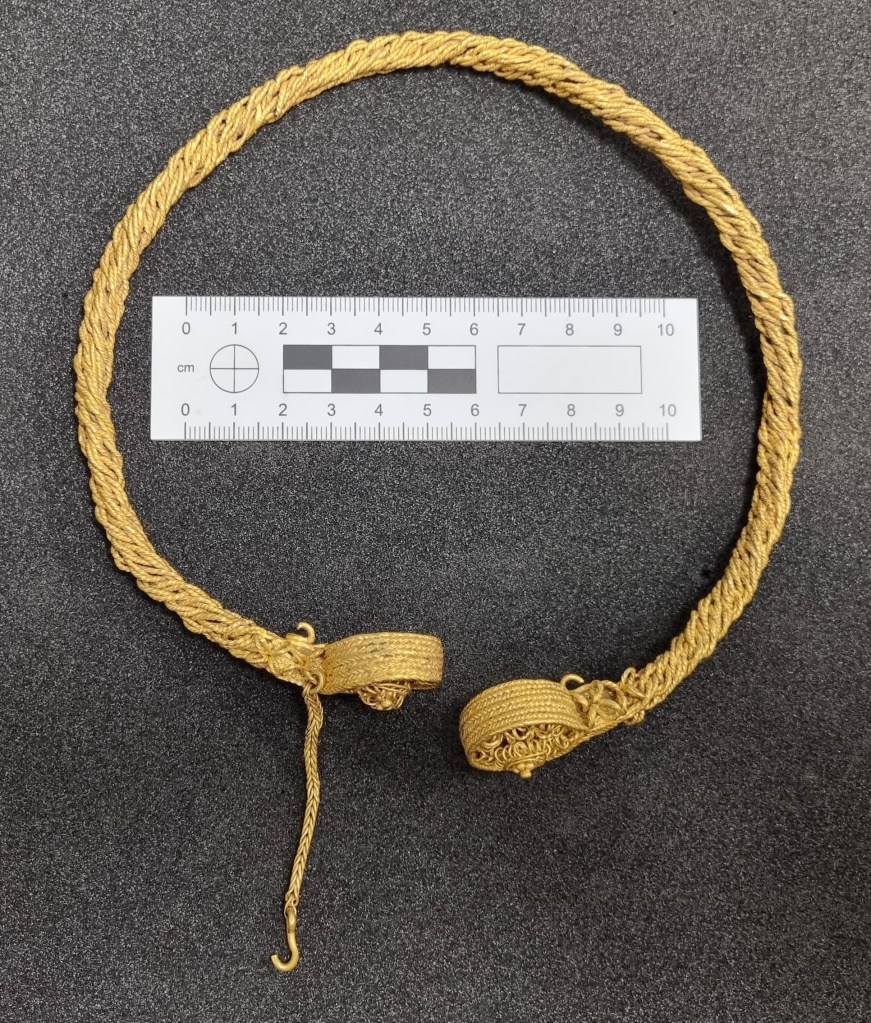
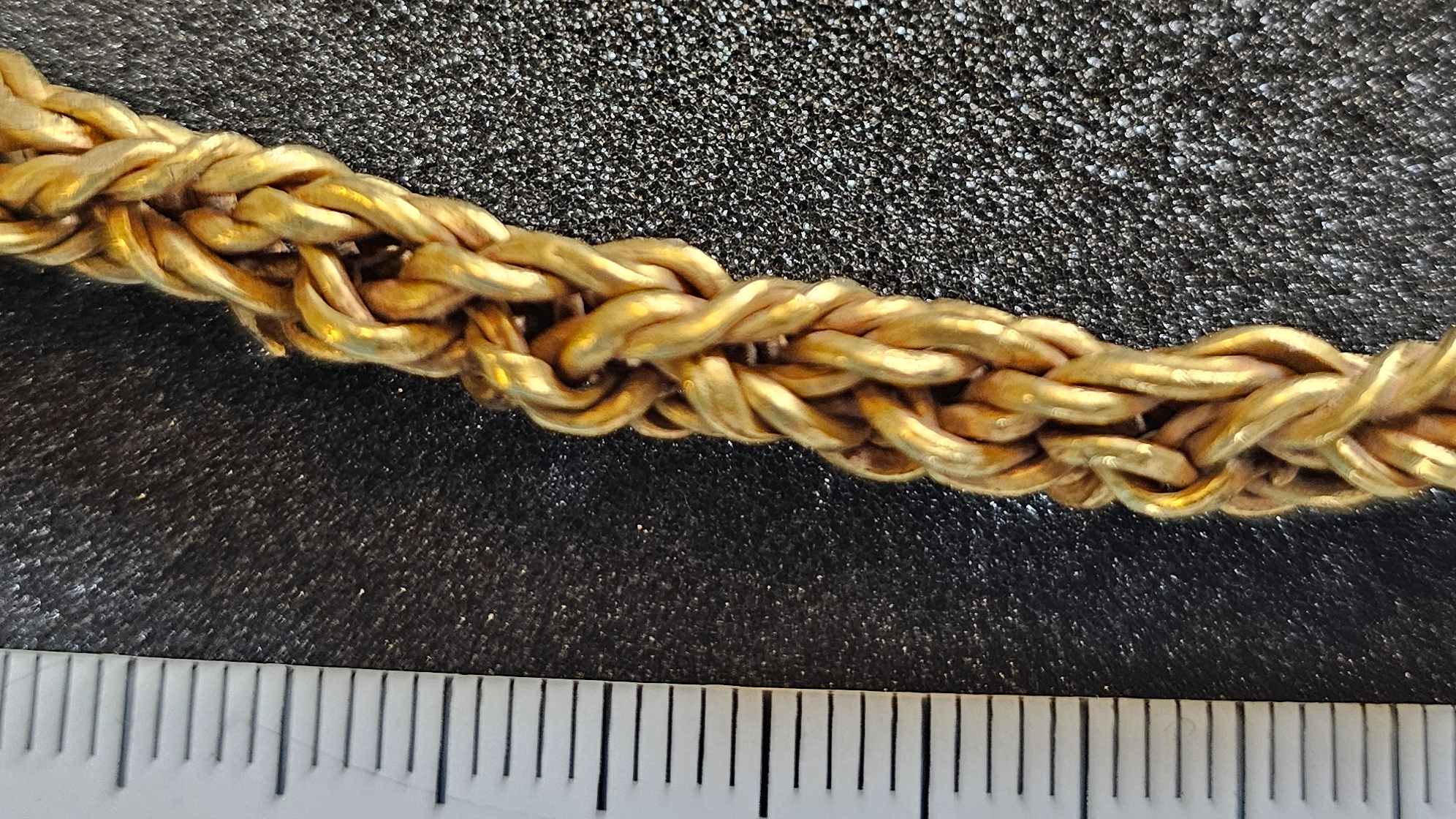
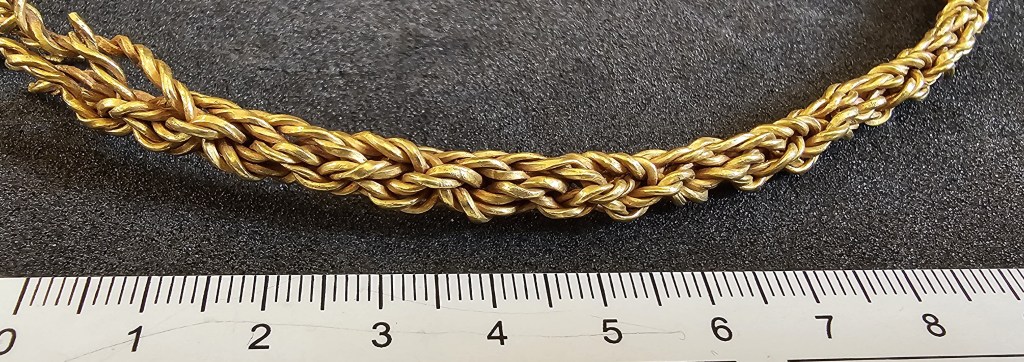
The torc is made from twelve strands of wire, twisted into six pairs. These pairs have then been braided to form the neck ring. Each wire measures c. 1.1mm in diameter and has been hammered, acquiring slightly faceted faces from this hammering. The pairs of twisted wires have a width of c. 1.9mm and the width of the braided neck ring is c. 5.5-5.6mm.
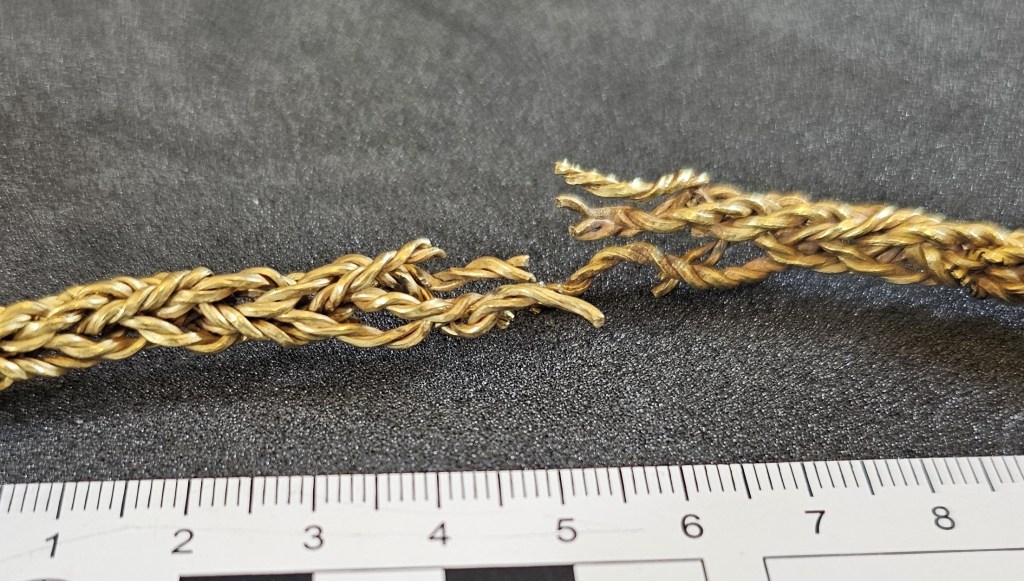
The wire ends are irregular and do not appear to have been cut with an implement, but instead perhaps snapped – although this is uncertain. The broken wires are uneven in length and this would suggest a haphazard breaking-up of the torc or, perhaps, that the uneven wires are evidence of an unfinished braided torc element, yet to be tidied before being made into a complete torc. There is no evidence of nicking, or any other damage or manipulation of the neck ring.
An unusual torc
At first glance, there’s not much more to say about this torc: it looks to be ‘just’ wire. However, despite its apparently ordinary appearance, this torc is actually a very interesting and unusual example. That interest lies in the way the wires have been braided to form the neck ring. As previously mentioned, there is another braided wire torc: the Blair Drummond example. But, although similar, that torc was made with only eight wires, and those are twisted, square cross-section wires, not hammer-faceted ones.
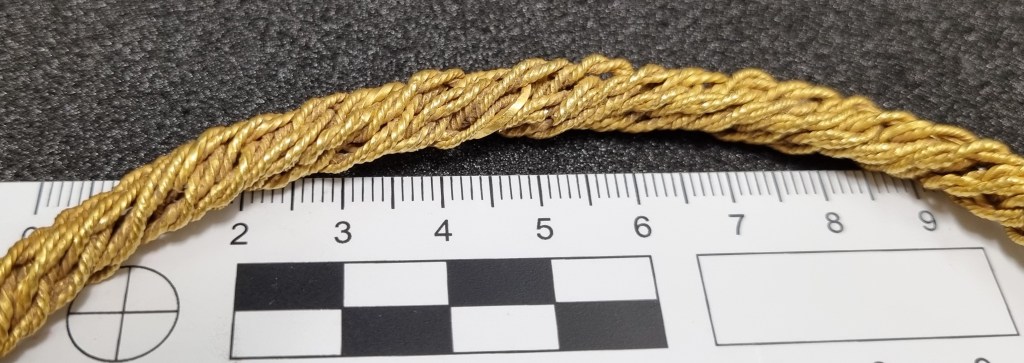
Another visually similar neck ring, and of comparable neck ring width (c.5.8mm), is that found with the Clevedon terminal. This wire neck ring, however, has only six wires, twisted into pairs, and the neck ring was formed by twisting – rather than braiding – the pairs together:
In comparison with other torcs, the braiding of the Middleton Hall torc marks it out as highly unusual. From the hoard site at Snettisham, despite there being around three hundred torc neck ring fragments, and sixty-three complete torcs, there is not one example of a braided neck ring. On that site, pairs of twisted wires, (either used singly or twisted or coiled with other pairs of wires to create a neck ring, as with Clevedon above) or coiled wires, further coiled in groups, are the norm.
Indeed, apart from the Blair Drummond wire torc, there is no other torc made from braided wire known from Britain or Ireland. I can also find no examples from Europe. As such the Middleton Hall torc, although at first glance a very simple example of wirework, is actually rather special: one of only two such types from these islands, and possibly even Europe.
The absence of this type of braiding within the large Snettisham assemblage is worthy of note: it could suggest that this braided type of neck ring may be a regional Western/Northern type, not found in East Anglia, or more widely in the South and East of Britain. Alternatively, it might also point to this type of torc being of a different period of manufacture to the torcs deposited at Snettisham. However, with Snettisham comprising torcs from a likely two to three hundred year period, this is perhaps a less secure explanation.
Currently, with only two examples. it is impossible to be certain, but I would lean towards the former, ‘regional variation’ theory, as the Blair Drummond torc assemblage, alongside the wire torc, includes earlier, lobed sheetwork and ribbon torcs, likely to be contemporary with some of those found at Snettisham. However, no matter what the explanation, what initially appeared to be just a plain wire neck ring, is actually of greater significance than it first seemed.
And on that note, I’ll leave you until next time. If you’d like to be kept up to date, please remember to ‘Subscribe’ below.
(P.S. Keep everything crossed that the Royal Collection Trust decide to allow me to reproduce the Needwood Forest torc photos, or the next blog will be a little short of images!)
 The Big Book of Torcs
One Reply to “”