
by Tess Machling
[A download/print PDF version can be found at the end of the paper]
Before I go any further, I want to state that the theft and destruction of heritage across the world is not uncommon and I fully acknowledge the horrific losses currently being experienced in places like Palestine and Sudan. This blog does not attempt to claim the losses in the UK are comparable: they aren’t. I write this as a gold researcher with a specific interest in the prehistoric gold artefacts from these islands, hence my focus on this material.
——————-
I’m writing this on a sunny Tuesday morning the day after it seems likely that a significant chunk of important Welsh – and UK – prehistoric gold history has been stolen from Amgueddfa Cymru’s (National Museum of Wales) site at St Fagans, Cardiff.
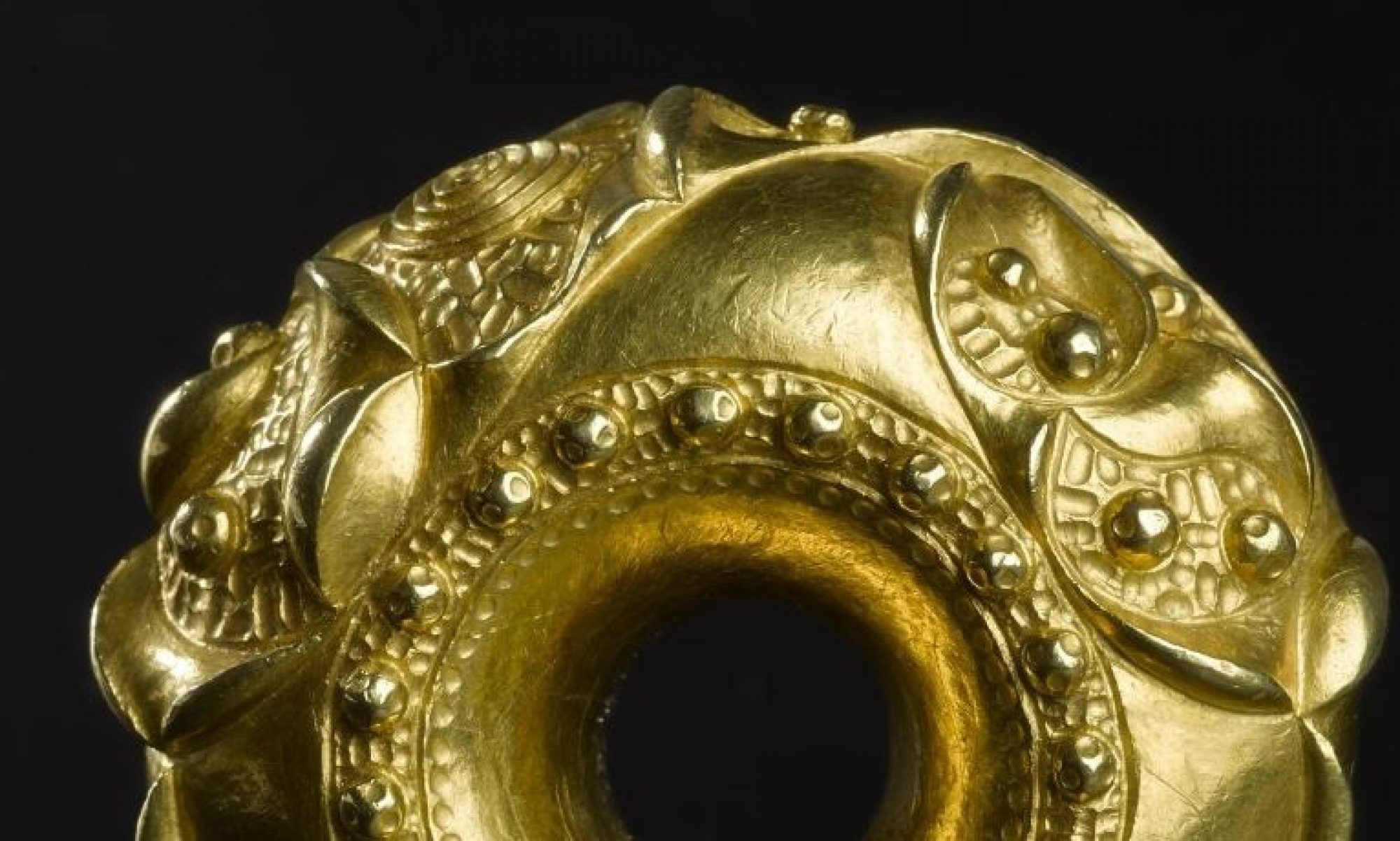
From what has been said in the media so far, it seems that ‘Bronze Age gold jewellery… on display in the Wales is gallery’ has been stolen and – if it’s as bad as I think it is – this will represent a large proportion of the Welsh prehistoric gold collection: items which we would describe as ‘the first’, ‘the only’, ‘the oldest’, ‘the most intriguing’ etc. To say that those of us who look at this stuff are gutted would be an understatement. The loss to researchers and the museum going public is huge, the loss to our history, immense. The only upside to this whole terrible episode is that staff working on the site appear not to have been hurt during the raid. That is a blessing.
Sadly, the St Fagans theft is not the only theft of prehistoric gold that has taken place recently.
Ely and Coggalbeg.
On May 7th 2024, in the early hours of the morning, two thieves forced their way into Ely Museum in Cambridgeshire and stole the Ely Bronze Age torc and a Bronze Age bracelet. Both items were solid gold. To date, neither have been recovered.


Although several such torcs are known, the Ely torc was one of the largest in Europe at 126cm in length. It also weighed a staggering 730g. Both bracelet and torc had been found by detectorists, the bracelet in 2011 and the torc in 2015. Under Treasure Act 1996 rules, both had been acquired by Ely Museum, the bracelet was valued at £20,000 and bought from the finder and landowner with the torc valued at £220,000, and the finder and landowner paid this from funds raised from public donations and grants. So their loss, to the museum and local and national communities was huge: they were literally owned by us.
Another theft of Bronze Age gold, but which turned out for the better, was the Coggalbeg hoard from Ireland which had been found during turf cutting in 1947, but was unknown until 2009, when the pharmacist where the gold was stored was robbed and the safe stolen. In this case, the robbers apparently had not recognised, or been interested, in the gold lunula and discs hidden between papers in the safe and had dumped the lot in a skip, where it was later found.
St Fagans.
Although the precise details of what has been stolen from St Fagans have yet to be confirmed, from the latest information given this morning, the raid appears well planned and targeted. The BBC have reported that the raid took just four minutes, with the thieves knowing ‘exactly where they were going’ and ‘that they had come for specific items’. As such it would appear that the thieves had the gold Bronze Age artefacts very much in their sights.
The ownership of ‘treasure’.
As any of you who have read my blogs before will know, I have a major issue with finds being held in private ownership, or with finds being bought by the public from private individuals. I also despair the ongoing loss of contextual information from many detected finds. All of the above end up costing the British public in money and knowledge. They lead to historically valuable artefacts being less easily studied and understood and/or less accessible to the public. As such, our shared national heritage suffers.
Although, the thefts of such items above cannot be related to their provenance, the costs and staff time incurred by buying detected finds are a huge burden on already struggling museums. It should also be noted that the amounts recommended by the Treasure Valuation Committee are for the object itself: they do not factor in ongoing conservation and, more importantly, insurance and security costs. These are born by the museum.
But these artefacts are essential to the ongoing popularity of museums, with other detected and gold finds, for example, the Iron Age Leekfrith hoard from Staffordshire, pulling in 20,000 visitors in its first month on display at The Potteries Museum and Art Gallery in Stoke.
Bling draws a crowd, but the current lack of resources and funding being experienced by UK museums is only being exacerbated by the need to buy and look after ‘treasure’ finds. Is it any wonder things keep getting stolen when we spend our limited resources paying huge amounts of money to lucky individuals who find this stuff as their hobby, whilst not investing hardly anything on the museums and staff who preserve and protect these artefacts, in perpetuity, for all of us?
Reframing the discussion.
With gold finds clearly being of huge interest to the museum-going British public we need to think about the messages we are sending about precious metals. After all those messages go also to those who would wish to steal.
Sadly, all too often, even in archaeological reports, and more generally in media reporting, artefacts made of precious metals are referred to as ‘treasure’ or as being somehow special: a quick Google search today of the word ‘treasure’ under the ‘News’ tab brings back Norfolk Bronze Age rings, silver coins from a Florida shipwreck and a Luxembourg Roman gold hoard. The fixation on artefacts and their worth, that tends to come from the reporting of the latest Treasure Act find makes for easy clickbait news headlines.
But what rarely gets talked about, sadly even in archaeological circles, is what this bling can tell us: how these artefacts were made, and by whom. What story can this item impart? By playing into the media need to sell copy, we become part of the system that makes objects like those from Ely, St Fagans etc a target: just immediate cash value rather than items of irreplaceable historic value. No wonder they get nicked.
In the case of the St Fagans goldwork, if it has been stolen to order for a collector, then it might at least be preserved, but if -as is likely – it has been stolen for the gold it contains, the bullion value at today’s boom price of £85 per gram (another factor in recent thefts) would still only make the items likely stolen worth around £50,000… and that’s a ‘legitimate’ price: as un-hallmarked bullion, with no provenance, a much reduced figure on the Black Market is likely.
This in itself makes me wonder if the thieves really understood how little gold goes into such goldwork: the skill of the goldsmith in creating more bang for your buck, can make these things look far more weighty than they actually are.
But whatever, I do hope whoever took the St Fagans’ gold gets caught, and will feel any prison sentence was worth it for the £20-30k they are likely to make. As it currently stands, a significant assemblage of goldwork from prehistoric Wales has been taken and, should it not be recovered, there is now a gaping hole where Welsh history, and indeed the history of these islands, used to be.
I don’t know how whoever took it can live with that.
EDIT:
4.45pm, 7/10/25 Two men have been arrested, but the gold has yet to be found.
11.14am, 8/10/25 Two men have been charged. The whereabouts of the gold remains unknown.
Keep everything crossed, folks! 🤞🙏
 The Big Book of Torcs
2 Replies to “Solid-gold rant incoming…”