By Tess Machling
[A download/print PDF version can be found at the end of the paper]
Hello again folks. Hope you all had a nice break? A few things have happened since the last blog, so I thought I’d write a quick update.
If this is the first you’ve seen of all this, then do catch up HERE: I started writing about how detected and non-context finds affected my torc research, that turned into a deeper dive into private finds, image rights and then to crunching the data behind the hobby of metal detecting. So do go have a read if you’re interested. It’s very much a work in progress, but I feel it’s important to document everything as I go.
Anyway, back to now, and before I get into the main APPAG info, I wanted to share something new I’ve spotted in the figures. I’ve previously shared this on social media, but by writing about it here, it will be ‘on record’ and can be referred back to, or shared, more easily.
Donated finds.
In each annual ‘Reported Treasure Finds Statistical Release‘ the number of Treasure finds donated to museums are recorded. Each report also records the ‘method of recovery’ for each case: so whether the find was a detected find, chance find, mudlarking find… or an ‘archaeological find’. ‘Archaeological finds’ should be those found on archaeological sites, so those commercial or research excavations, where ‘Treasure’ has been recovered during the course of archaeological work.
Each commercial archaeological unit/university research dig (and archaeologist working for them) waives their right to Treasure finds and/or 1996 Treasure Act ‘rewards’. Therefore, the ‘archaeological finds’ should be the Treasure cases where title to a museum has been written into the archaeological brief and donation will be automatic. As such, the number of archaeological Treasure cases should be able to be immediately deducted from the number of Treasure cases given to museums, to leave the number of cases that were donated by everybody else (detectorists, chance finders and mudlarks). Except there is a problem…
If you compare the number of Treasure finds donated to museums, with the number of excavated finds, a rather alarming picture appears:

As can be seen, the number of Treasure finds donated by detectorists, chance finders and mudlarks has crashed since the time of Covid. For 2023, not a single find appears to have been donated by anyone apart from archaeologists.
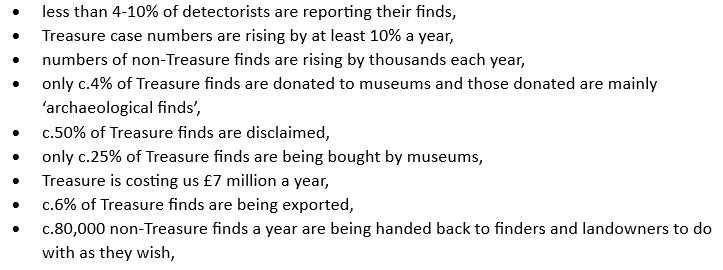
This mirrors the massive increase in finders, and – albeit anecdotal – apparently increasing interest within the detecting community in cash, rather than historical, value. It must also be remembered that this donation total is currently less than 4% of the total number of Treasure finds being recorded each year: the rest, over 96% of finds, are being kept by the finder and/or landowner, or sold on the open market/exported to satisfy the 50/50 split between finder and landowner.
The latest, 2023, figures are of concern, as they would appear to show that three Treasure finds, apparently archaeological finds, were not donated to a museum. Could this be due to a lag in time between finding, researching and being given to a museum? This would suggest that the 2023 data is not catching finds which will still be donated in coming years. I truly hope this is the case.
But there is another thought that crossed my mind, and something which I wrote about previously. Are these Treasure finds that have been excavated on private archaeological digs (perhaps like the Norton Disney History and Archaeology Group excavation, where the Norton Disney dodecahedron was found) where title to a museum has not been agreed and so the finds, including Treasure finds, rest with the excavator/landowner, rather than a museum?
Currently, there is no way to tell, but I will be keeping a close eye on these figures in future report releases. But whatever the case, the data above clearly shows that beyond organised and regulated digs, Treasure finds are increasingly rarely – if at all – being donated or offered at a reduced cost, to museums,
The APPAG enquiry.
On the 23rd December 2025, the All Party Parliamentary Group for Archaeology (APPAG) reported on their year long inquiry on Archaeology and Metal Detecting. Gleaning evidence from various interested parties, and including oral submissions, the questions asked and videos of the oral evidence can be found here.
Having watched the oral evidence – from the Portable Antiquities Scheme (PAS), museums, archaeological contractors, detecting organisations, funding bodies etc – I have to say that I didn’t feel that the scale of the crisis we are currently facing was adequately covered, with little of the data I’ve been mining apparently having been similarly mined by the APPAG committee. The overall picture – apart from several notable pieces of evidence from the likes of Gail Boyle (representing the Treasure Valuation Committee (TVC) and museums), Nancy Saul (Art Fund) and Vanessa Wells (National Lottery Heritage Fund) – was one of ‘Yes, all is well, we’re a bit busy, and could do with some extra funding, but generally OK’. I have to say this really surprised me, especially in the case of the evidence given by the PAS.
I was also somewhat surprised to see that of the 148 written responses, only 31 were from archaeologists, and that there were a further 95 from the National Council of Metal Detectorists (NCMD), who had set up an online survey for their members. As such, the archaeological community did not do much to represent its thoughts…
The report.
The report is only 14 pages long and much is taken up with introductions, the questions asked and lists of those consulted. At the end are conclusions and recommendations. But it is light on detail and data… and, most significantly, funding. Without extra cash these ideas will be non-starters.
I also hoped to see more of an analysis of the acceptability of detecting: with the bedrock of archaeological science being preservation in situ and a growing concern about the number of archaeological finds that have yet to be researched or published, and which need to be stored, the underlying acceptance that metal detecting will just carry on without limitation was unwelcome to me. Just because people want to, doesn’t mean they should.
Several sections really jumped out at me as being utterly contradicted by the data I have been looking at, so I will just briefly comment on these:
‘Increasing numbers of detectorists are adopting a more archaeological approach to searching and recording, are working closely with the PAS and other archaeological bodies’ (page 3)
I fundamentally disagree with this statement, as does the data: less than 4% of detectorists are recording, and none are donating their finds. The majority of Treasure finds are still excavated with no archaeological input, and over one third are being exported overseas. As such, this statement can’t be supported.
In the section on Recording Archaeological Finds it is stated that ‘relationships between FLOs and their local detecting communities remain positive’ with no recognition given that only 4% of detectorists are recording and that many FLOs receive abuse during the course of their work.
There are parts which I found really helpful: the issue of detectorists working long distances from their local territories, thus damaging local relationships and finds distributions, is noted. The recognition of work by organisations, such as Historic England, in combating heritage crime is also welcome. The understanding that rallies, and removal of material from context, are problematic is also to be cheered! Also raised was the hugely underestimated problem of the afterlife of detected private collections.
As mentioned, the number of responses from the detecting community was high and echoed many of the tropes seen in detecting groups: ‘bemoaned the lack of recognition of their contribution’, ‘find processing slow’, ‘finds not put on display’, ‘access to finds restricted’ etc. The lack of understanding of the working of museums (that money is tight, that the majority of museum collections aren’t ever on display, that if we listed every person involved in an artefact’s finding, excavation, preservation, research etc, we’d have museum labels the size of A3 posters…) is also very obvious.
It was also said that ‘detectorists experienced bigotry, disrespect and prejudice with archaeologists looking down on them and their activities’…
This really raised my eyebrow: any archaeologist, especially a female one, spending any time in online detecting groups, often with many tens of thousands of members, will know that the ‘disrespect, prejudice and bigotry’ is certainly not directed at detectorists but is instead aimed at archaeologists, FLOs and the TVC, often with libellous opinions not being moderated by group owners.
Conclusions and recommendations
The report makes 11 recommendations which can be read HERE. I will take them one by one.
- The development of an electronic finds’ submission tool: this worries me. Archaeologists and FLOs are trained and should be adequately resourced and paid. Will this just end up being another means to cut costs, and overload PAS with yet more information that needs to be checked and validated? Who is going to fund it? As to crowd funding: nope, we, the British public, are already paying at least £10 million per year on detecting. It’s time for a financial contribution from the detecting community. Perhaps from the £600,000 fund held by the NCMD??
- Detectorists should be given more opportunity to work collaboratively with archaeologists on archaeological sites: great in theory, but what about the practice, and who pays for this? Detectorists will need to effectively become archaeological employees… and if they do, why not other archaeological volunteers? This strikes me as yet another time volunteers will be used for what should be a professionally qualified, and paid for, role.
- That detecting organisations should align behind a single code of conduct: yup, like this one. A really detailed code of conduct (I assume this also means not just ‘conduct’ but ‘code of practice’?), with – hopefully – the legal obligations and practice laid out clearly and promoted by all detecting groups. Except… the NCMD and AMDS (Association for Metal Detecting Sport) barely communicate, let alone work together, and there are also numerous other People’s Fronts of Detecting. So yes, great plan, but let’s see, eh?
- The new Code of Conduct to be included with all metal detector sales: again a really good idea, but see 3.
- All new detectorists should be trained: Again brilliant, let’s do it. To be provided by SMA (Society of Museum Archaeologists) and PAS: Yup, great idea: now who’s going to fund the trainers???
- Detecting rallies scoping exercise: Again, really good news, but who’s going to fund this?
- Museums must have resources to acquire: wooo hooo! Yes, but again who pays? I would have also like to have seen acknowledgement of the current parlous state of play, where less than 25% of Treasure finds are acquired by museums and less than 4% are donated. There is also no acknowledgement that tens of thousands of non-treasure finds are handed back to finders/landowners each year, many of which should be in museums. A recommendation to encourage donation of *any* detected find would have been good.
- Review of rewards: definitely needed. Nobody deserves £4.3 million for shovelling coins into a washing-up bowl…
- Museums fostering links with detectorists: Yes, great, but this isn’t all a one way street and detectorists need to engage with museums too…and again, who funds this when many museums are facing huge resource and staff cuts?
- Greater consideration for the afterlife of collections: Again, yes, something that urgently needs attention. Furthermore, like museums, I do think formal access to private finds needs pressing: it shouldn’t be that researchers are completely at the whim of landowners/finders to study what is, after all, our shared national heritage. I think we also need a better way of these finds being catalogued… after all, 96% of finds aren’t even being recorded. This to me seems the biggest issue. There needs to be a law/recommendation that all detected finds are recorded…but of course that would currently be impossible because… yes, you guessed it… funding!
- Ongoing police training and support: yup, clearly needed.
What I would have liked to have seen.
For me, the minimum we need right now is licensing: most responsible detectorists do not have a problem with this. The amount paid could also contribute to the cost of administrating detected finds.
If the license was tied to an online test – which examined the understanding of the law and the new detecting code of practice – and that passing the test was a requirement of receiving a license, then that would at least draw a line between illegal and legal detecting. And before anyone comes at me with ‘but it will drive it underground’: in the current situation of the statistics below, can it really get any worse?
For ten years I’ve offered the results of all my research for free and open access. I’m an independent researcher and have no funding, so all museum trips, research visits, writing up, conferences etc are funded by my scraping together savings and lecture fees etc.
Thanks to a few recent changes in circumstance, this is getting more and more difficult for me to fully support and, even though I’ll still be doing everything open access and always will, if you do have a bit of spare cash (…and really only if!!) buying me the occasional ‘coffee’ to support my gold research would be really fabulous. You can buy me a ‘coffee’ here!
 The Big Book of Torcs