by Tess Machling
[A download/print PDF version can be found at the end of the paper]
Having previously written about the H7 torc from Snettisham a few years ago, I recently had the chance to see it up close at Norwich Castle Museum. This blog details the torc and once again, shows the value of examining a torc in detail: there is always extra information that can be gleaned.
Introduction
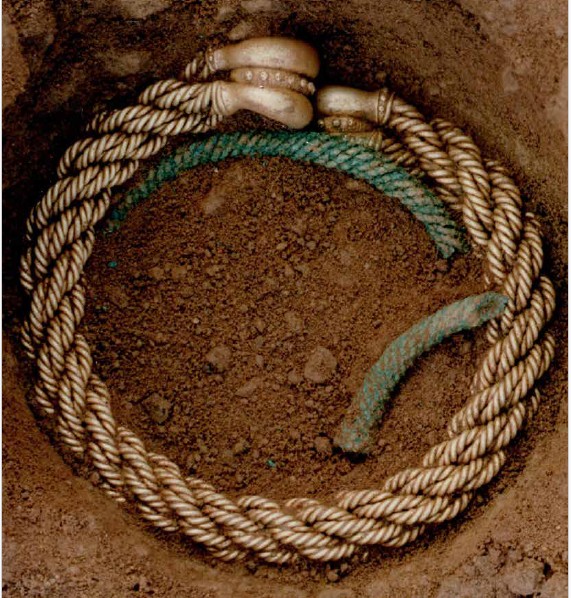
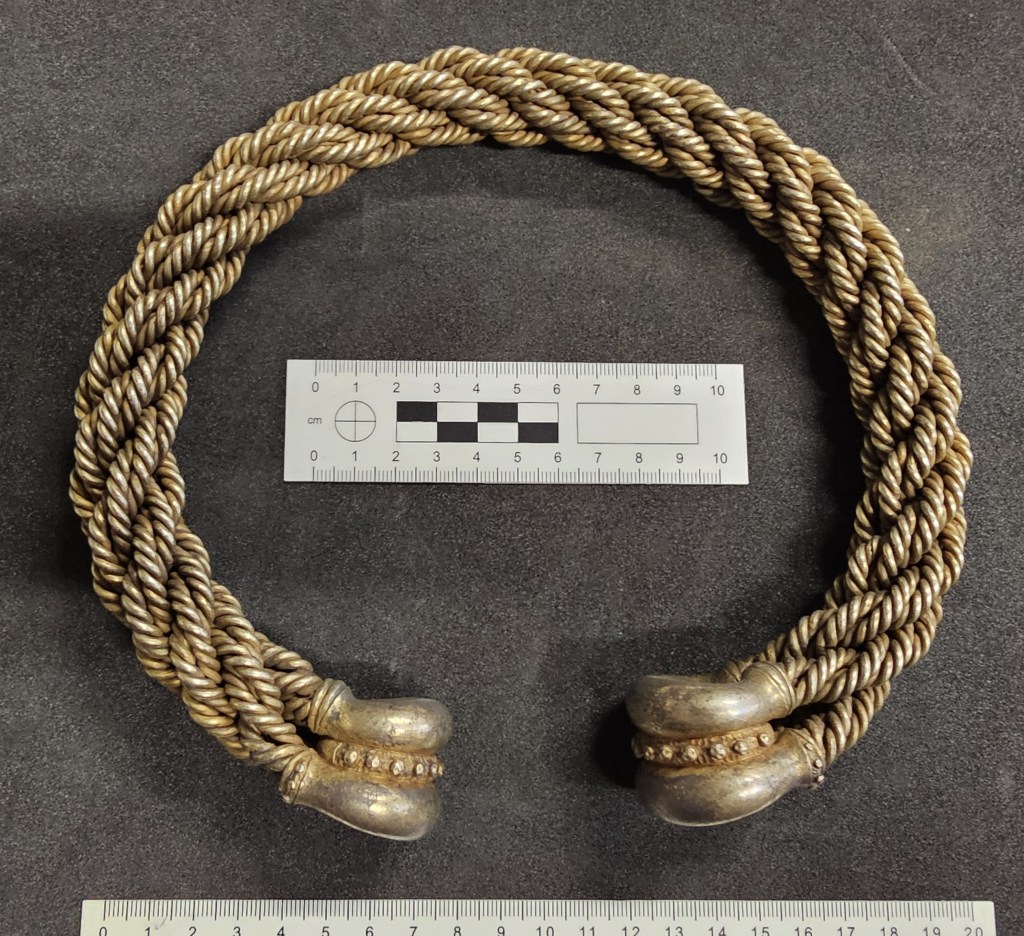
Snettisham torc H7 (British Museum accession number 1991,0407.15 ) was found in 1990, during the British Museum excavations at Snettisham, Norfolk. The torc was located in Hoard H, one of the fourteen hoards located on the site. Full details can be found in the Snettisham hoards publication, Volume 1, page 132. This hoard comprised eleven torcs placed one on top of each other, but apparently in two separate deposits: six torcs in the upper deposit and five in the lower. The pit they were buried in was about 22cm wide, by 16cm deep. Torc H7 was the uppermost torc in the lower deposit of this hoard, and had been compressed to fit the hole, with the torc springing back into shape after removal (Fig. 1).
Torc description
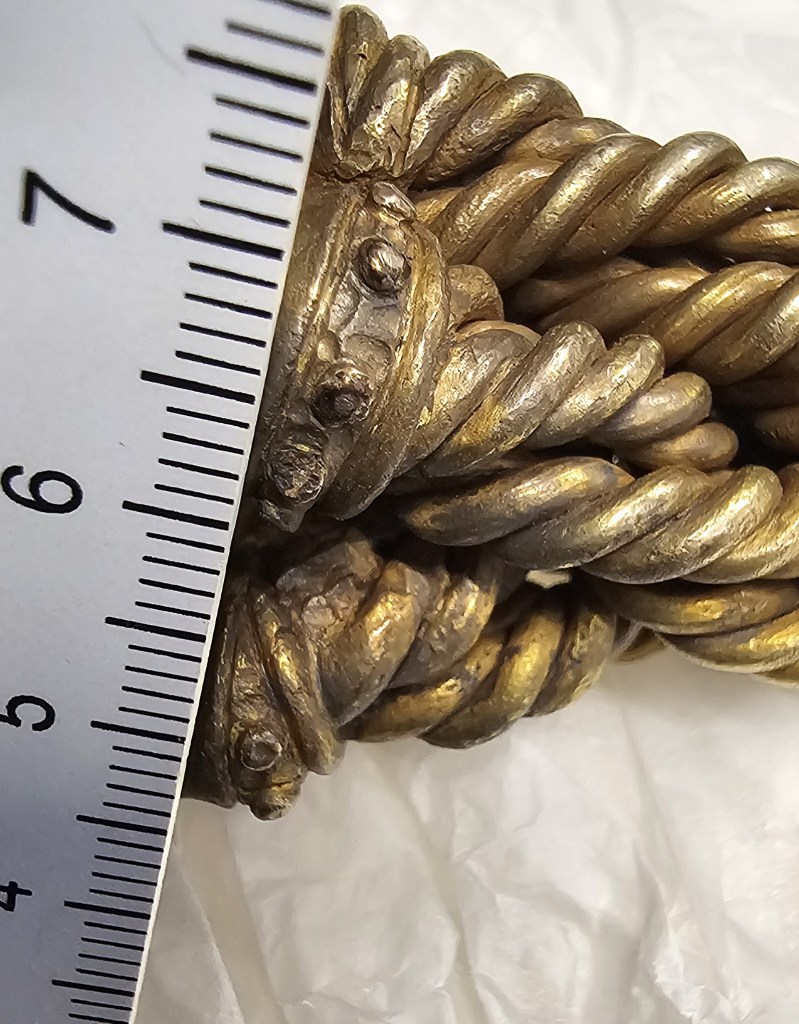
The torc has an external diameter of 205mm x 183mm and an internal diameter of 160mm x 135mm. The width of the neck ring is c.22-25mm. The torc weighs 1208g. There are two terminals, one (Terminal 1) measures c.35mm x 28mm and the other (Terminal 2) measures c.35mm x 30mm. Terminal 2 is visibly larger than Terminal 1.
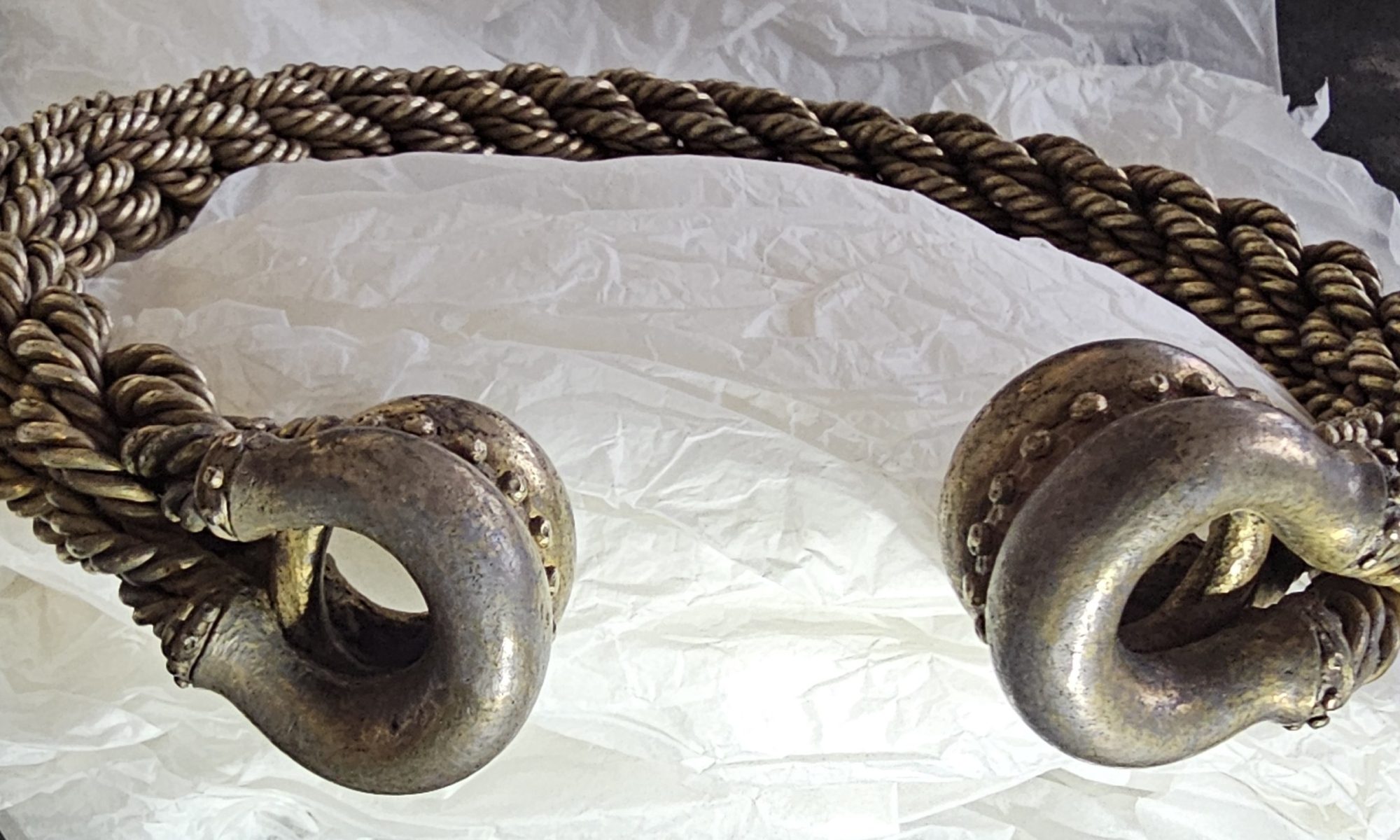
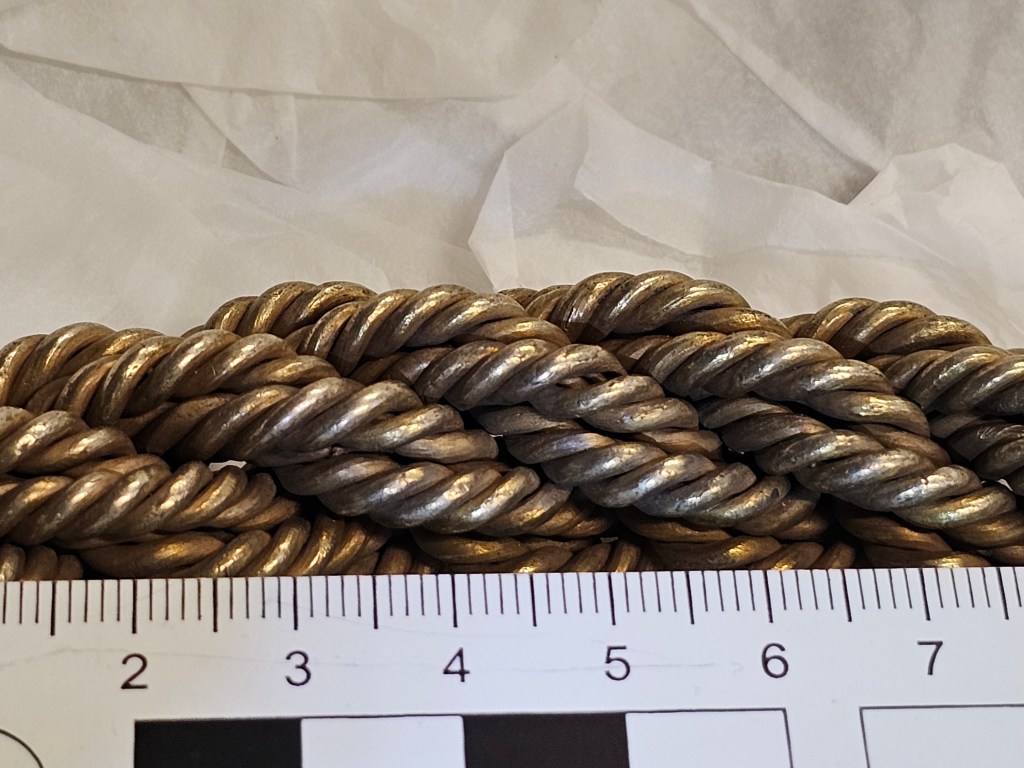
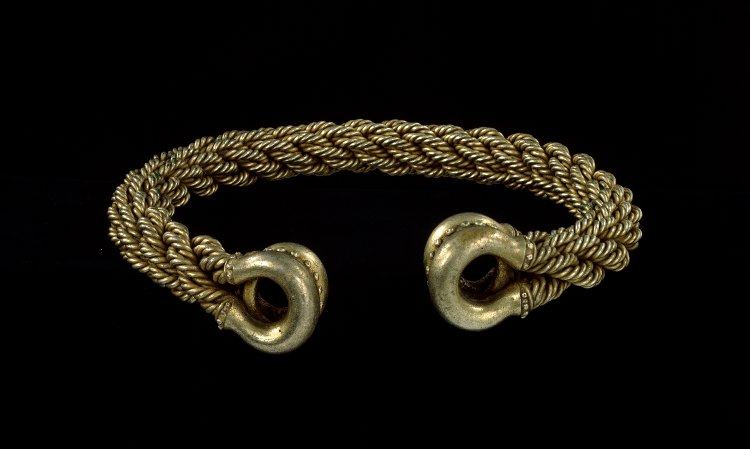
The torc is a multistrand torc and the wires of the torc are each between 1.9mm-2.2mm in diameter (Note: the British Museum suggest that each wire is 1.2mm in diameter. This is incorrect) and there are three wires in each twisted strand, and three strands in each rope (Fig. 2). There are four ropes, one secured to each attachment point on each terminal. In total there are thirty-six wires.
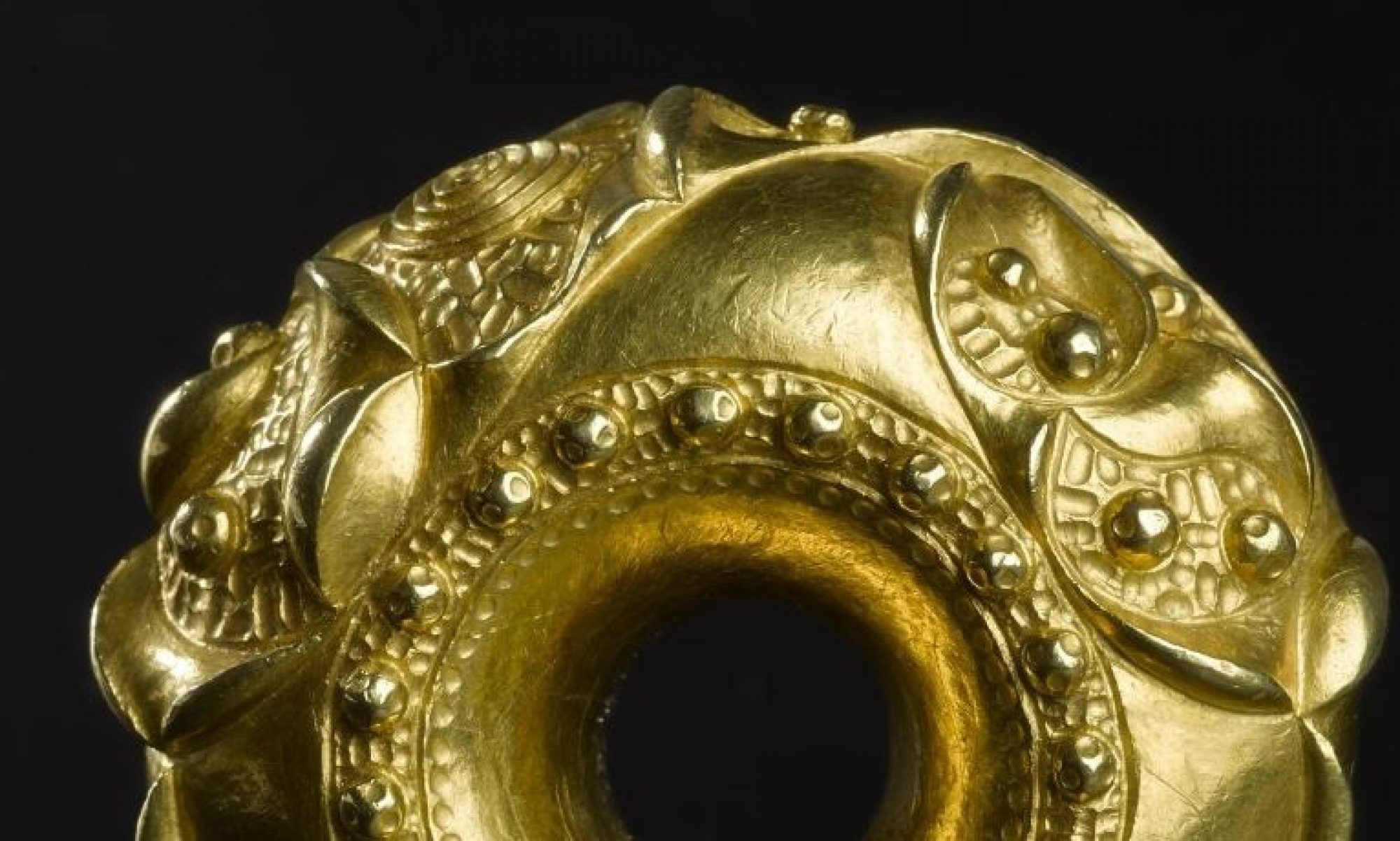
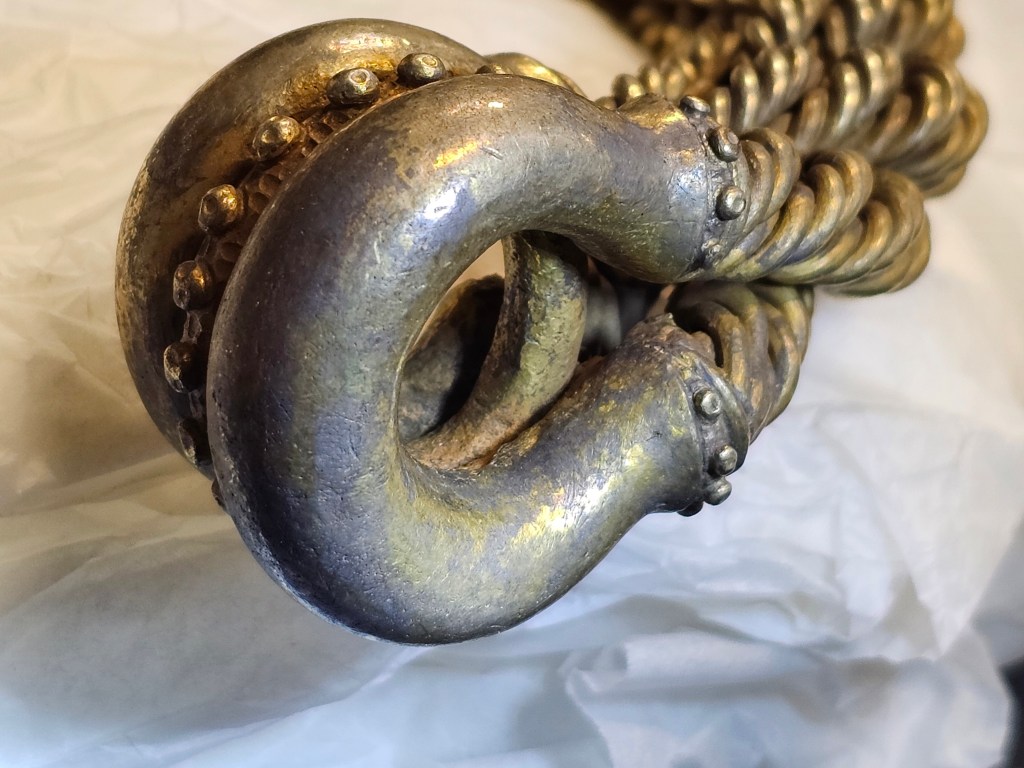
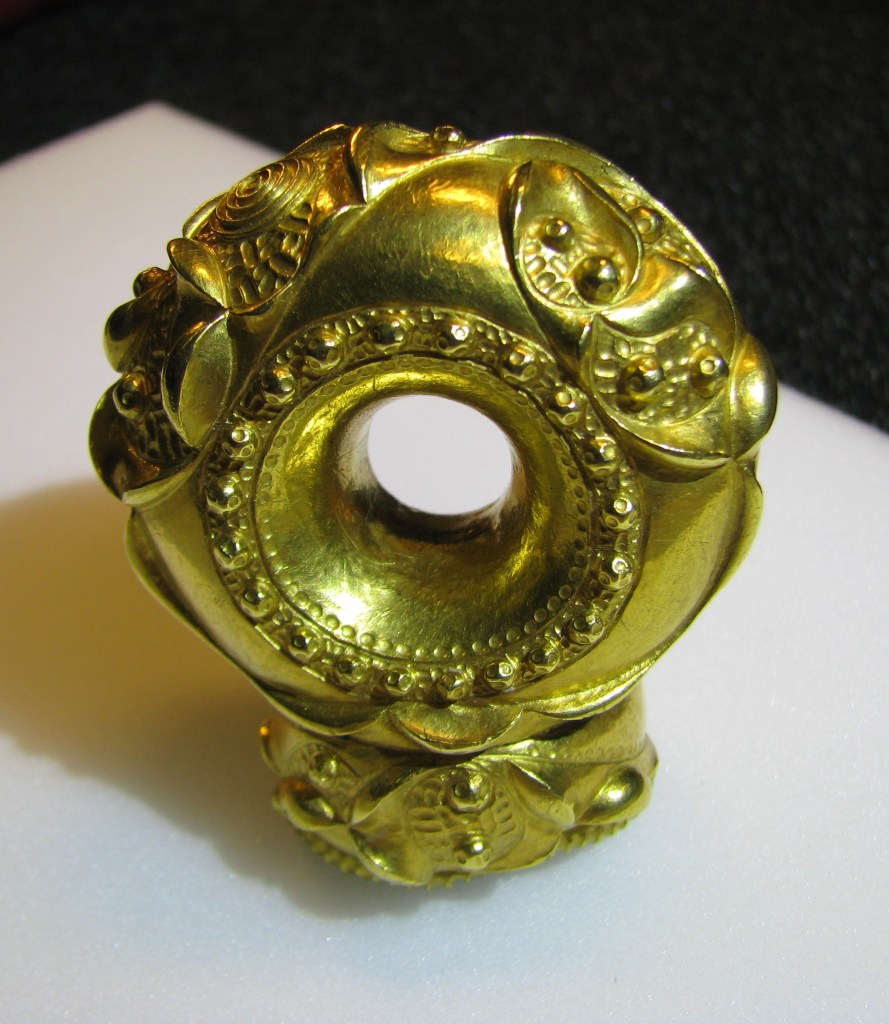
The terminals are composite ‘cushion’ types, with two bulbous terminals joined together by the insertion of a thick ring soldered in between the two terminals (Fig. 3).
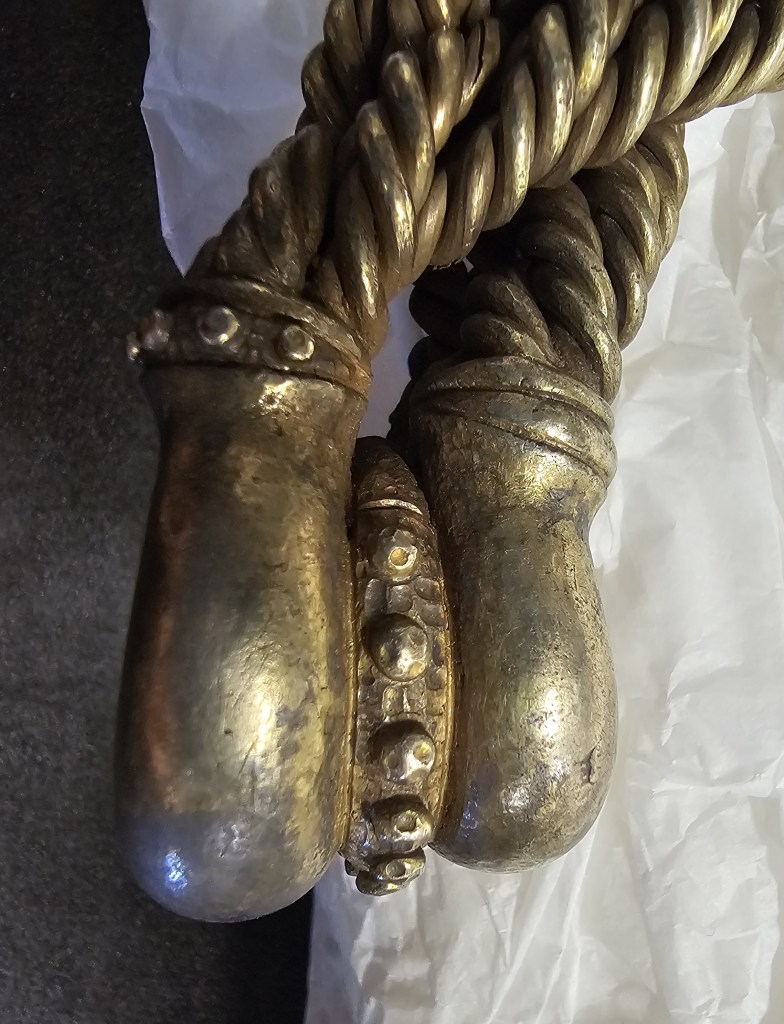
Examination of the interior of the terminals would suggest that the terminals were not created from the wires of the neck ring (as perhaps seen in torcs like Needwood Forest), but were instead made separately, before being attached to the wire neck ring. It is uncertain if the terminals are solid or hollow, although the edge of an apparently hollow area seen in one of the terminals (Fig. 4) might suggest either a failed hollow casting or a hammered edge that was not turned in correctly.
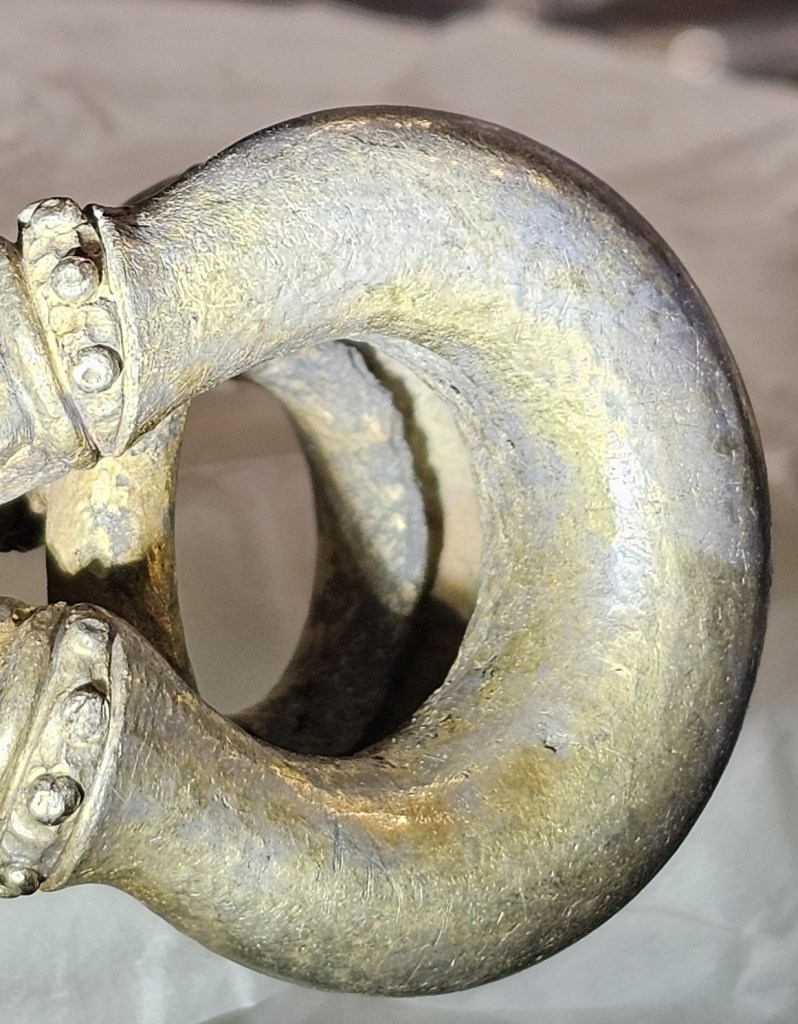
Decoration
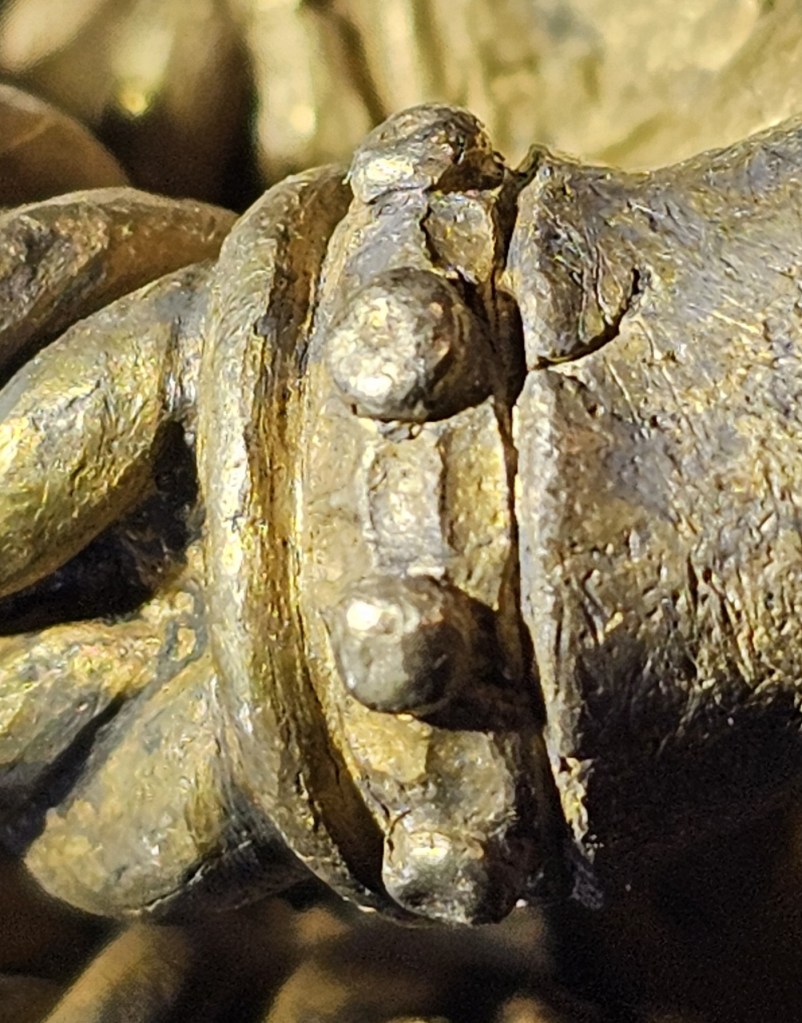
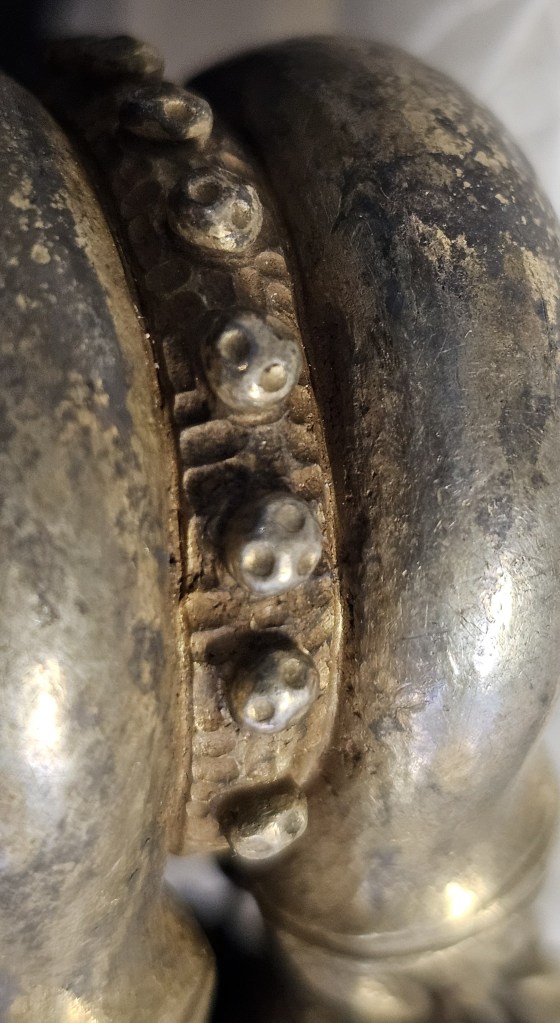
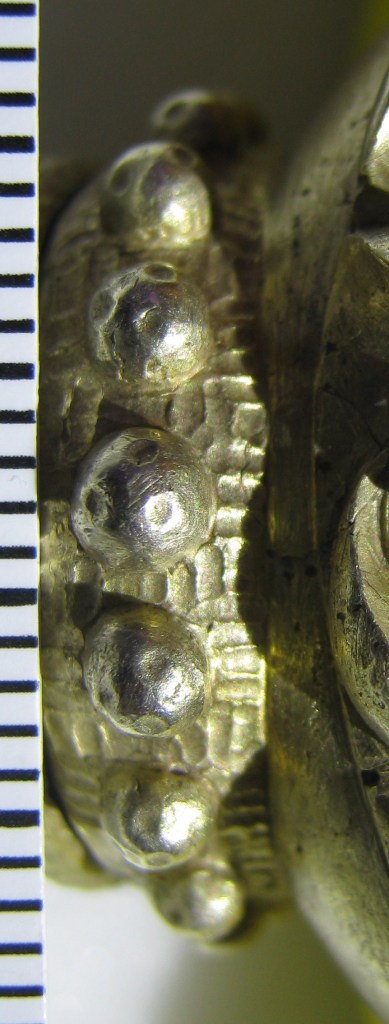
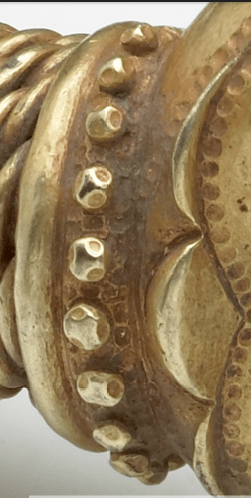
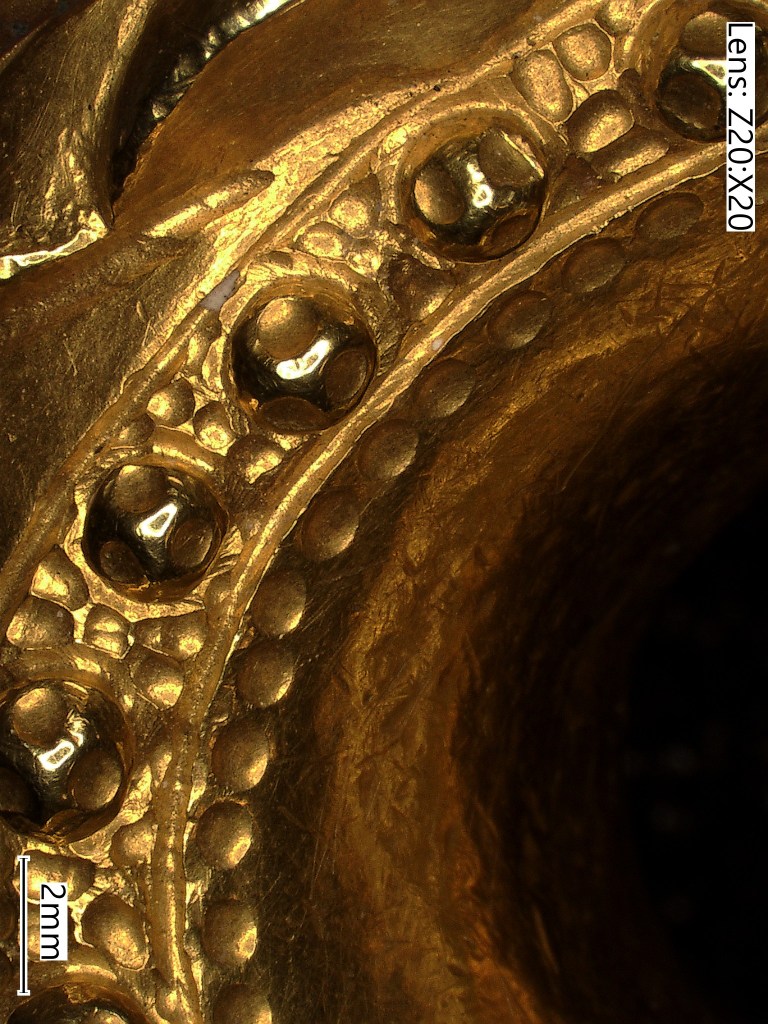
Each terminal of the torc is decorated with dummy rivets and punched lines. Dummy rivets occur both on the added ‘cushion’ and on the outward face of each collar on the terminals. The dummy rivets appear to have been cast with the other elements, although they have been finished with punched dots (three on each of the dummy rivets on the cushion ring, and one on each dummy rivet on the collar). The rivets have been waisted using a punch, to make them stand more proud of the terminal body.
Interestingly, the number of dummy rivets is not equal on each terminal, with Terminal 1 having twelve dummy rivets on the cushion, five on one collar and four on the other. Terminal 2, however, has thirteen dummy rivets on the collar and five on each collar. There is no apparent reason for this difference, with the same amount of decorative space on each torc. Such differences have been seen on other torcs: Needwood Forest has nine dummy rivets on one terminal and thirteen on the other.
With many other torcs, such as Newark and Sedgeford, the decoration is identical on each terminal. But with torc H7 (as with the Snettisham Great torc and Needwood Forest) the difference between terminals may be yet more evidence that detached terminals were being re-used and remade into new torcs at a later date or may be indicative of an individual maker, or a maker’s mark of some kind. It is also possible that these differences are evidence of different makers working simultaneously on one torc. If taken in conjunction with the different style of punching seen on each of H7’s terminals, this idea perhaps becomes more likely.
Punched decoration
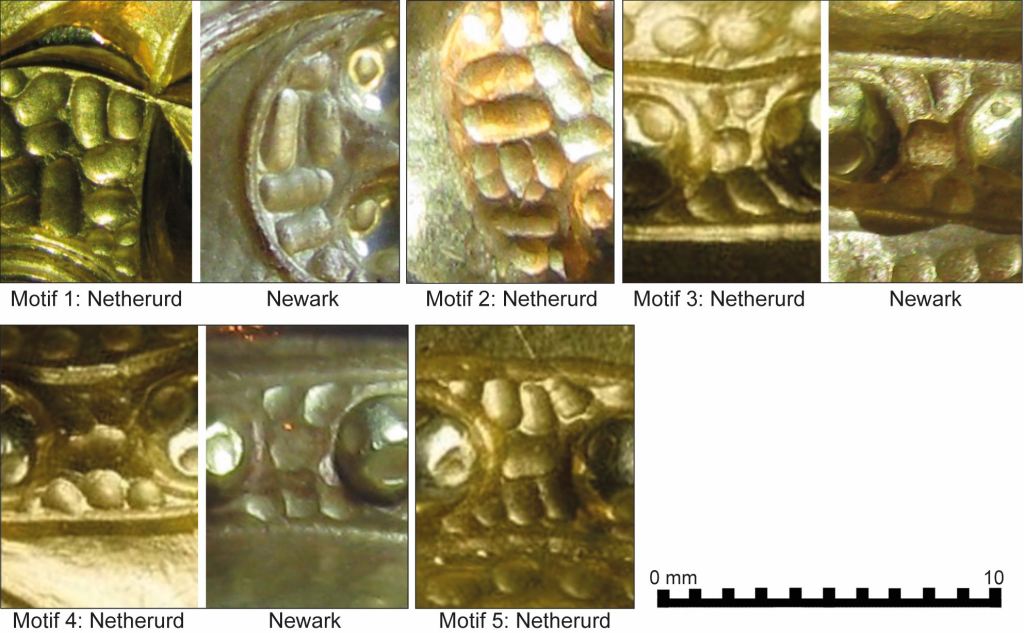
The inserted ‘cushion’ and collars of the terminals are covered in punched lines, which fill the area surrounding the dummy rivets. These punched lines are well known in Iron Age artefacts and occur on a multitude of torcs. The different punched motifs used on torcs were the subject of my first paper, which found a similarity of motifs on both Newark and Netherurd and suggested that both these torcs were made or finished by the same hand. My reason for wanting to see Snettisham torc H7 grew from this research, with motifs on this torc apparently resembling those from Newark and Netherurd.
The collars
The punching on each collar is indistinct. However it is clear, that where the punching is defined, that this punching has not been achieved in an organised or regular pattern. It should be noted that the space available is minimal and, with a c.0.7mm punch, punching appears to have been added ‘where it fits’ rather than in any particular pattern (Fig. 5) and so this may not be indicative of choice, but rather necessity.
The cushions
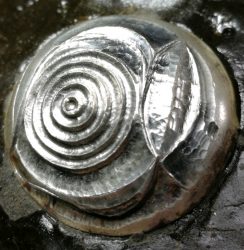
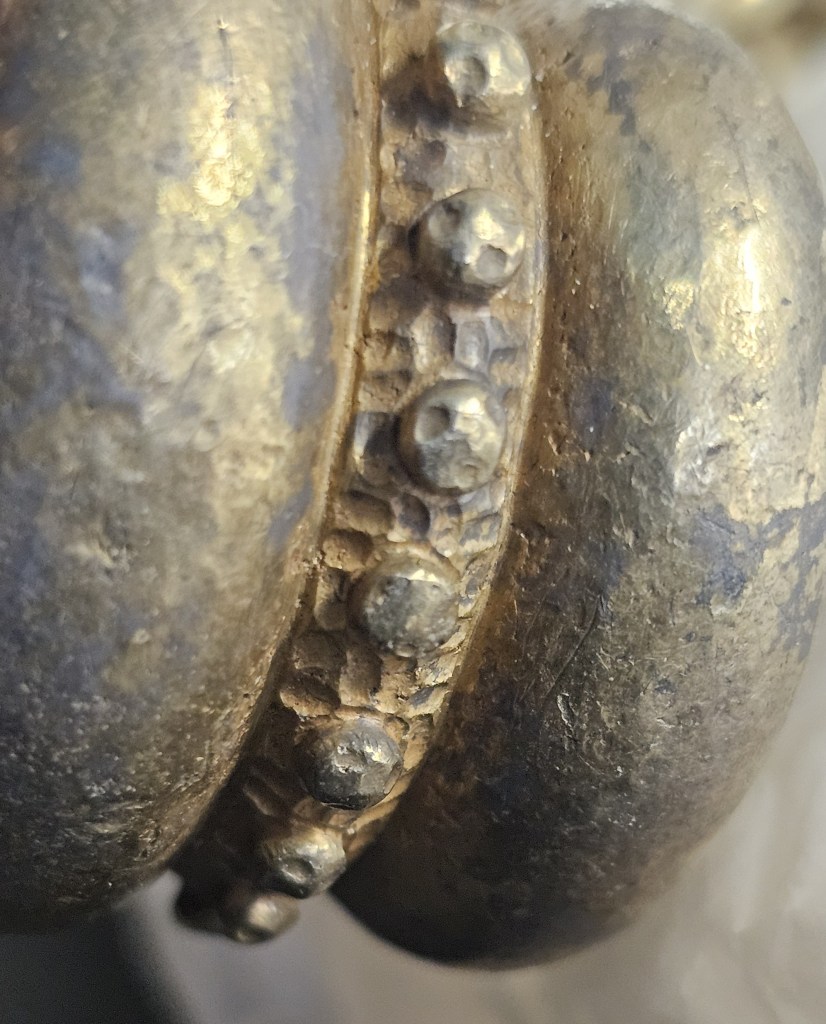
On the added ‘cushions’ the punching is far more obvious and easier to document (Fig. 6). Interestingly, the punching on Terminal 2 is more regular than Terminal 1, which shows a more freeform pattern.
As suspected, the punching on Terminal 1, and to an extent Terminal 2, matches both motifs 4 and 5 seen in the Newark torc and Netherurd terminal (Fig. 7).
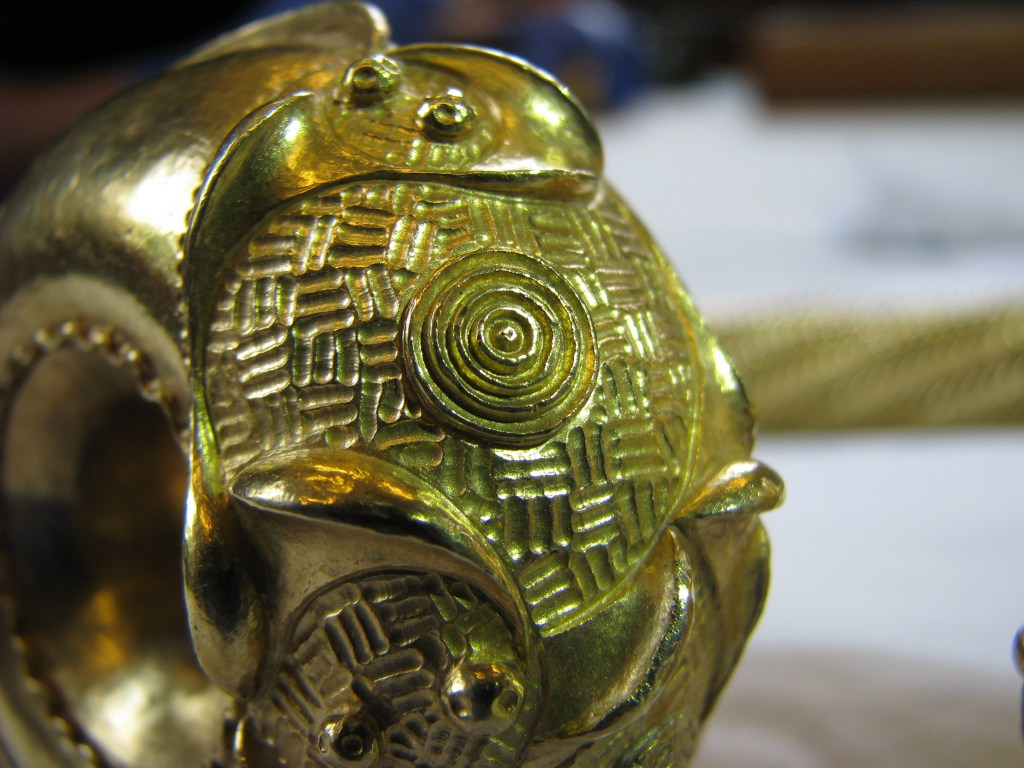
As previously mentioned, these motifs differ greatly from other torcs such as the Sedgeford and Snettisham Great torc (Fig. 8).

However, it should be noted that the H7 Terminal 2 does show regular punching which might compare more favourably with the Snettisham Great torc, or the Sedgeford torc. Could we perhaps be seeing the work of two makers in Snettisham torc H7, either working together to make the torc or perhaps, as has been previously suggested for the Snettisham Great torc, is H7 a torc that has been created using an older torc terminal, which has been reused, with a new terminal and neck ring added? It is difficult to be sure and either theory would be supported by the different sized terminals, unequal numbers of dummy rivets and the differing style of punching.
The dummy rivets
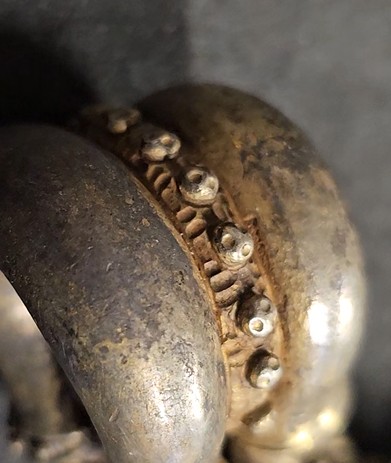
Although the dummy rivets look similar to those on other torcs, there is something about the H7 dummy rivets that speak of Netherurd and Newark and not Sedgeford, the Snettisham Great torc, or other torcs. Unlike the dummy rivets on the Sedgeford torc, the H7 dummy rivets are smaller, less globular, and with deeper punching (Fig. 9), and match those from both Newark and Netherurd more closely.
The terminal surfaces
Although in many photographs, torc H7 looks to be of one, gold, colour, when examined up close it is very obvious that the torc, especially on the terminals, has a very patchy colour with areas of greyish silver and yellow gold apparent (Fig. 10). This is visible under natural light, but especially obvious under artificial lighting.
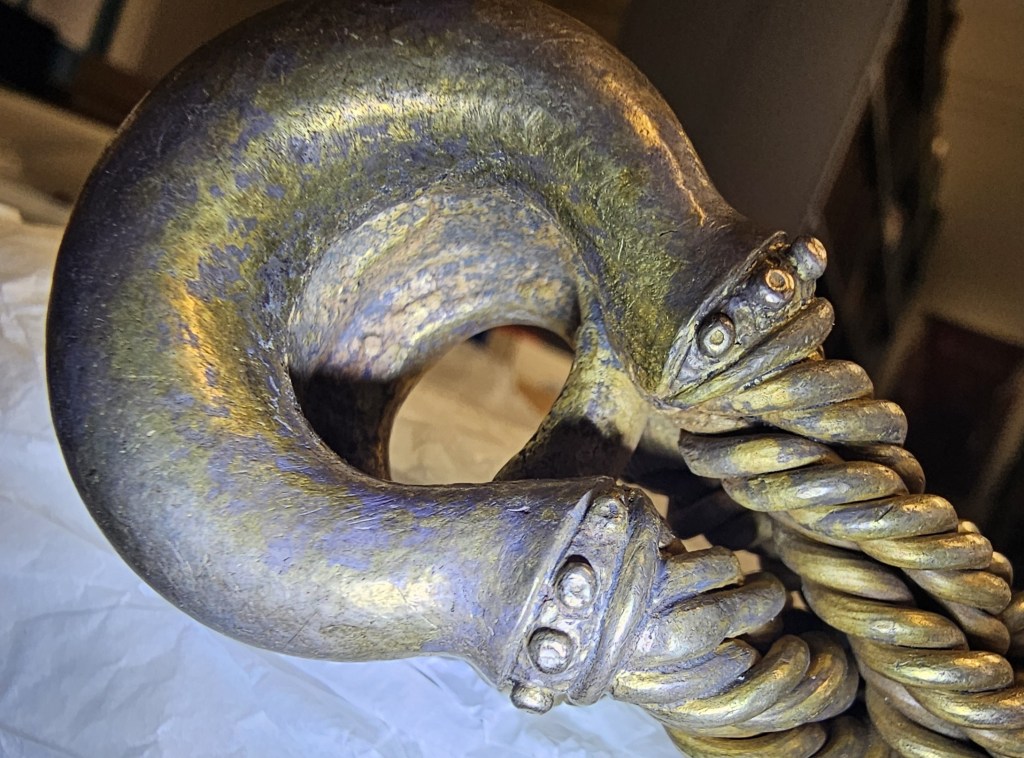
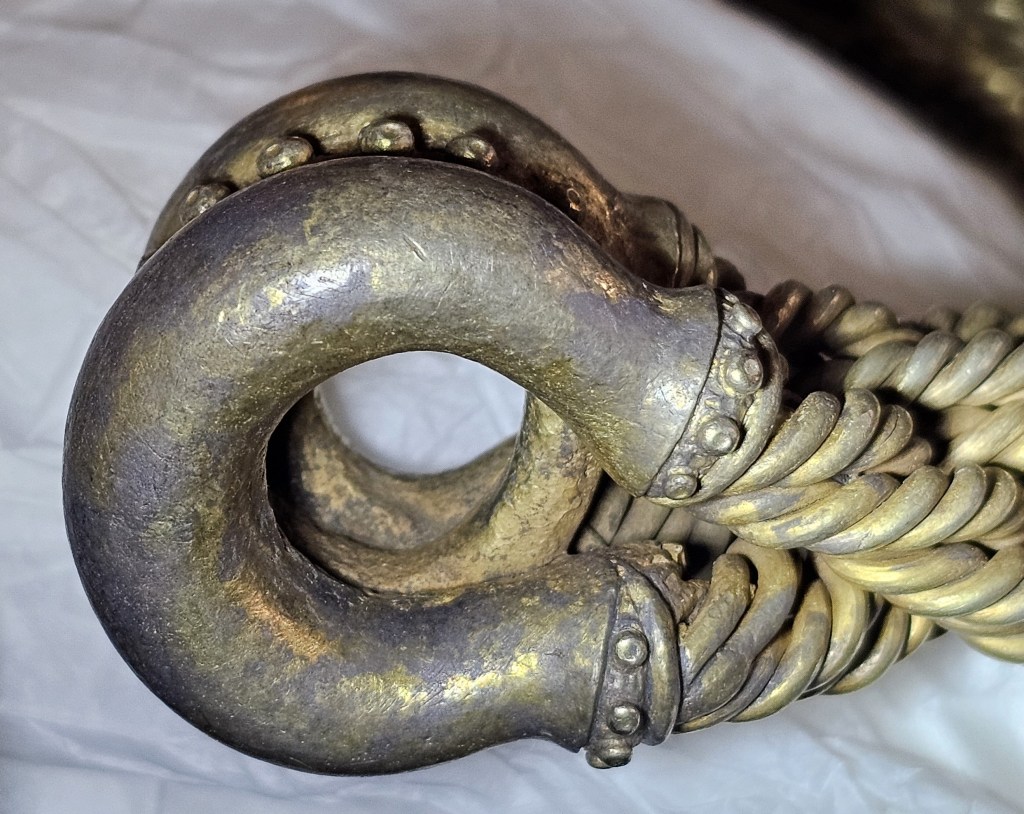
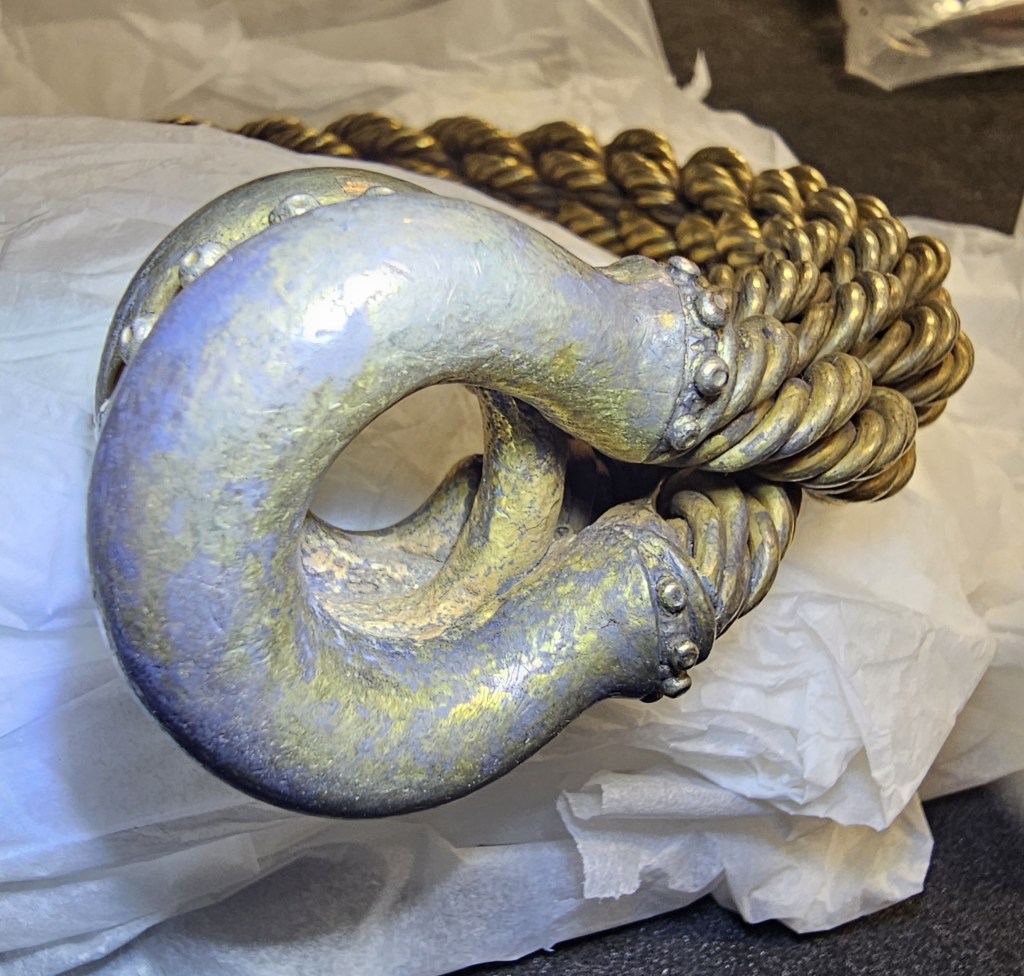
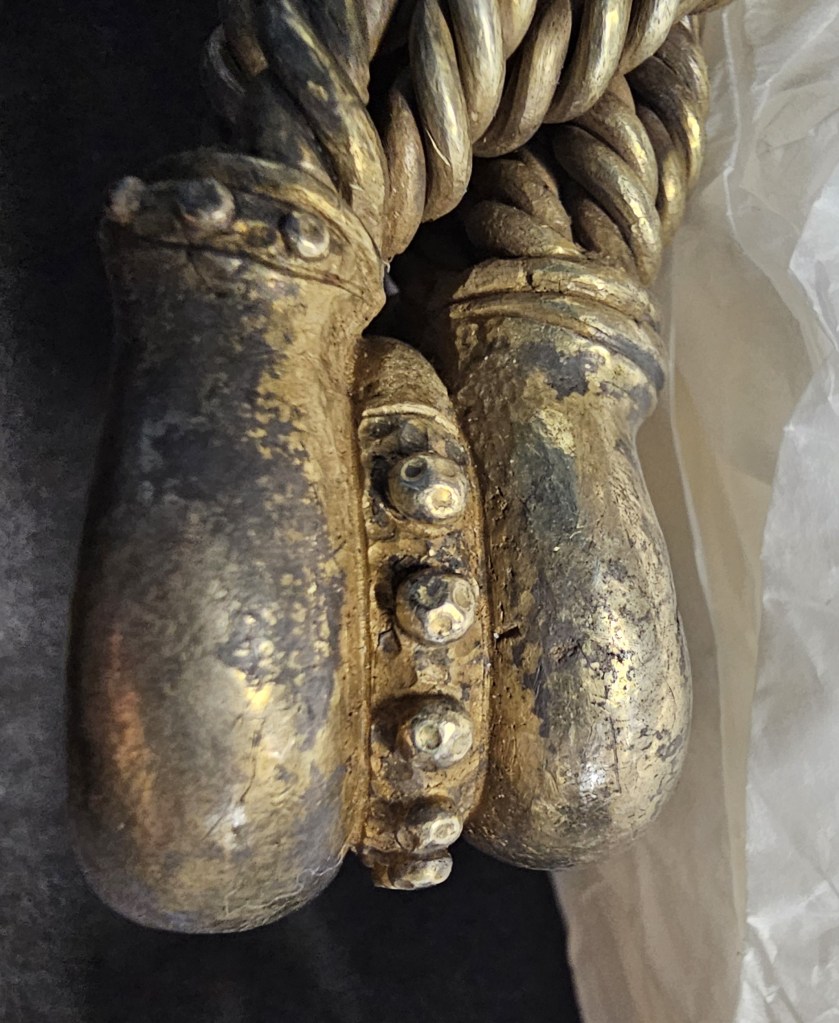
Although this difference was not picked up by the British Museum in their Snettisham volumes, the surface of this torc stands out as being very different to any other torc I have ever seen (…and I have seen a lot!!!). The fact that the gold colour occurs most often in protected ‘valleys’ on the exterior of the terminals, or on the interior, makes me think that the greyish (presumably silver rich?) colouration lies beneath the gold colour, and that the gold has either rubbed off during use or has been removed by some kind of depositional process.
My first thought is that this torc, in the terminals at least, has been mercury gilded and that the gilding has either come off, or never adhered well, in certain areas. The gilding technique is well documented at Snettisham in other torcs from both Hoard H and other hoards.
It is also possible that the different colours represent some kind of surface enrichment process, which created a purer gold layer on the surface of this mainly silver-rich gold alloy, but which has been lost over time. Again, this process of surface enrichment is well documented from Snettisham and elsewhere.
Further scientific examination would be necessary to explore this idea, however, such techniques are beyond the scope of my research. It is just a shame that this was not spotted by the British Museum who have the facilities to explore this further.
Conclusions
Snettisham torc H7 is yet another wonderfully intriguing torc that, under close examination has revealed some, but not all, of its secrets. Initially thought to be by the same maker/finisher as both Newark and Netherurd, I am satisfied that the punch marks, dummy rivets and the level of skill in making suggest this is highly likely. It has that chunky confidence that I’ve seen before in Netherurd and Newark and enough absolute comparable elements to confirm this feeling.
The gilding/surface treatment is however an oddity and that will take some pondering: if it is of a lesser quality silver rich gold alloy, or indeed is gilded, taken in conjunction with it apparently being made by the same Netherurd and Newark maker/finisher, it would suggest that the quality of gold alloy available to the maker varied from torc to torc. This matches with the high quality sheet gold used to make the Netherurd terminal and the hybrid casting/hammering method seen on the lower quality gold Newark torc. Is torc H7 yet more evidence that makers were skilled in a number of different techniques and that, rather than colour selection – as has often been assumed by others – the availability of alloys may have been more significant in deciding the final design and method?
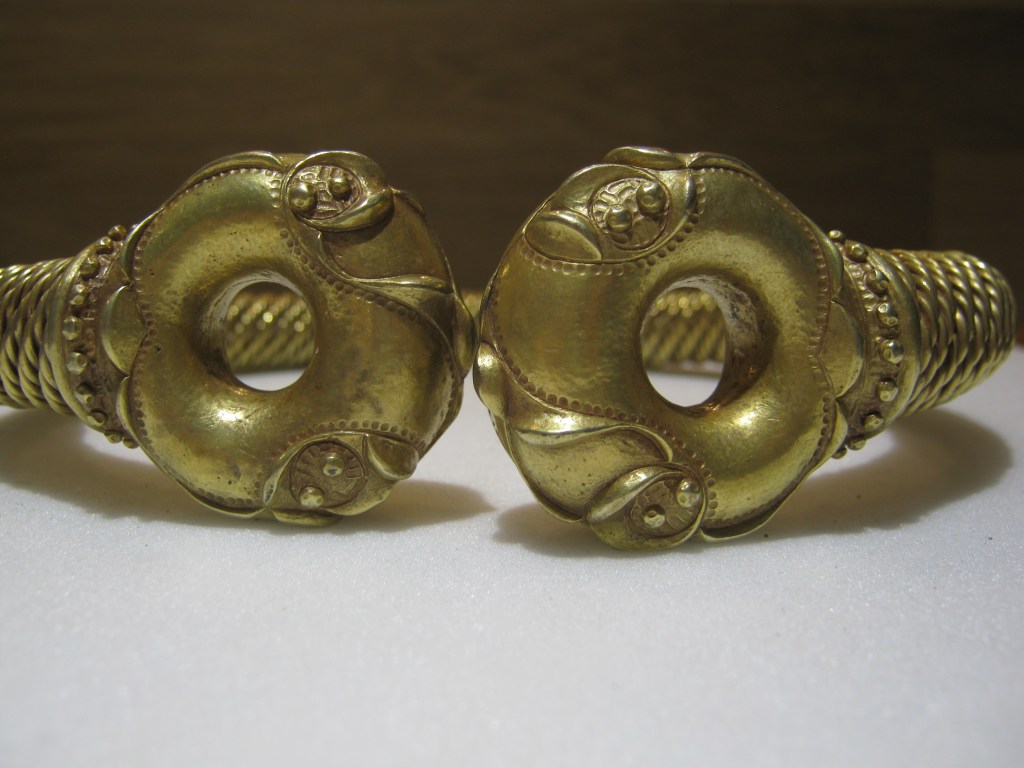
I think the differences between the Newark, Netherurd and Snettisham torc H7, and yet the consistently advanced level of skill seen in their design and manufacturing techniques could indeed suggest so. What superbly clever folks they were!
I will be writing more soon about how these torc H7 insights can help us understand more about Hoard H and the other Snettisham hoards, but in the meantime, thank you for reading and as always: it’s good to torc!
For ten years I’ve offered the results of all my research for free and open access. I’m an independent researcher and have no funding, so all museum trips, research visits, writing up, conferences etc are funded by my scraping together savings and lecture fees etc.
Thanks to a few recent changes in circumstance, this is getting more and more difficult for me to fully support and, even though I’ll still be doing everything open access and always will, if you do have a bit of spare cash (…and really only if!!) buying me the occasional ‘coffee’ to support my gold research would be really fabulous. You can buy me a ‘coffee’ here!
 The Big Book of Torcs
Hi Tess How timely is this! Me and John are going to Norwich for a few days
LikeLike
Oh great! Yes, do go have a look!!
LikeLike