Last week, I was lucky enough to be able to go and see the Alrewas torc bundle up close. Before we go any further, I want to say a huge thank you to curator Joe Perry and the Potteries Museum and Art Gallery in Stoke-On-Trent. I highly recommend a visit to this wonderful museum: not only do they have the Alrewas torcs on display, but also the utterly gorgeous Iron Age Leekfrith torcs – and if your gold bent leans towards the more ‘modern’ (snigger!) then they also have the magnificent early medieval Staffordshire hoard, and replica helmet.
But back to the Alrewas torcs…and what an eye opener it was: I’d like to say the visit gave me answers, but if I’m honest, it mainly gave me more questions. But this is no bad thing: it’s always good to have more research to do, and questions to answer!
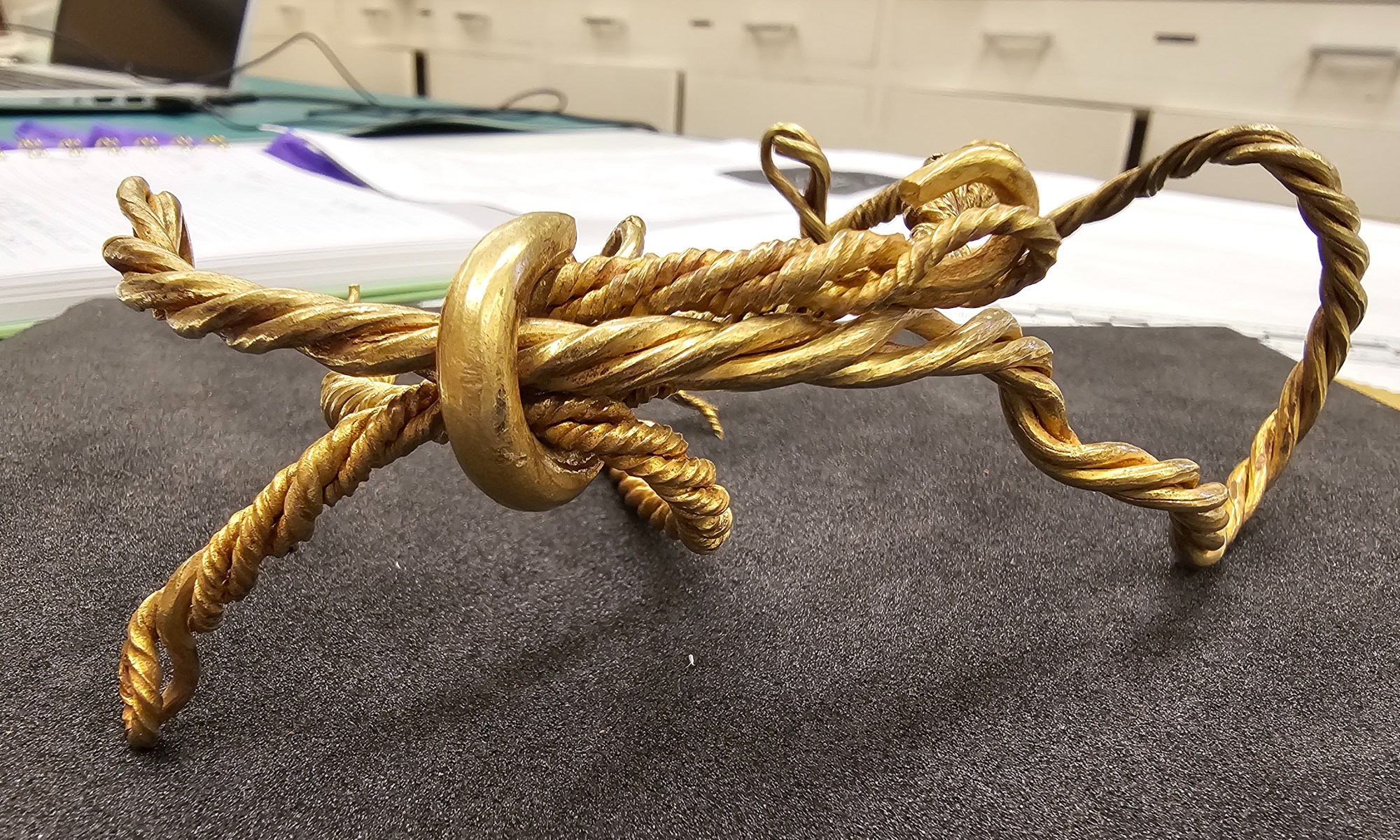
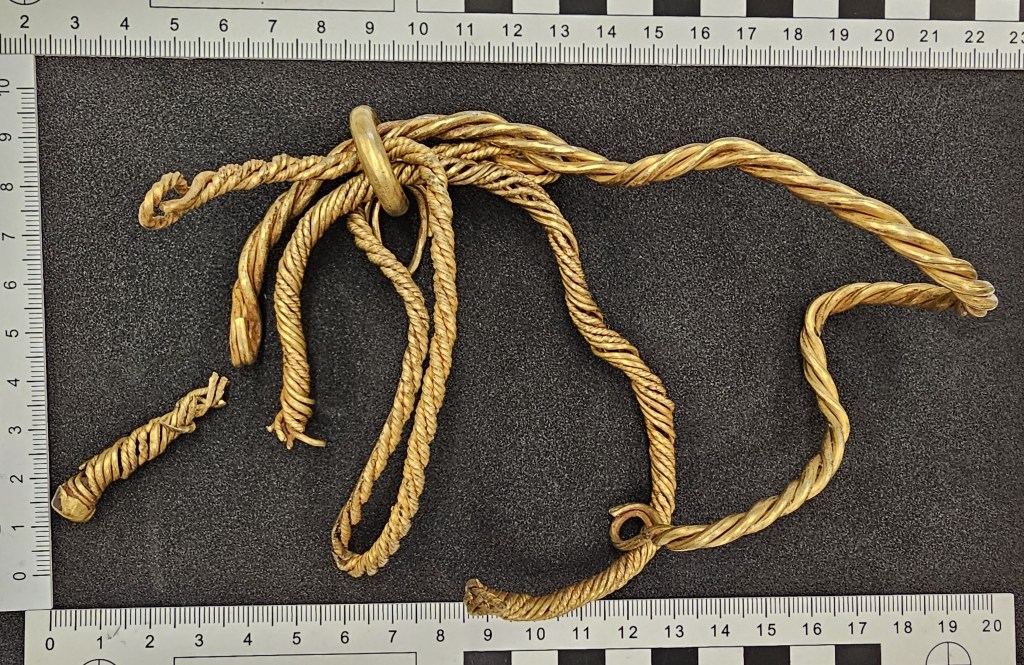
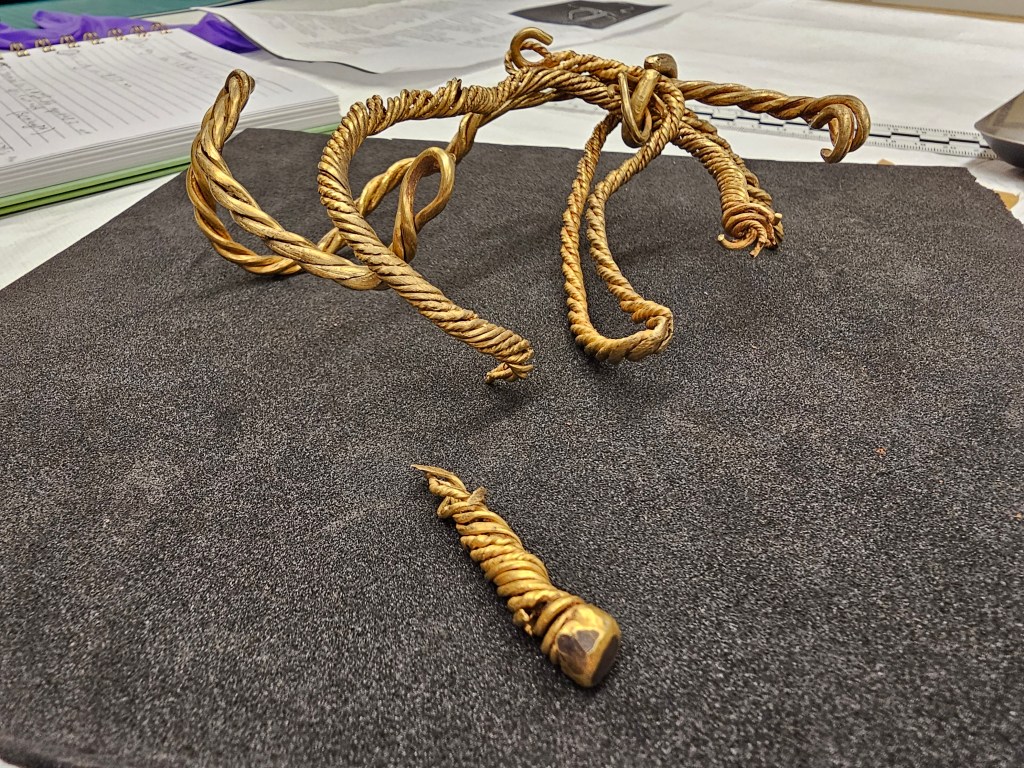
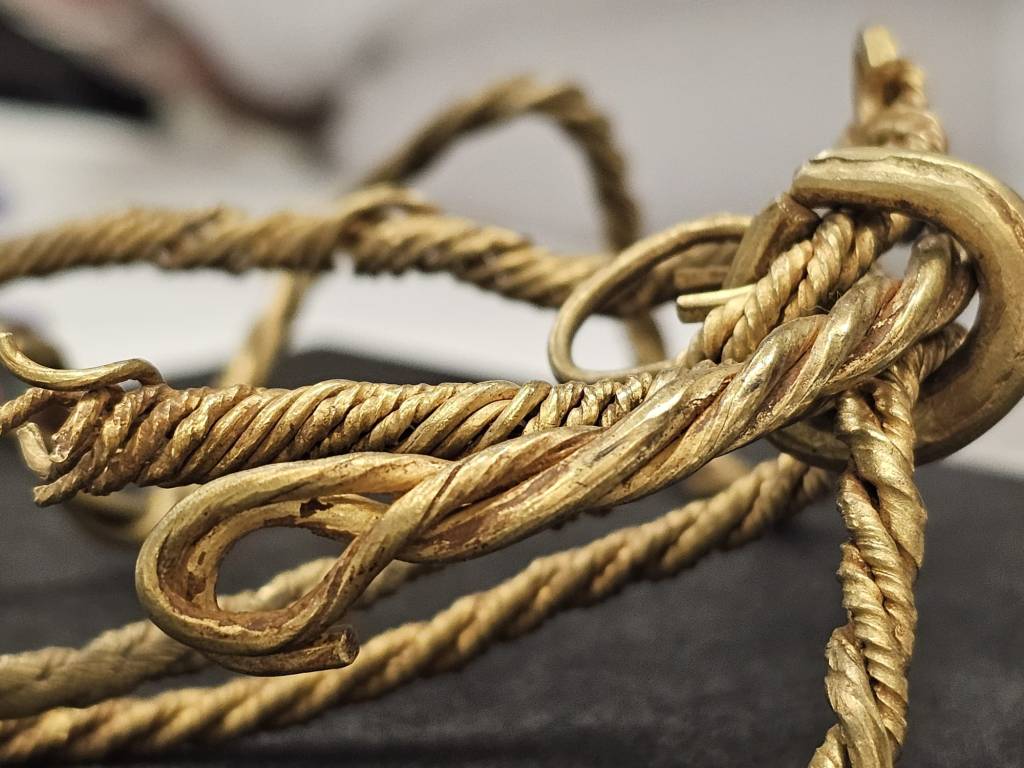
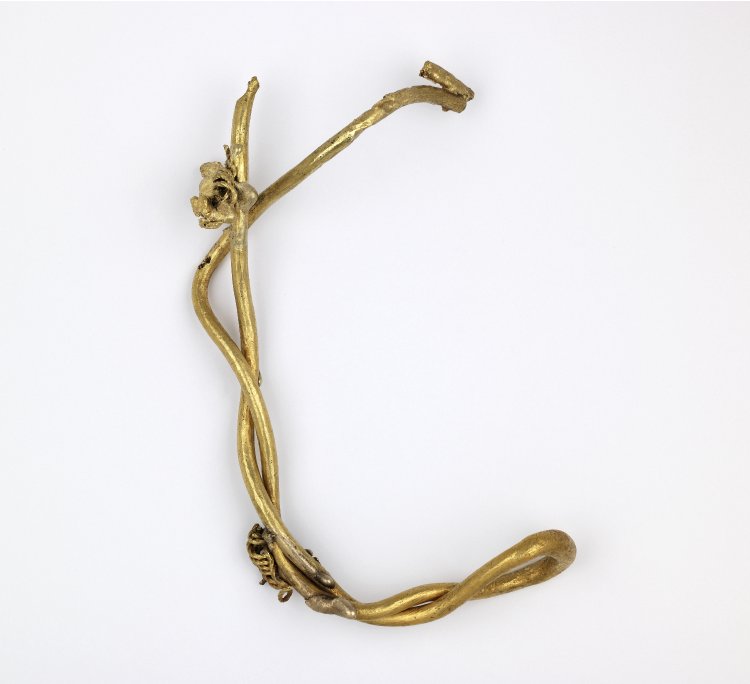
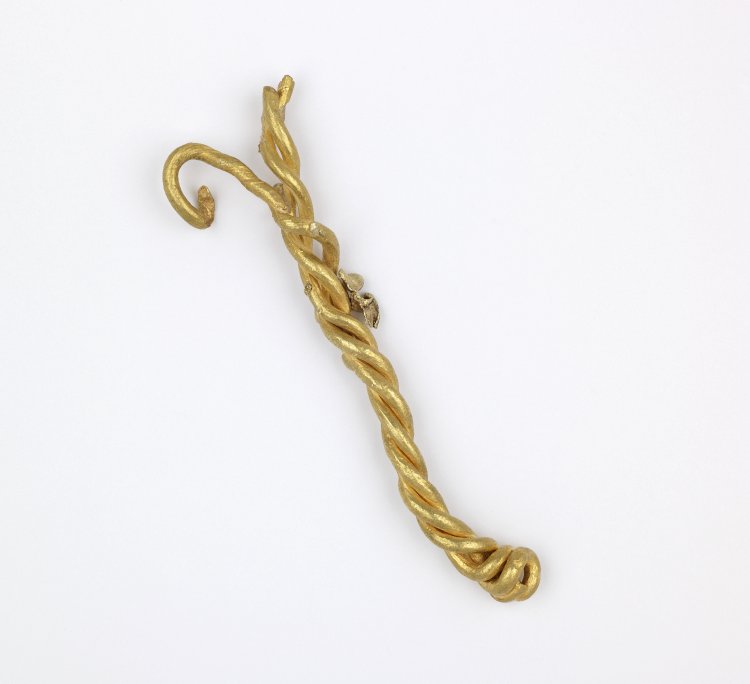
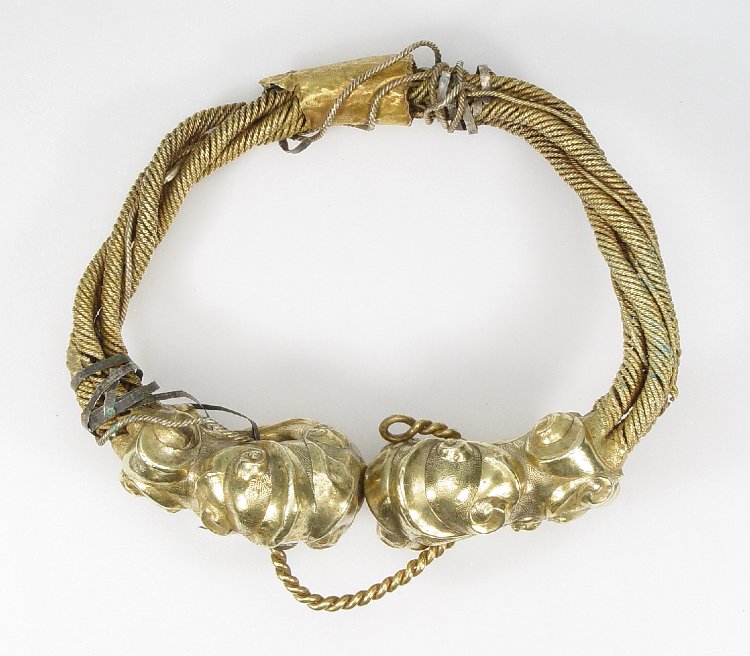
As you can see from the photos, the bundle comprises three torcs: two complete with terminals (B and C) and one with no terminals (A), although the detached terminal (F) in the photos did originally come from this torc, but was broken off by something like a plough. They are held together with a thick ring (E), which also has a thinner ring (D) looped through it.
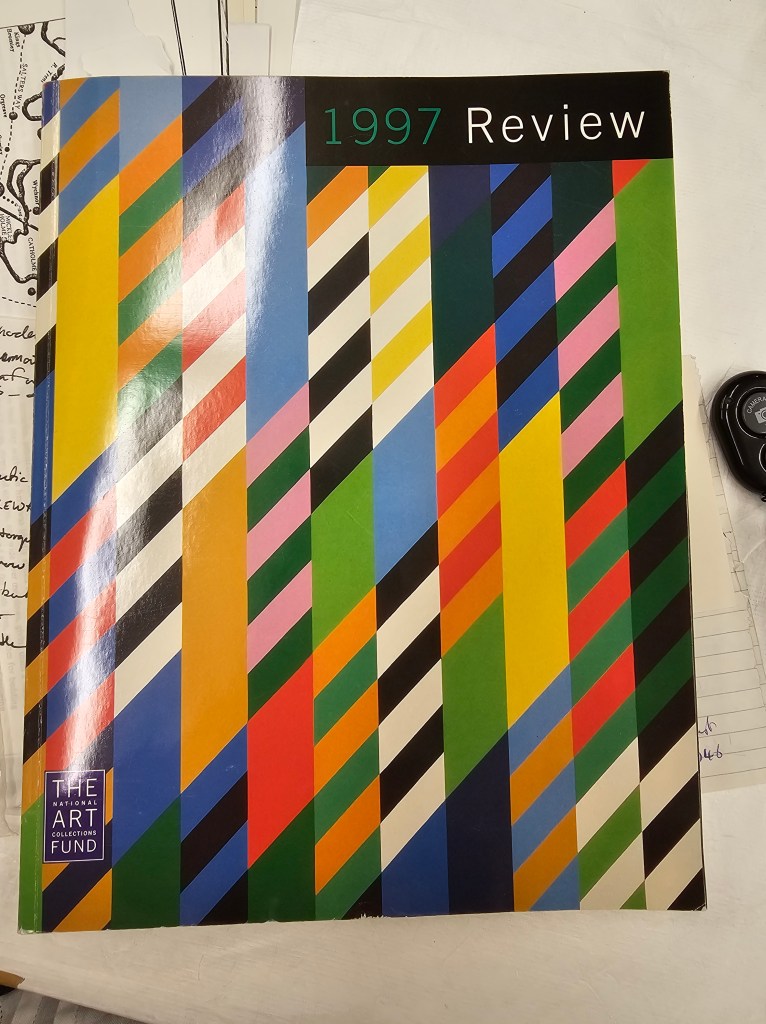
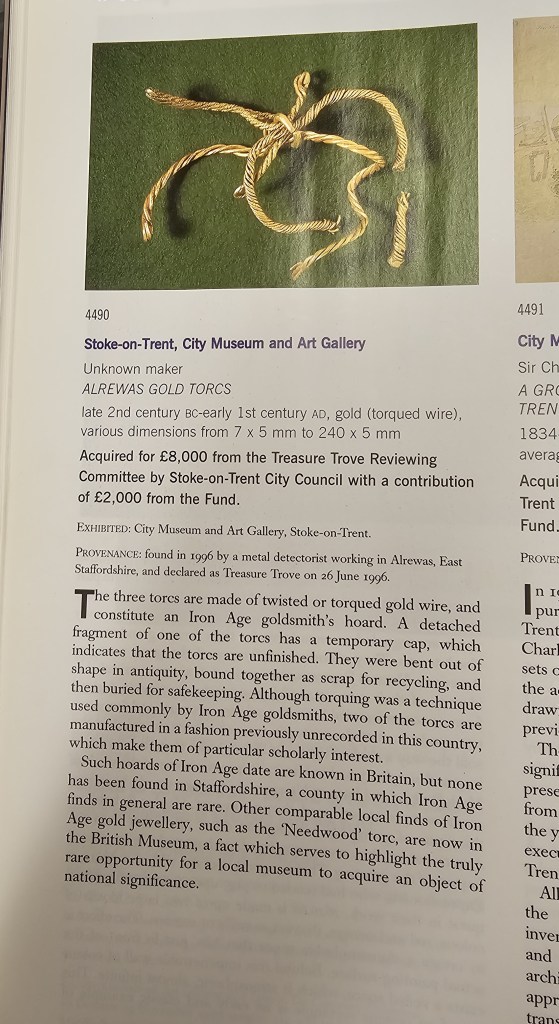
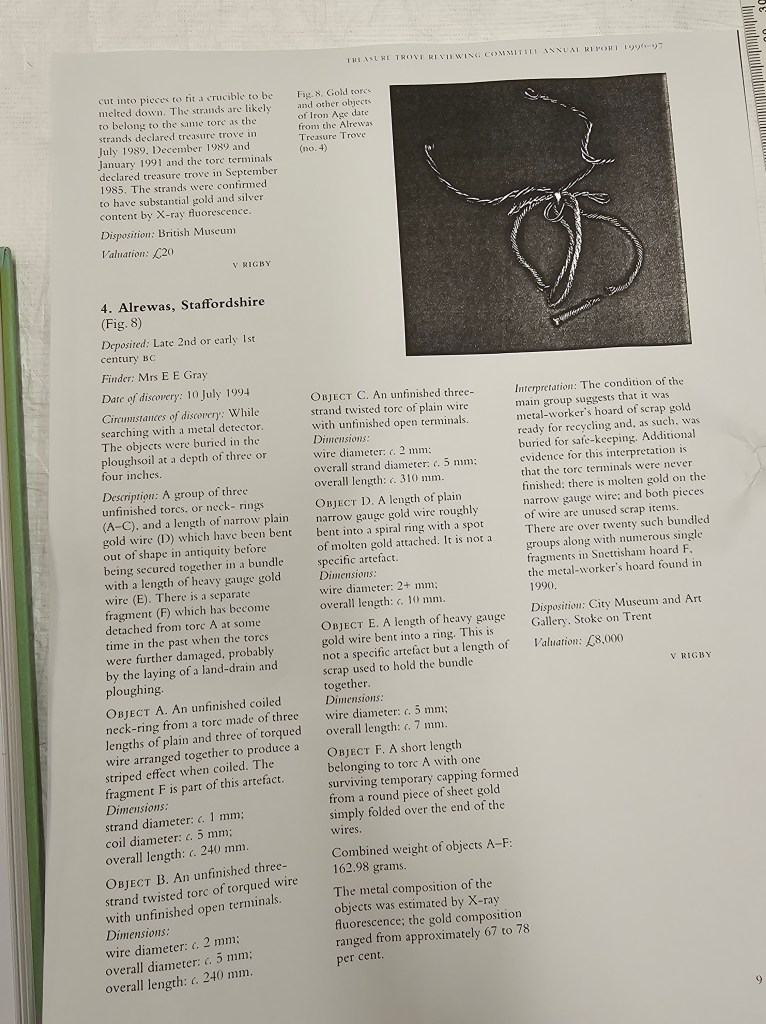
In the museum files there were also several relevant documents: an Art Fund review for 1997, a report from the Treasure Review of 1996/7 and a copy of an undated (although probably from 1996) report written by Val Rigby of the British Museum. Interestingly the Treasure round up suggests the torcs were found in 1994, but not declared until 1996, but it is difficult to tell if this is a typo or not. My feeling is 1996. But back to the torcs.
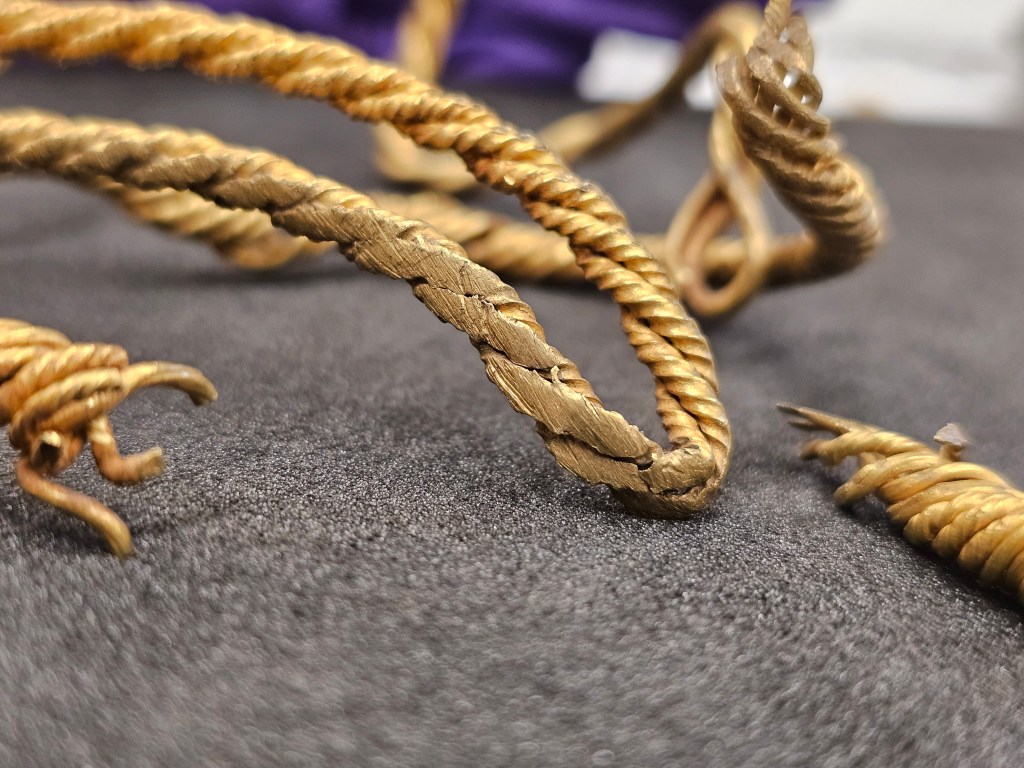
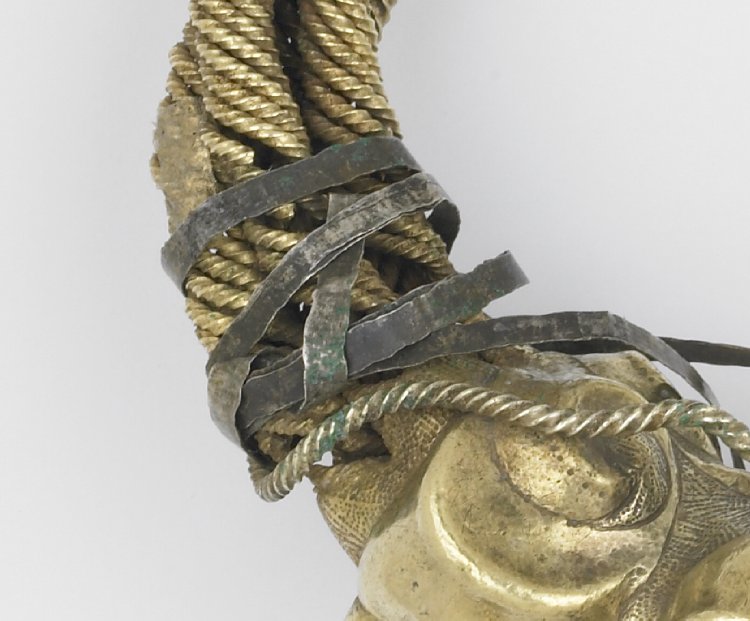
In places, all the torcs are highly abraded and damaged (see below). The pattern of this damage would suggest that it occurred after they were buried, and probably when the torcs were in a different configuration to the current one. From the location of the damage, all on one side of the bundle, it seems that the torcs were originally more curled up/nested when originally put in the ground.
It is likely that plough-dragging caused them to loosen and become abraded, with the terminal ripped off at this time. This is unsurprising, as they were found at a depth of only 10-15cm, presumably pulled up from a lower level. It is interesting that the missing terminal was not located: was it ever there? Or was it separated from the torcs when hit by a plough, or similar? Impossible to tell.
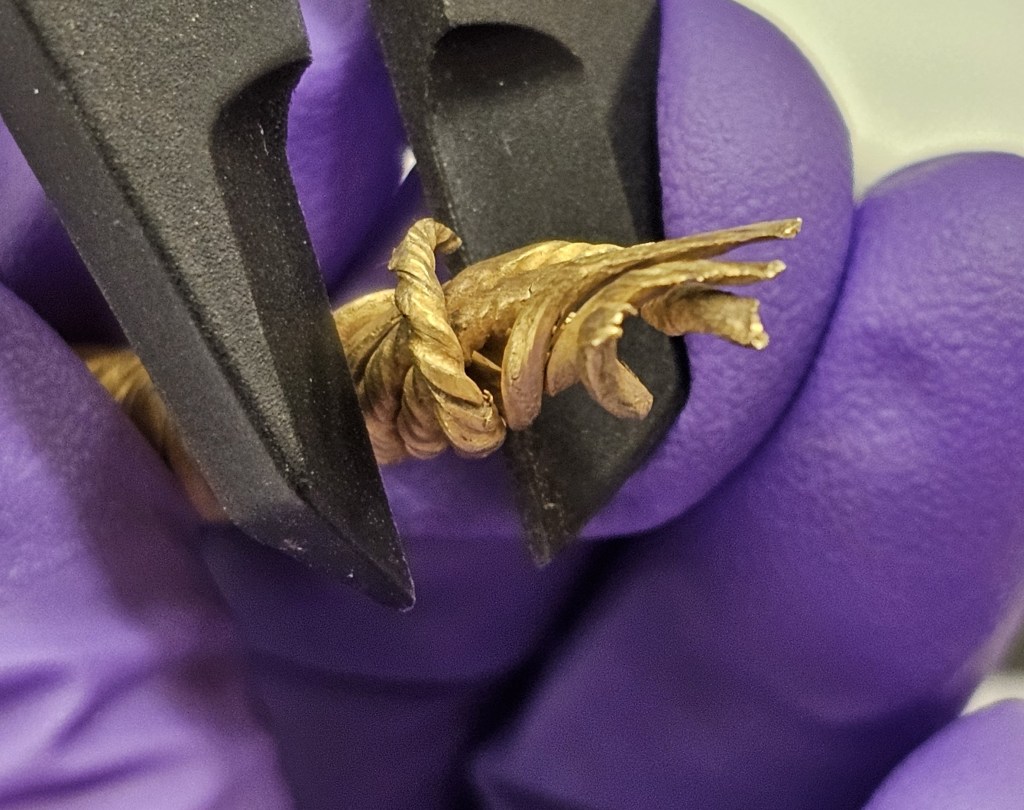
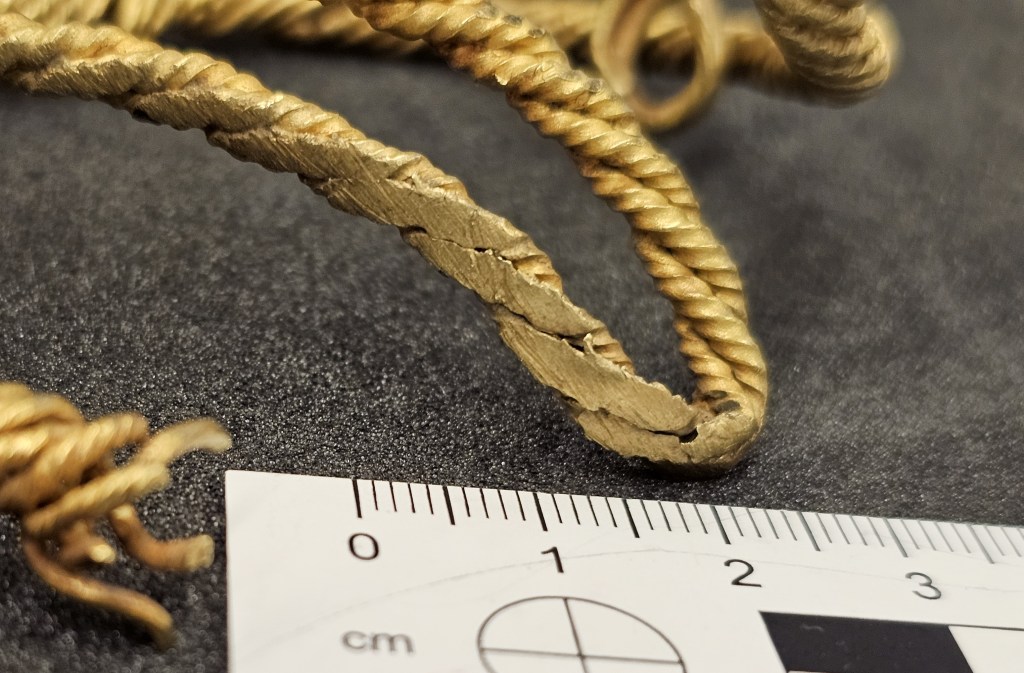
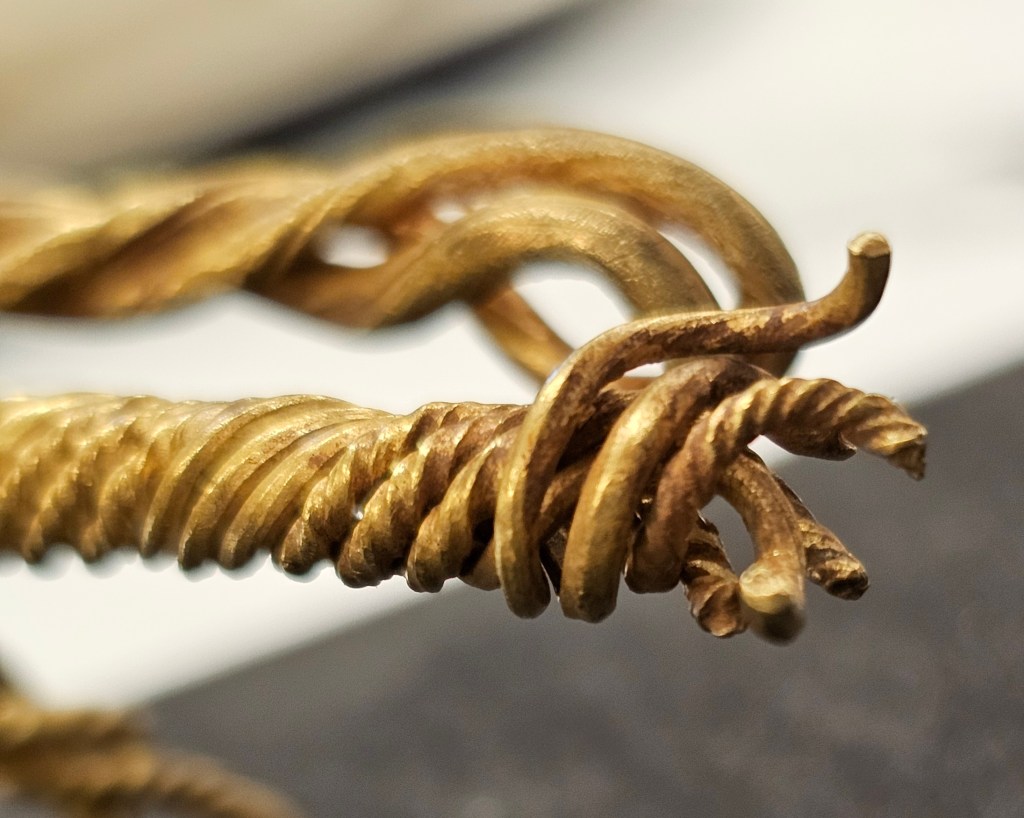
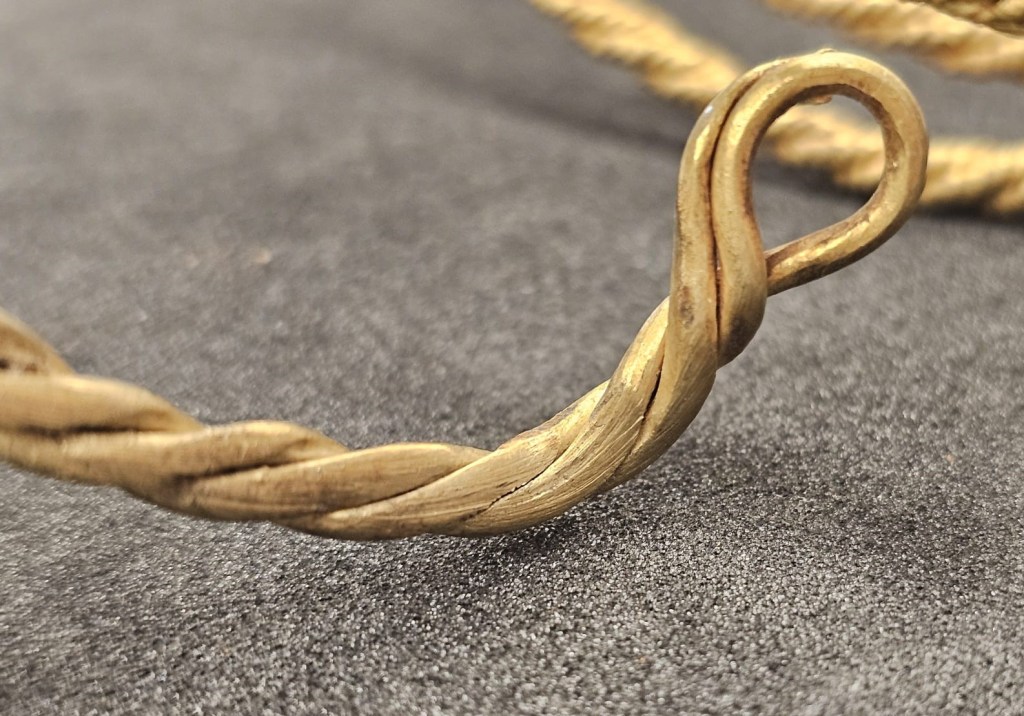
So we have two options as to what went in the ground originally: three complete torcs or two complete torcs and one other that was missing a terminal. In addition to the torcs, and binding them together, is a thick penannular ring (that is, a ring with a gap). A smaller thin wire ring is looped through the thicker ring, so we had five separate objects in total when they were buried. There are no nicks anywhere on the torcs, or rings, and so the Viking theft theory is not immediately likely.
After having had an initial look over, we next weighed the torcs. Although this won’t tell me much about how much each torc individually weighs, it’ll give me a rough idea: the bundle was 155g and the short terminal section weighed 8g: 163g in total, which gives us a very rough c.50-55g per torc. They are very light and gracile: certainly not like the 1086g Snettisham Great torc!
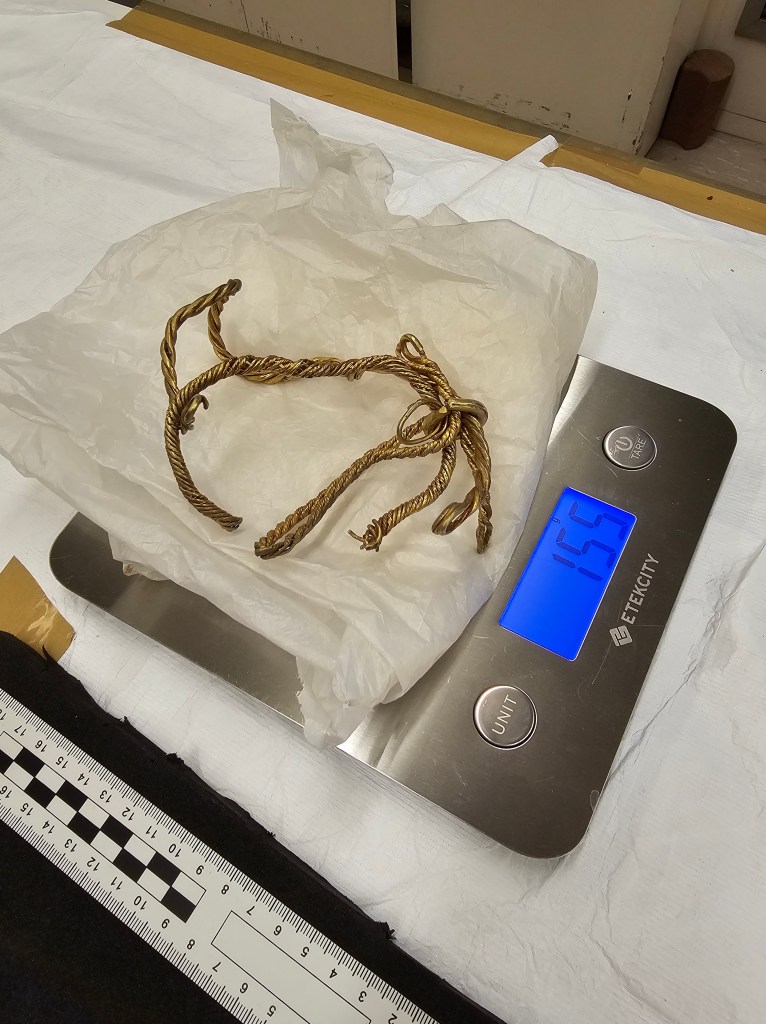
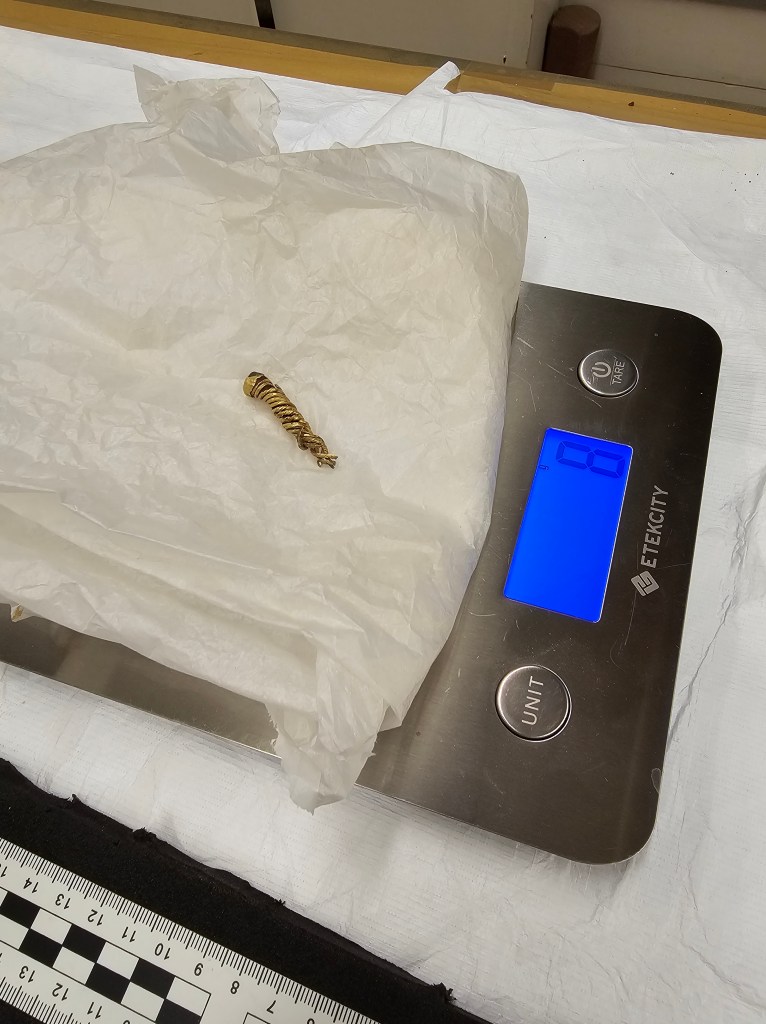
Now for some metrics, and following the conventions used in the 1996 Treasure report, I have used the A-F naming.
Torc A (and terminal F)
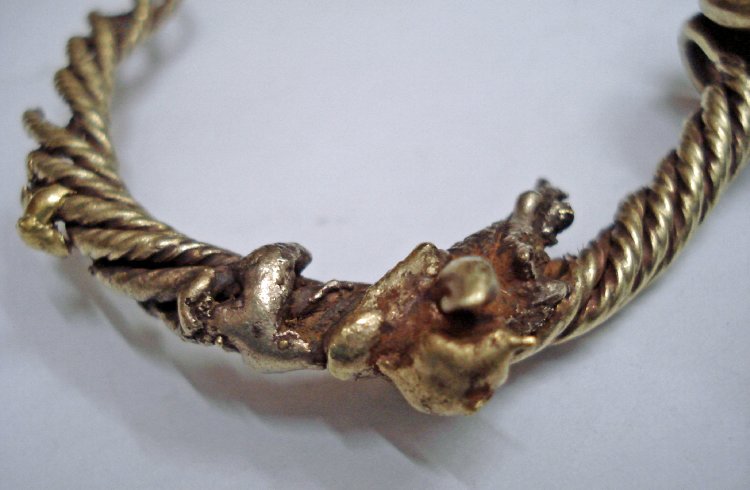
This torc is a neck ring with a cap terminal (F) broken from it. The neck ring is c. 30cm long (25cm of neck ring A and 5cm of cap terminal F) and, if it was neck ring, represents a torc of at least 11cm diameter, although it is more likely to be of around 14cm diameter if we add in an approximated 5cm length for the missing terminal. So, a small neck ring, but not unprecedented and well within the range of other neck rings from sites like Snettisham.
The ends of the neck ring are frayed and broken and there do not appear to be any intentional cut marks, so it is likely the torc was broken post-deposition, rather than intentionally cut up by human hands. The neck ring is made from six wires: three that have been plain hammered, and three with a square cross-section that have been twisted to create a spiral. The neck ring itself was formed by twisting the six wires around a former, to create a hollow coiled ‘spring’.
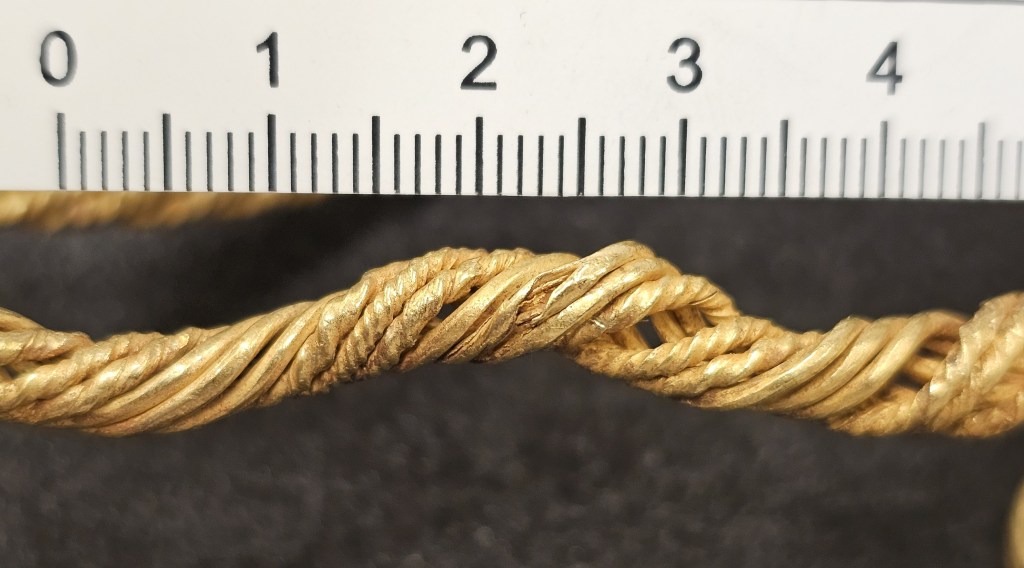
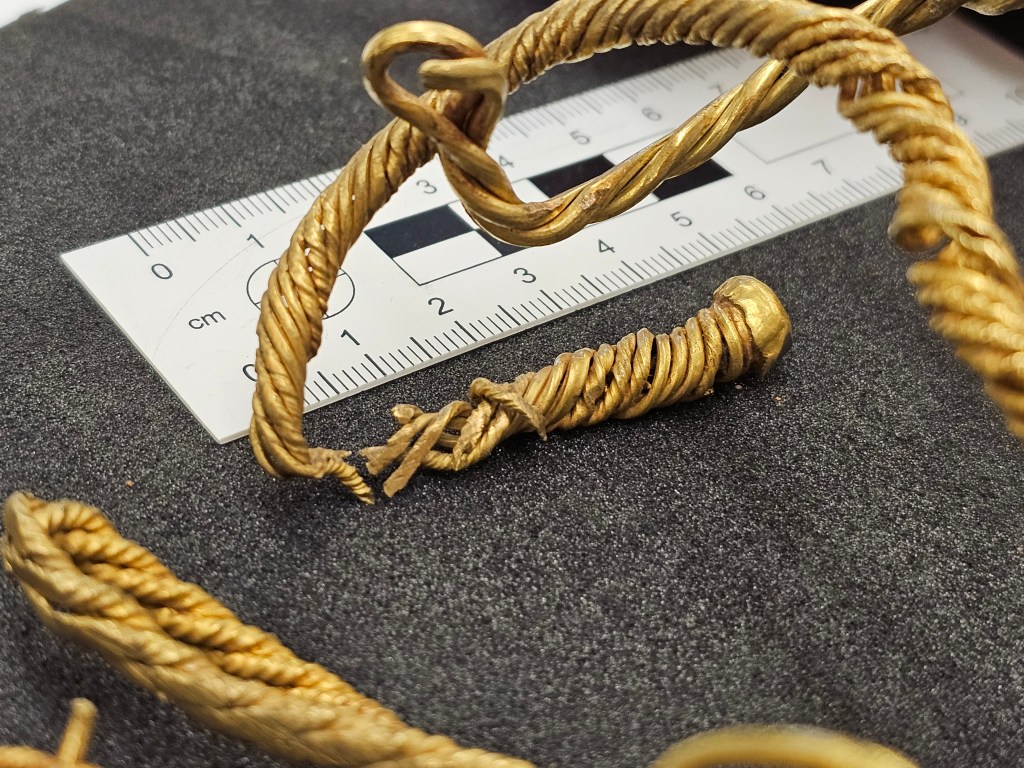
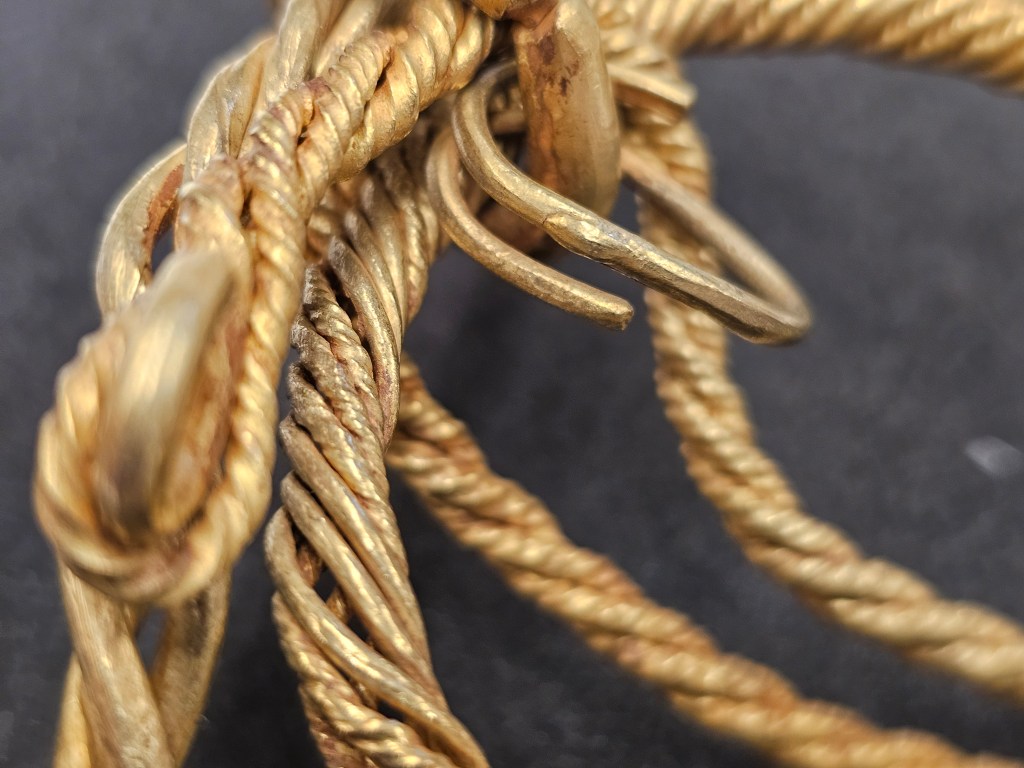
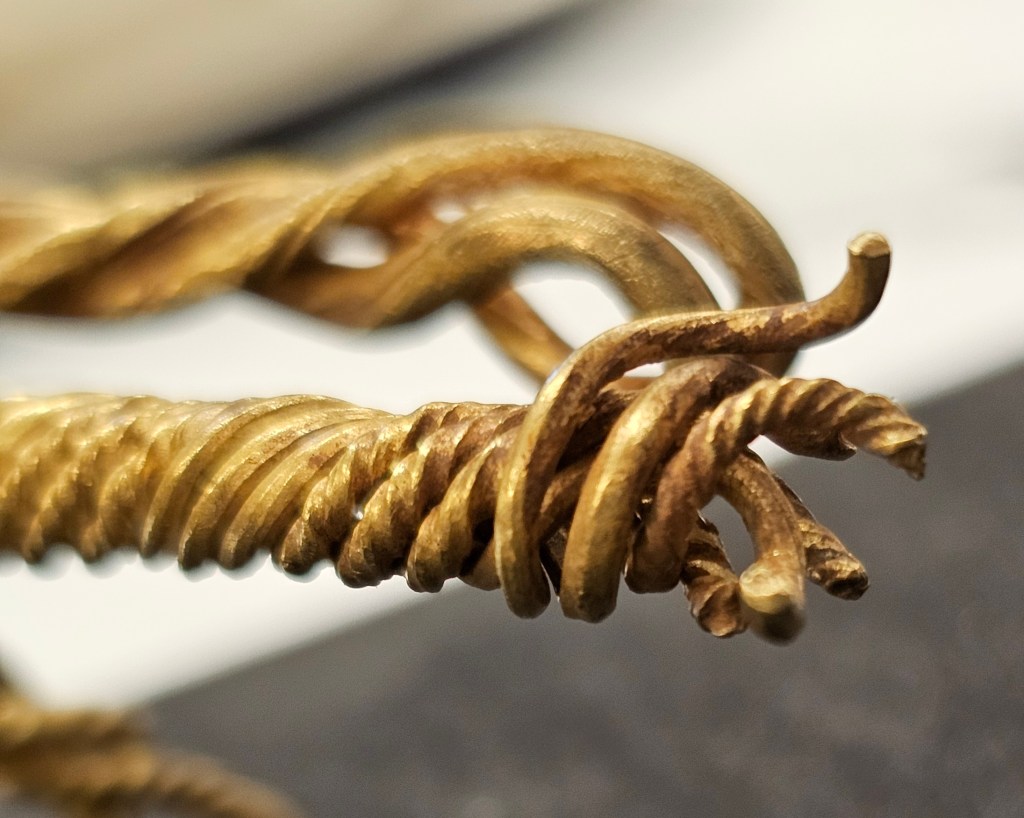
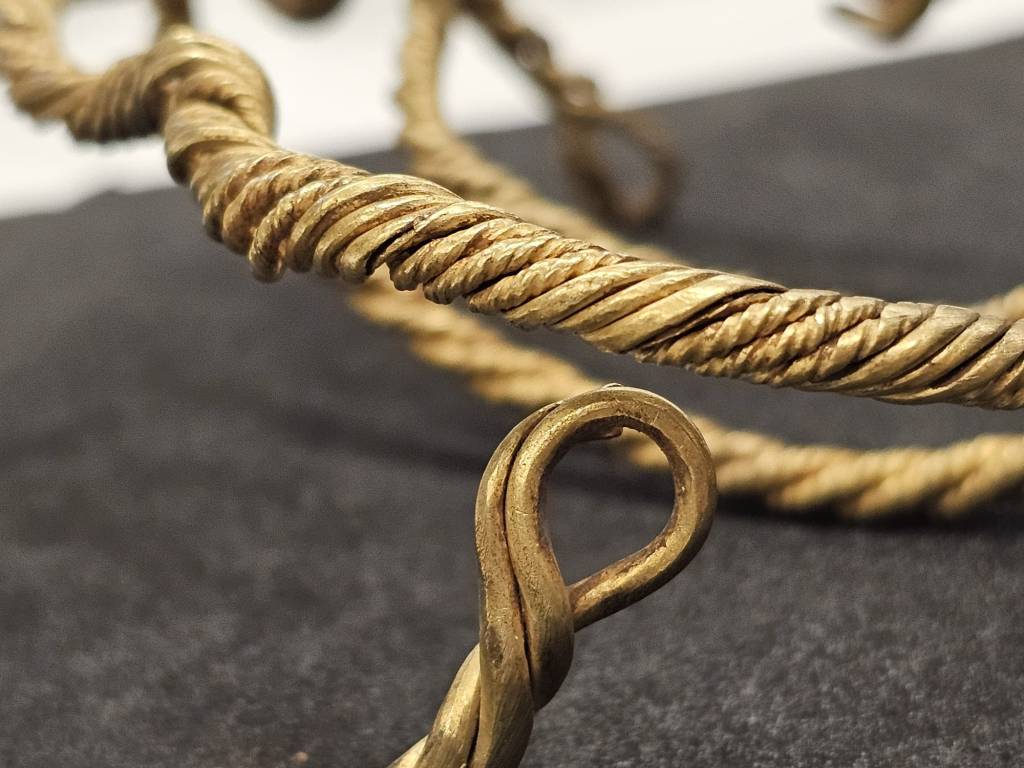
The neck ring is c.6.9mm thick and the individual wires range between 1.3mm and 1.5mm in thickness. These are typical measurements for the wires of Iron Age torcs.
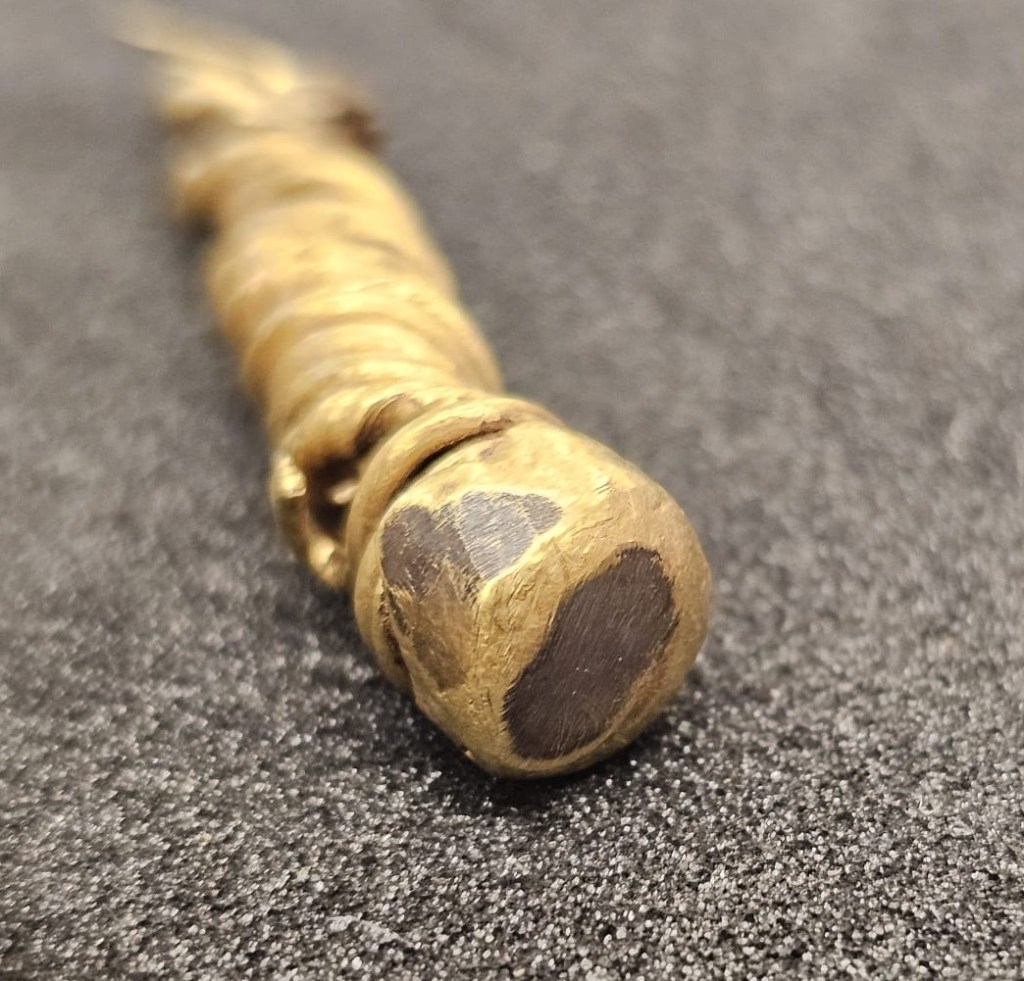
The cap terminal F has a terminal diameter of c.8.2mm and height of between 4mm and 5mm. It can be matched to one end of the broken neck ring (see centre middle photo above) from where it has broken off. The cap is made from sheet gold which has been crimped and folded to fit over the wires: it is uncertain whether the cap has been secured with solder, or just manual compression: the latter seems likely as no solder is visible. The cap appears to have been rather vigorously ‘cleaned’ in more modern times, with the brownish patina removed in several places.
Torc B
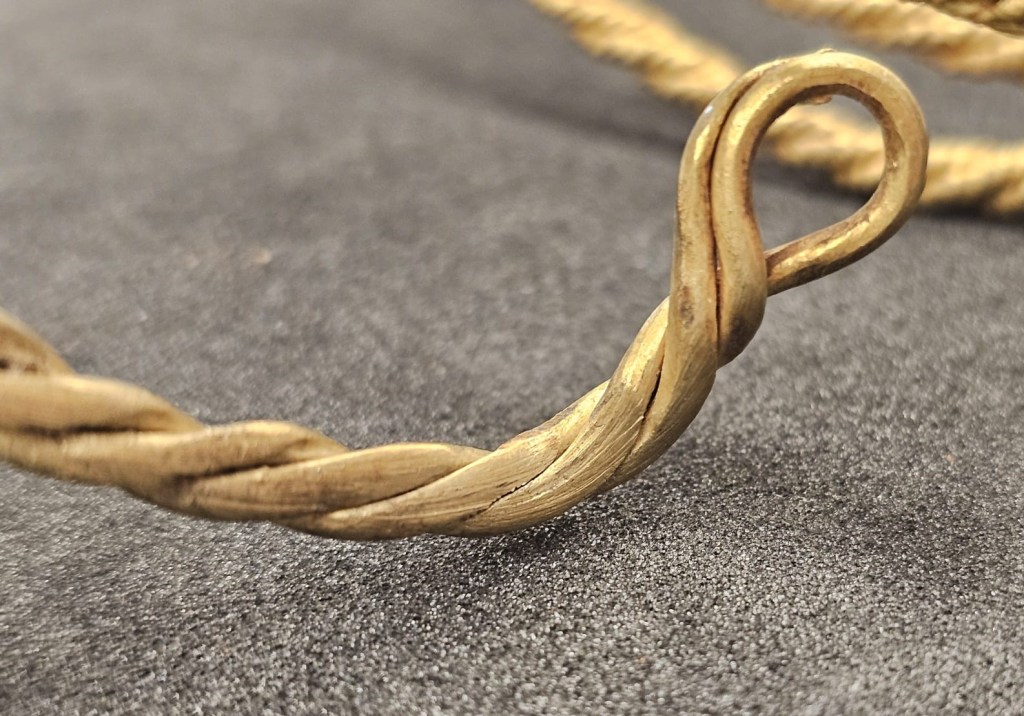
This torc is complete, with ring terminals at each end. The neck ring diameter is c. 3.7mm and comprises three twisted square cross-section wires, of between 1.9mm to 2.8mm in diameter, that have been twisted together into a rope. The terminals comprise loop ring terminals with an additional wire bent to match the terminal shape. The terminal diameters are between 10mm to 11.7mm.
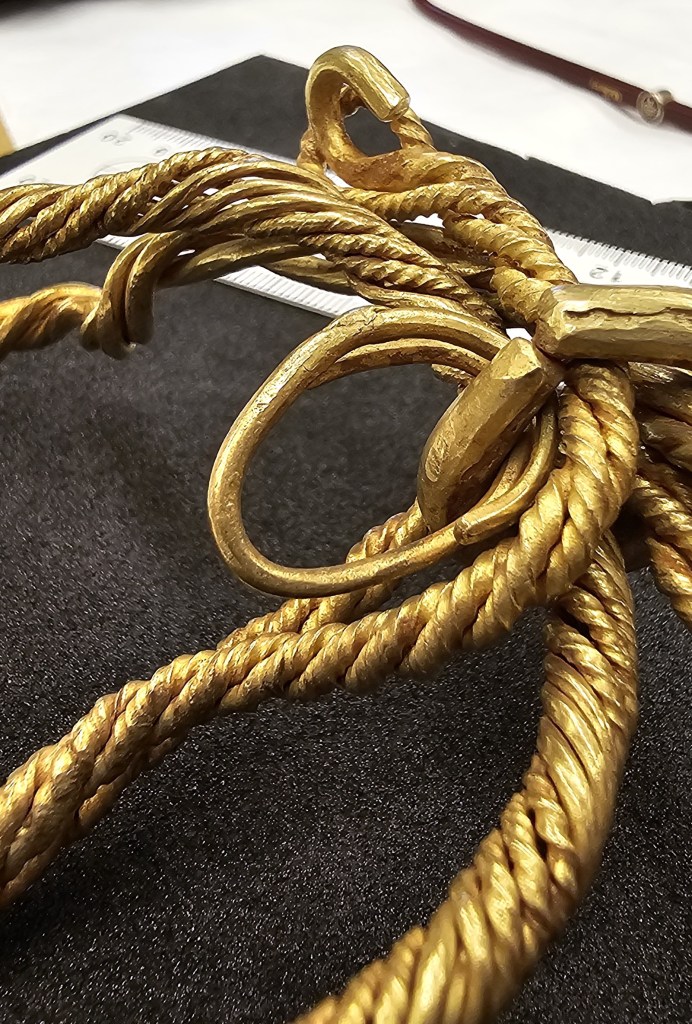
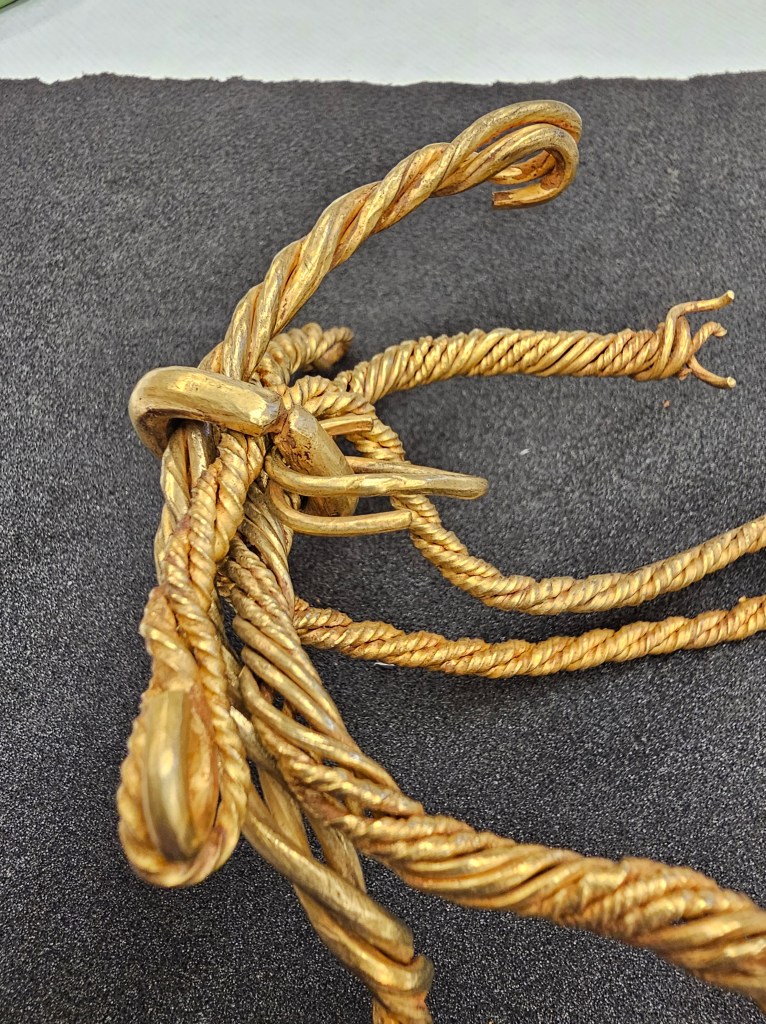
The torc has a length of c. 29cm, which would be the equivalent of a c.11cm diameter ring. This ring, although possibly designed for a child’s – or gracile adult’s – neck, would also be of a measurement consistent with that of an upper arm ring. However, it is difficult to know for certain although Iron Age hoards, for example Leekfrith, often contain both necklaces and bracelets/arm rings.
Torc B is also the only torc to pass twice though the thick ring E:
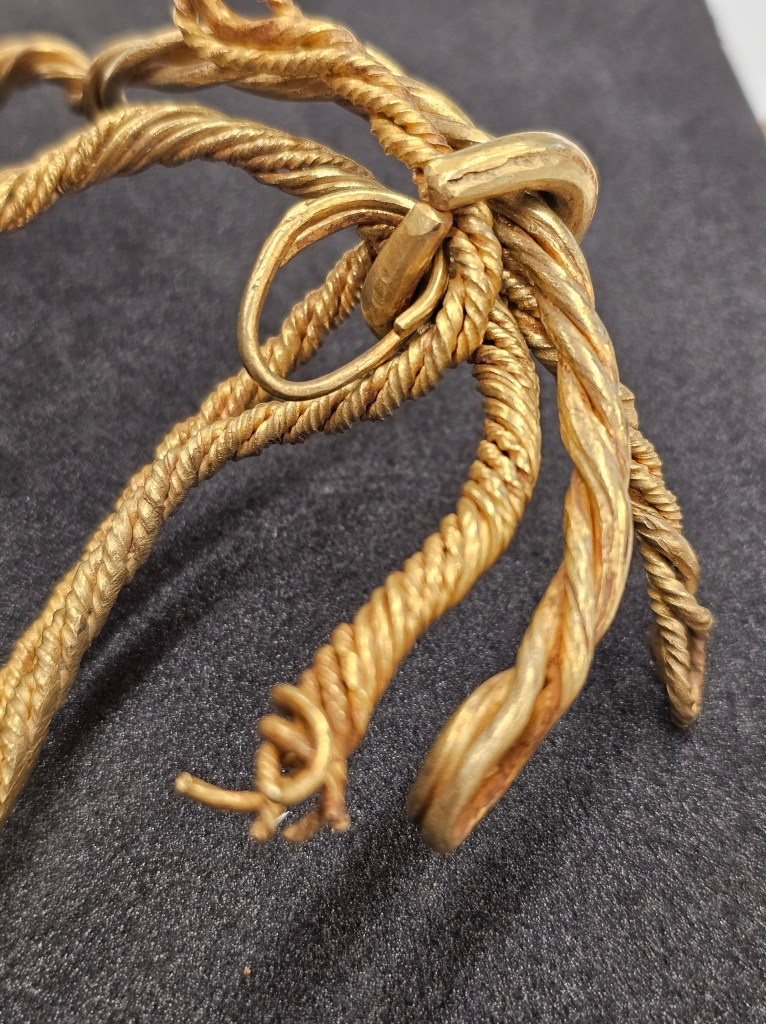
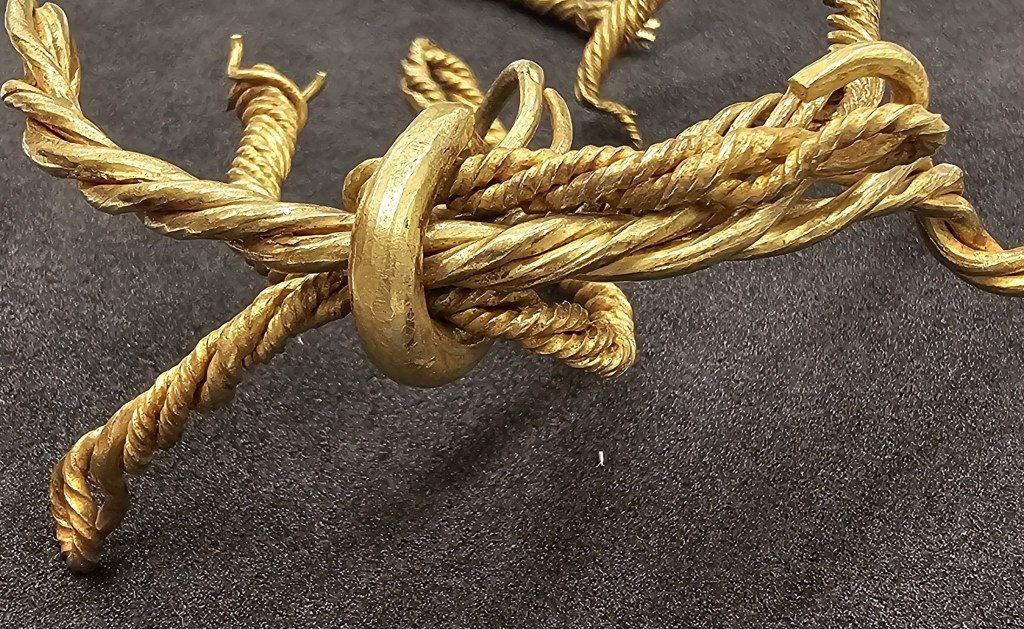
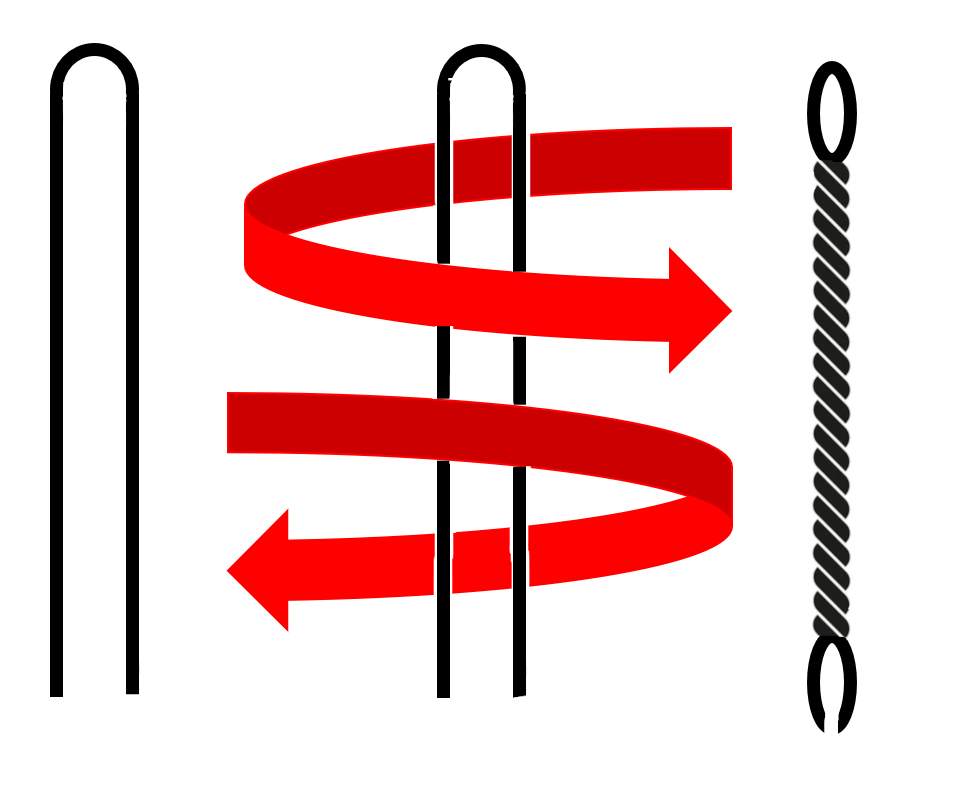
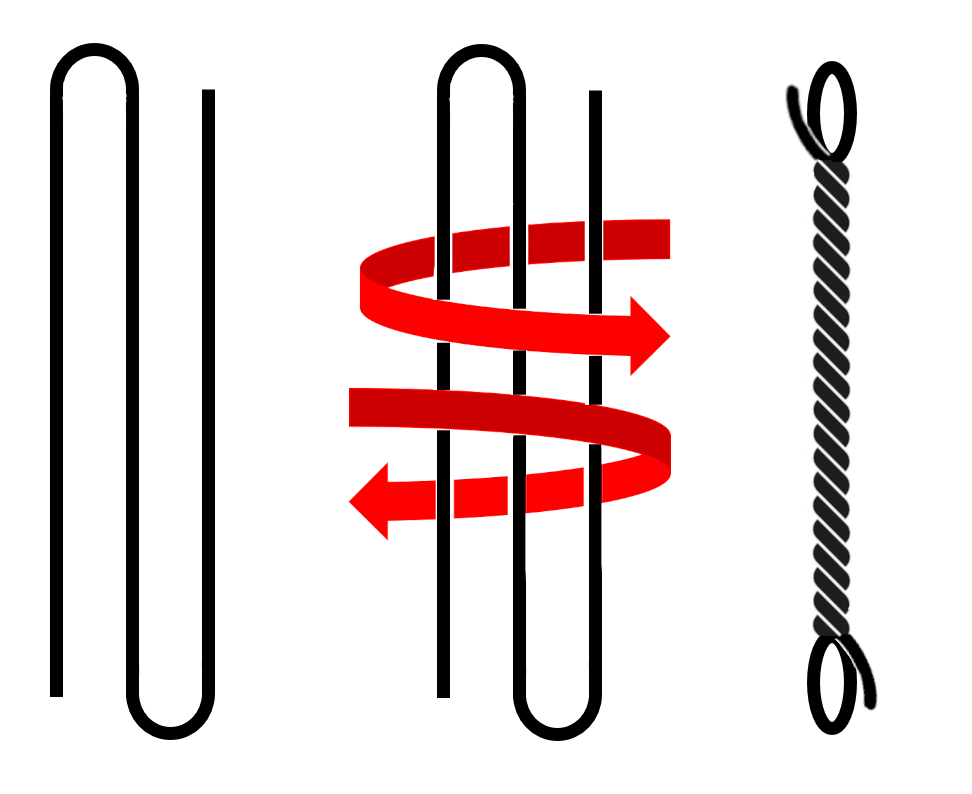
The way this torc was constructed is fascinating and has not previously been recognised in torc studies: most simple twisted wire torcs are created by bending a single piece of wire in half, creating a loop in the centre of the bend, which becomes a terminal, and then twisting both wires – either clockwise or anti-clockwise – together to form a neck ring. The two spare ends are then soldered together.
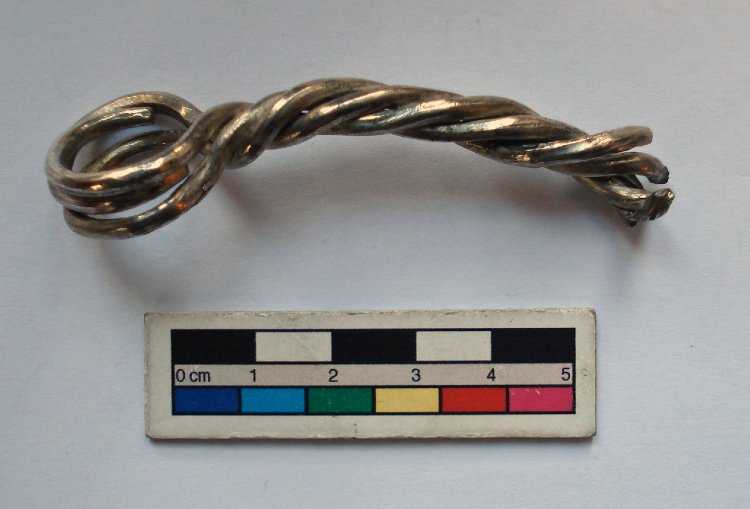
Torcs with more wires in the neck ring are thought to have been created in a similar fashion, with separate lengths/loops of wire laid next to each other and then twisted as above, with any ‘spare’ ends twisted into loop and ring terminals, etc (as below) or then overcast to create thicker terminals:
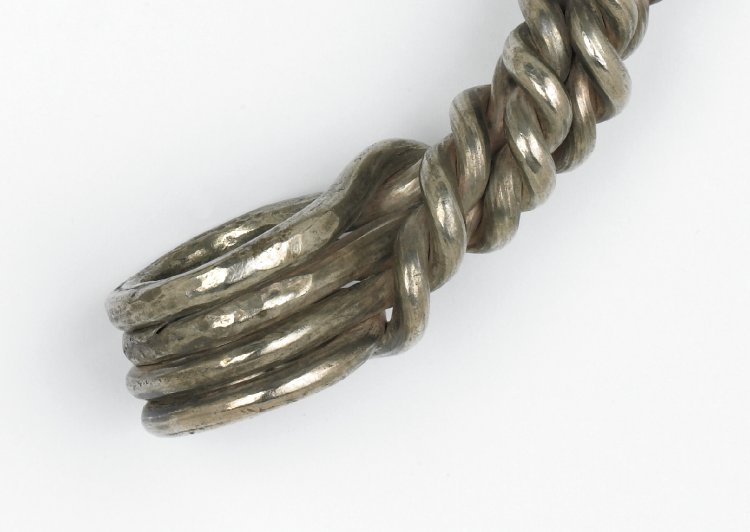
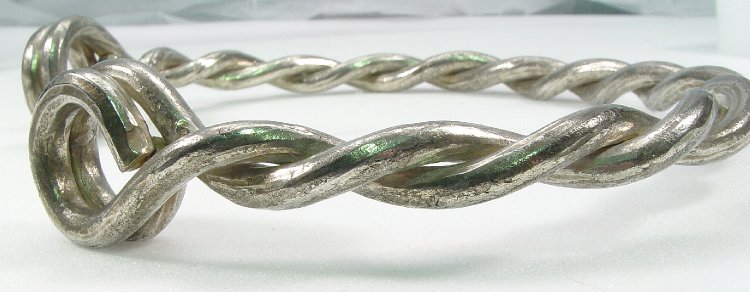
However, Torc B, and indeed Torc C (see below) have got me wondering whether what we have previously thought is right? Both these torcs have been created using a single piece of wire that has been bent twice to create a ‘N’ shape before twisting. This method results in the ‘spare’ tail of wire seen in the terminals of both these torcs, which has been neatly shaped to echo the loop:
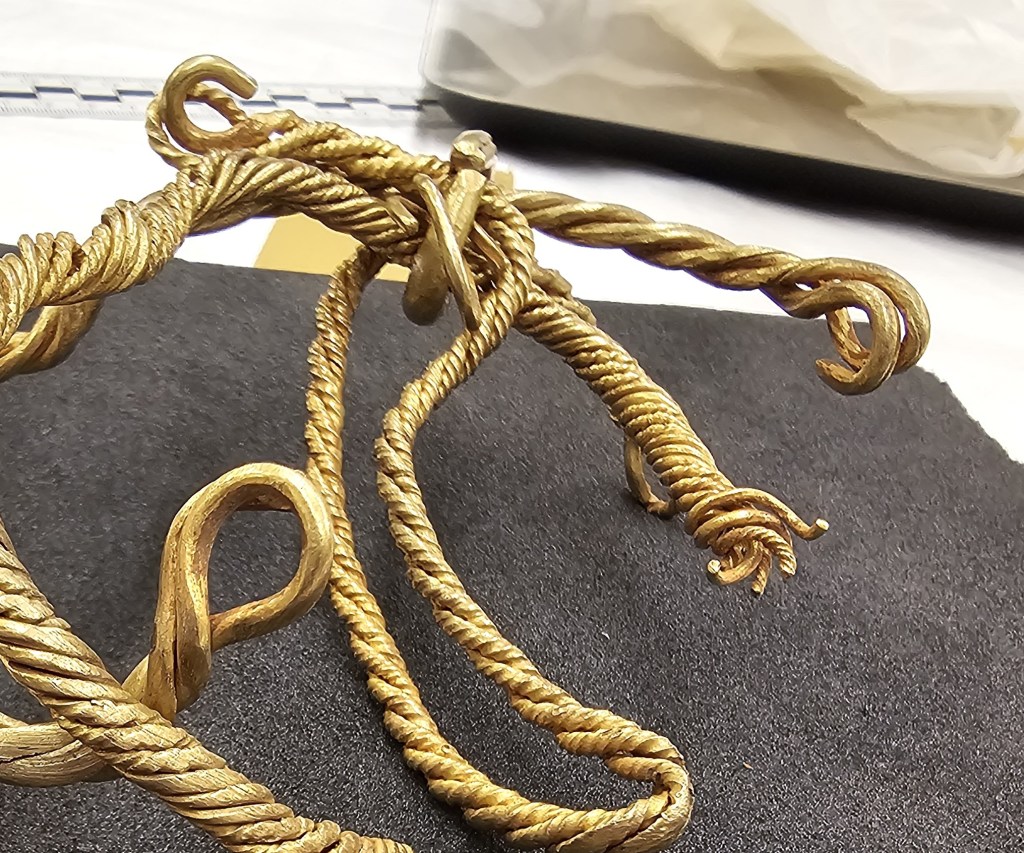
This goes against everything logical in torc making: why make your single wire longer than you have to? Perhaps that was part of the reason for doing it? Was it about showing your skill as a maker of long, and even, wire? Knowing exactly how much wire you’d need to create a torc of a set diameter, even after twisting, is quite a skill.
I have to say, this method, seen in these two torcs, has now got me panicking about other torcs: could this multi-fold method be present in other torcs too, and I’ve missed it? And if so, how many folds could they do this with? I will need to do some checking!! That’s another thing to add to the ‘To-Do’ list…
Torc C
Like Torc B, Torc C is another, complete, triple-wire twist torc. However, in this torc the wires are plain hammered. The length of this torc is c.34cm which would be, like Torc A, consistent with a neck ring of c.14cm diameter. The neck ring has a thickness of between 4.4mm to 5.4mm. The terminal diameters of this torc are 11.7mm and the wire thicknesses range from 2.2mm to 2.8mm.
Ring D
This thin wire ring, of a wire thickness of around 1.8mm, is looped though Ring E. The diameter of the ring is c.20mm, which would could suggest the ring might have been a finger/thumb ring. Simple wire rings, although rare, are not usual for the Iron Age.
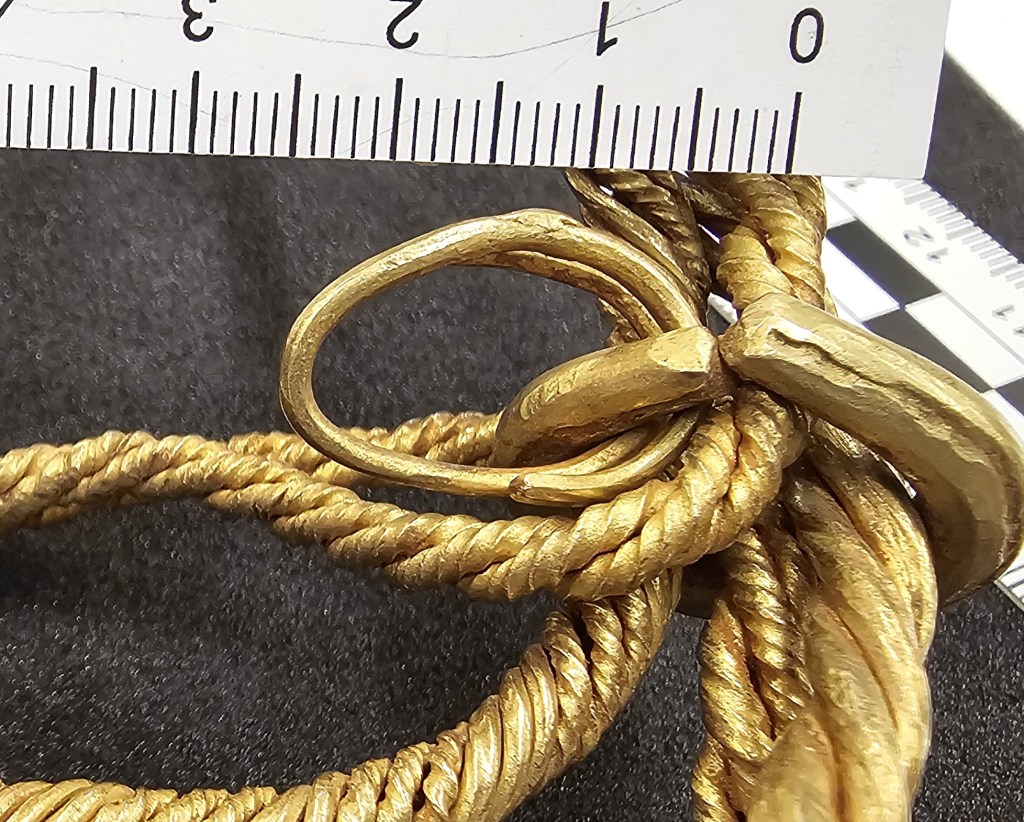
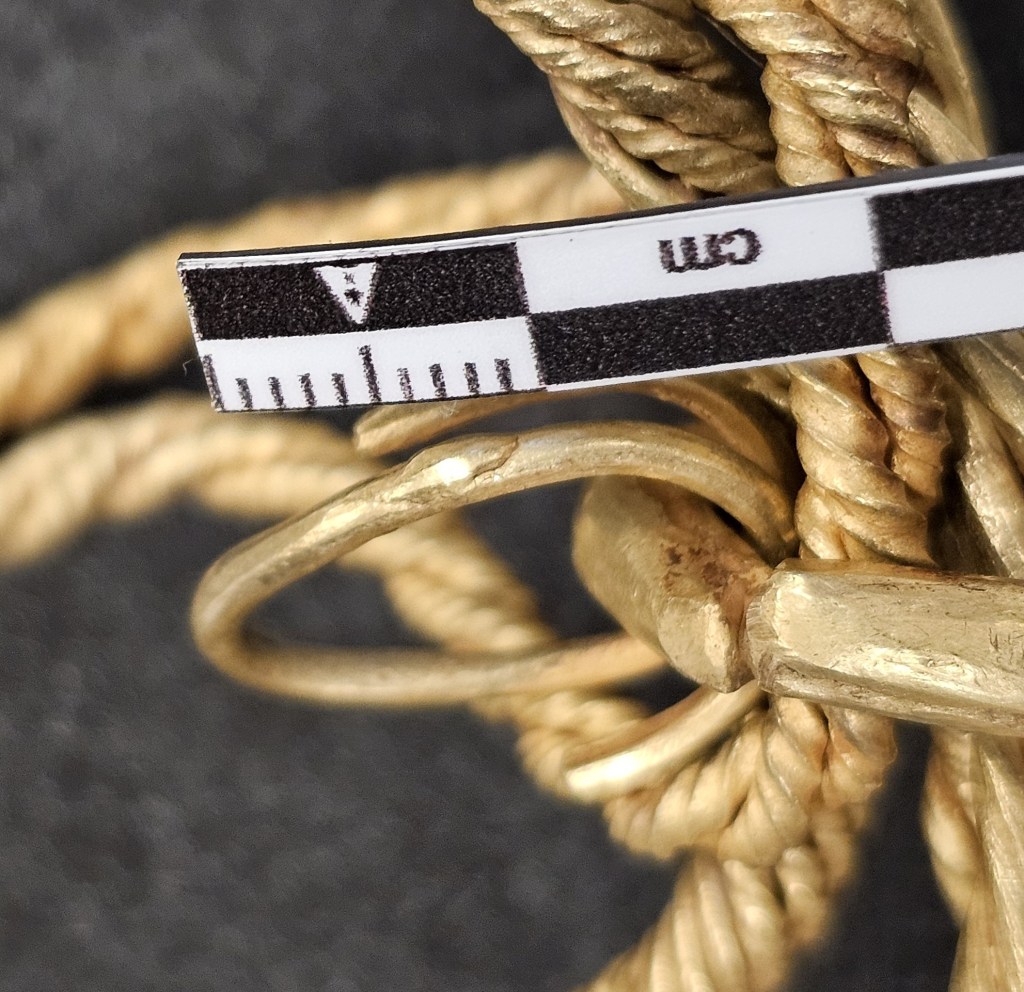
Of interest, there is a small blob of molten gold on the wire. Such blobs have been seen on several pieces of gold used to link torcs, and other pieces, together from hoards B/C and F at Snettisham.
At Snettisham, these have been assumed to be part of a ritual/ceremonial process, although we have previously suggested that they may represent accidents with casting, or evidence of incomplete melting. Interestingly, such blobs have never been found on any torcs beyond Snettisham. Is it possible Ring D might have its origins at the Snettisham site? The finding of another terminal at Snettisham, directly comparable to cap F (see below) might offer some support to this idea. Sadly, it is almost impossible to prove unless we could, for example. match the alloy exactly, and even then, such evidence might be coincidental.
Ring E
Ring E is a penannular hammered ring, made from a rod, 3.9mm to 5mm thick, which has been hammered into a ring shape. The external diameter of the ring is c. 23.3mm and the internal diameter is 15.9mm. All the torcs run through this ring, Torc B twice, and Ring D has also been attached to it.
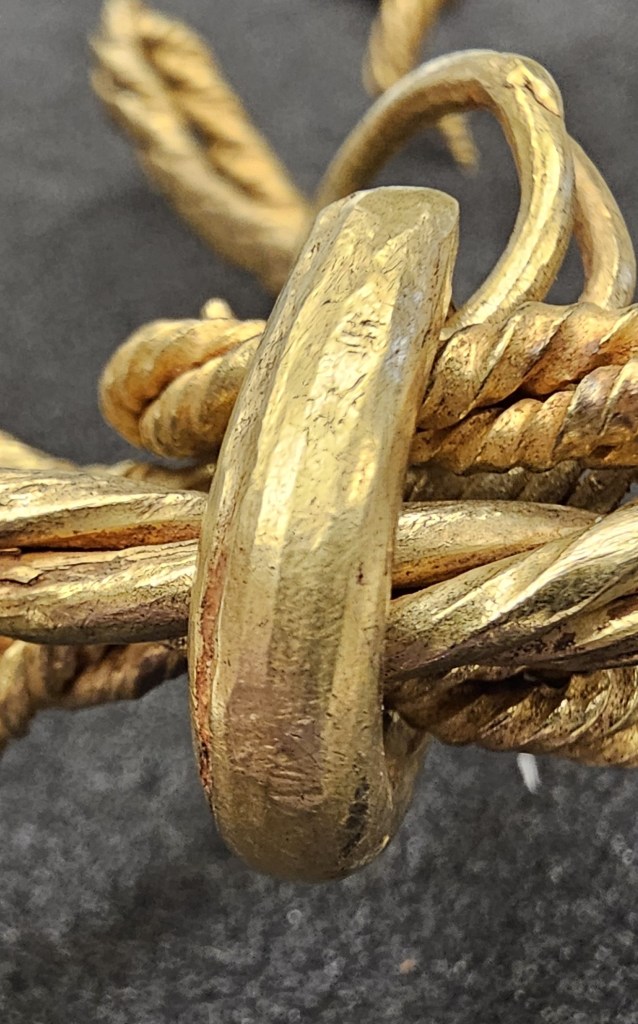
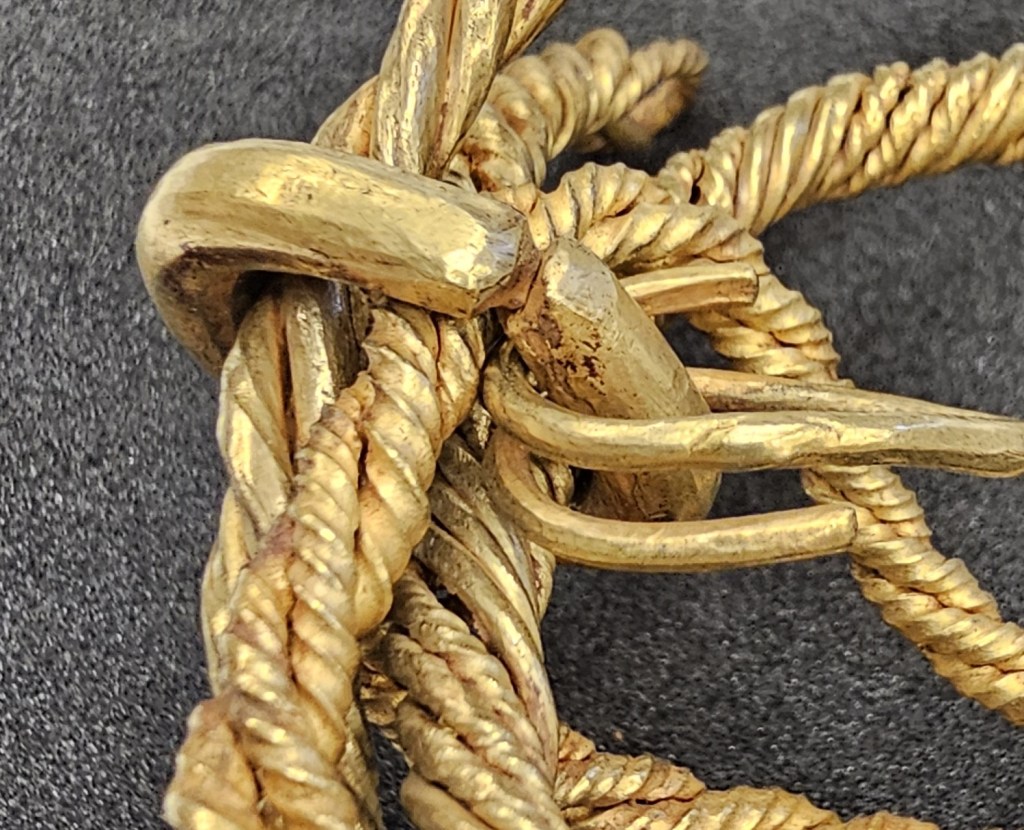
It is uncertain whether the ring was made and then the torcs threaded though, or whether the ring was hammered to shape around the torcs: the external diameters of the terminals of Torcs A, B and C – at no more than 11.7mm – would have been able to pass easily through Ring E, although as more torcs were added it would certainly have been a snug fit for the last torc to be added. As such, there is no way to be sure if the ring was made first, or bent around the torcs: my gut says the former though – to bend the ring around the torcs would not have been a straightforward task!
I also think that Ring E may be a reused terminal from another torc: the shape is not perfectly round and the thickness is greatest away from the ends as would be expected in a torc terminal. Having seen it up close, the ring to me feels firmly Iron Age, and there is nothing to suggest a Viking date for the ring itself. Shucks!
Discussion
So are these torcs Iron Age? Yes, undisputably so: they are Iron Age torcs. But was their gathering together carried out in the Iron Age? Of that I am less certain.
On the one hand, the linking together of torcs and torc pieces – often with rings and pieces splashed with molten gold – is well attributed in the Iron Age at Snettisham, with the Great torc and other groupings of secure Iron Age date showing this:
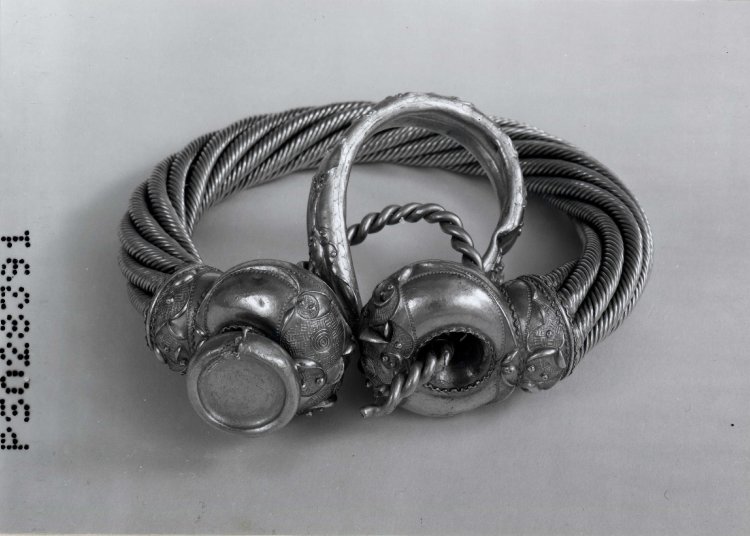
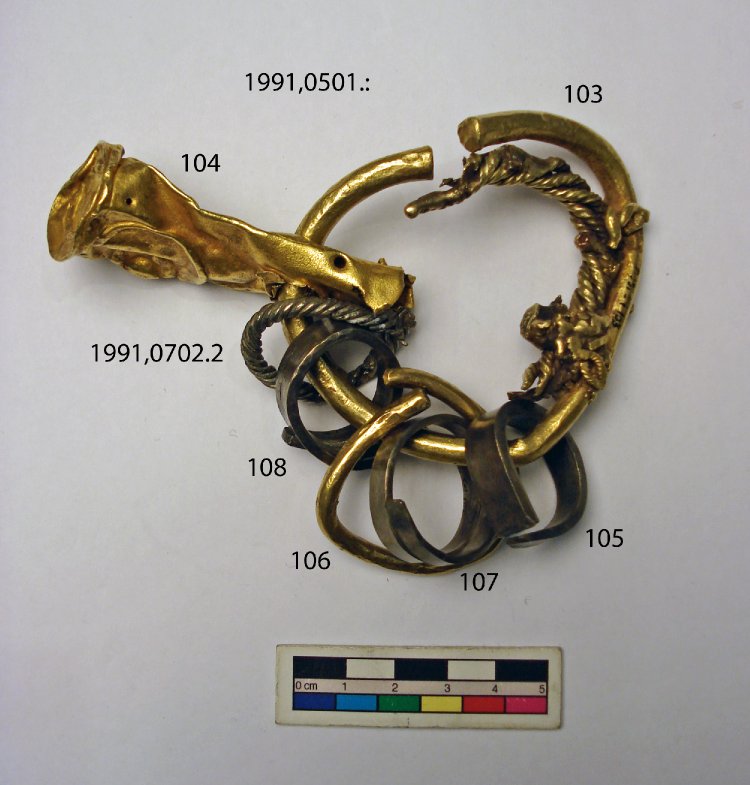
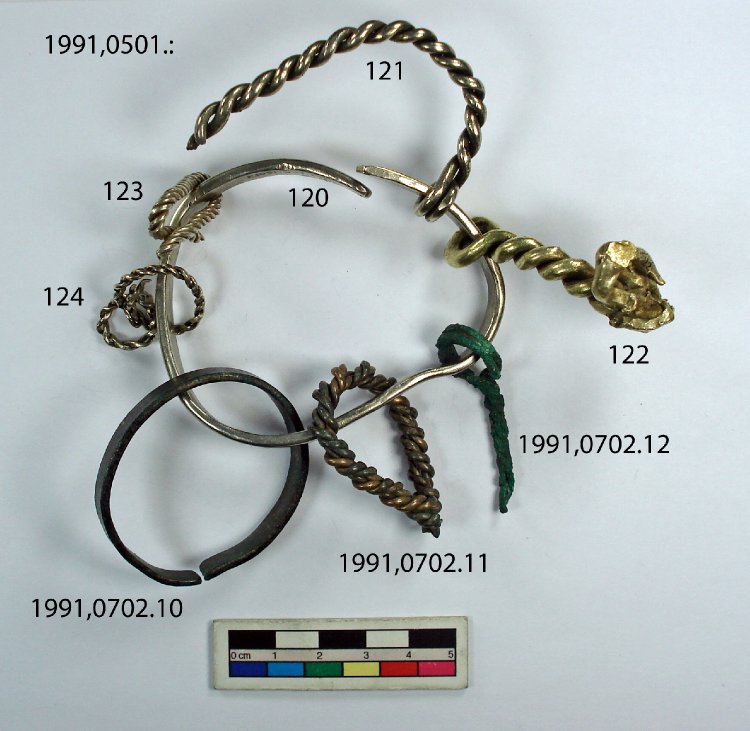
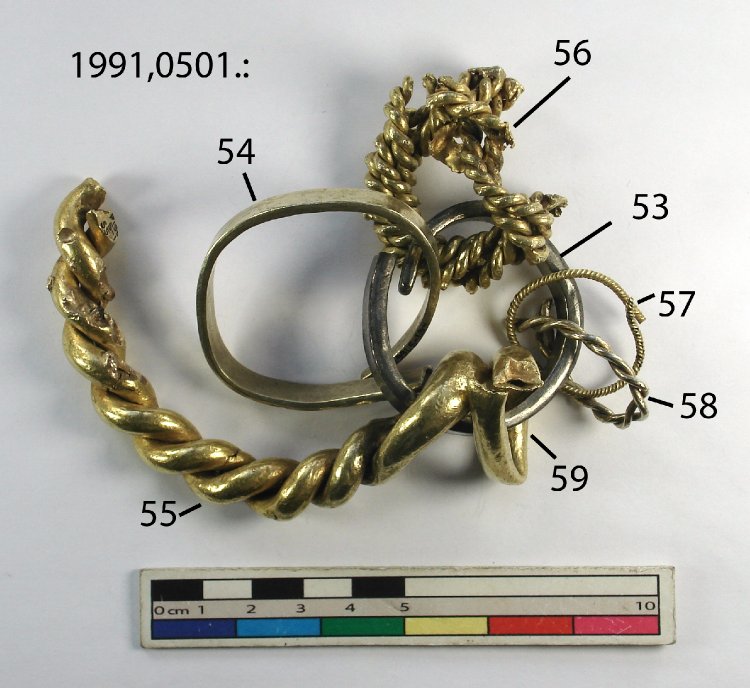
As such, perhaps we have a cultural/ritual tradition which stretched from as far as Staffordshire to East Anglia. There are also three torcs present: two small neck rings and a possible arm ring. This would be very Iron Age and comparable with several other hoards of this date.
On the other hand, the way the Alrewas torcs are bound together is unusual, and more reminiscent of Viking hoarding practices. In addition, the location of the Alrewas torc find spot, on flat ground, close to a river, and not far from the Viking associated finds scatter – and possible camp – at Catton, might suggest Viking influence in their gathering together and depositing: currently, I just can’t make up my mind. Hmmm…
As far as the condition of the torcs is concerned, Val Rigby’s report for the British Museum suggests that the torcs were not finished – the evidence for this being that the torcs have been bundled together, that there is molten gold on Ring D and that the the cap terminal F is ‘temporary’. There is also a suggestion that these thin torcs would have been bundled or twisted with other such torcs to make a complete torc like the Snettisham Great torc, or similar. The assumption made is that the Alrewas torcs were a metalworkers hoard: scraps and bits ready to be used or reused.
However, I don’t believe this to be borne out by the evidence:
- The terminals for torcs B and C have been nicely shaped, and the ‘spare’ wires in these terminals have also been shaped to snugly fit the loop terminal curve. This does not suggest unfinished torcs.
- In addition, at between 29cm and 34cm in length, these pieces would have been too short to wind into a bigger torc: length is lost in every twist and coil into a bigger neck ring, and pieces like the Snettisham Great torc or South West Norfolk torc, have lengths that are at least 45cm long.
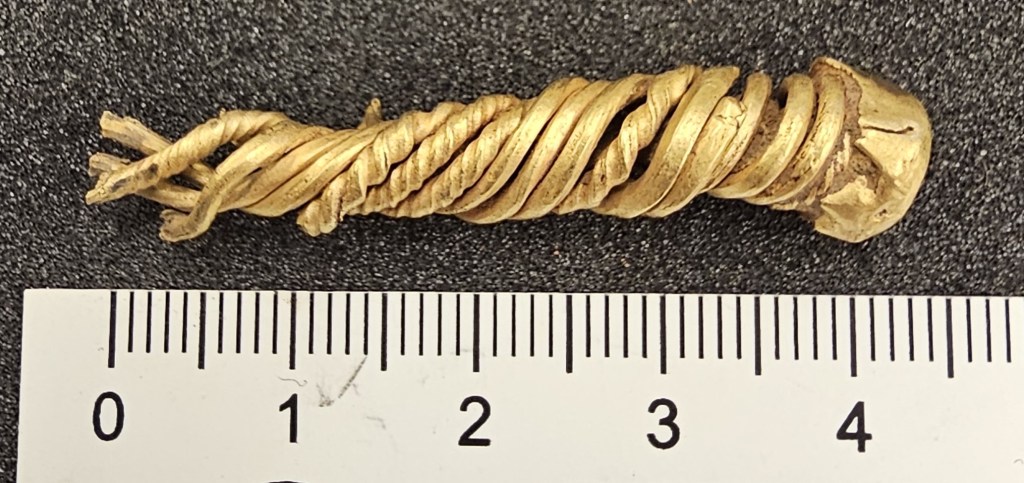
- In the case of the ‘temporary’ cap terminal F, we have a good parallel in a terminal piece from an apparently finished torc from Snettisham 1991,0501.214:
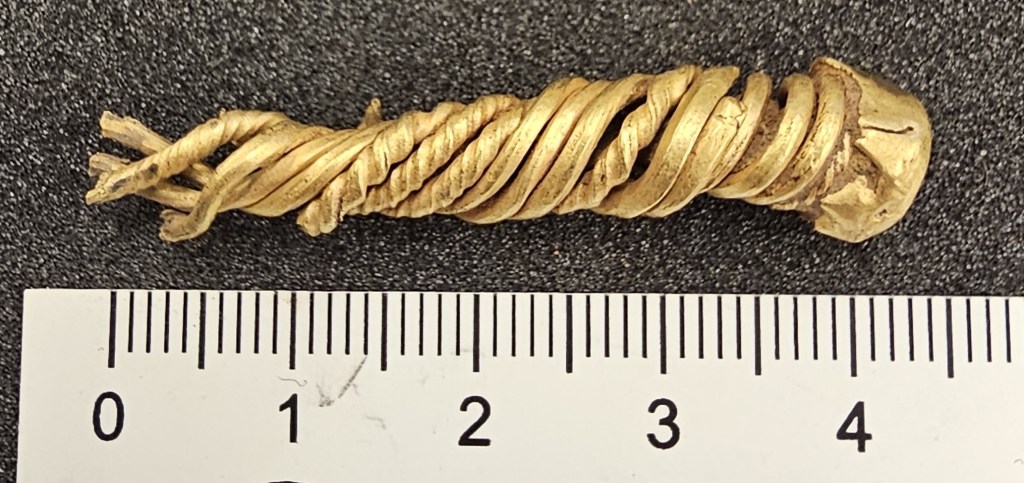
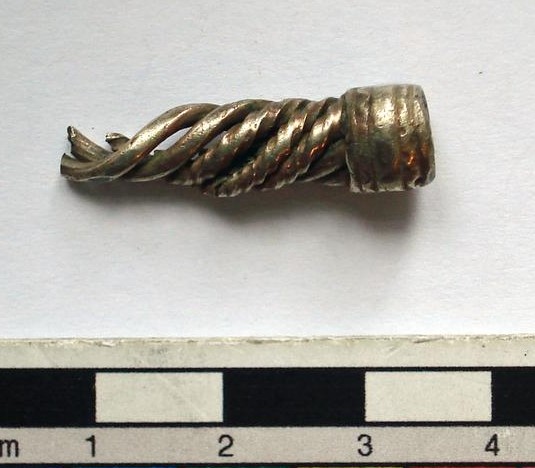
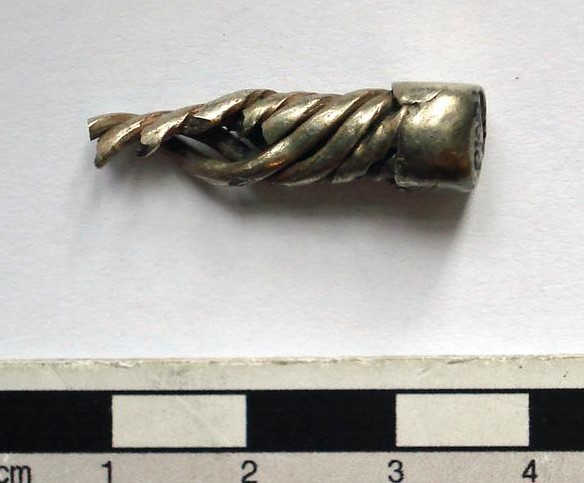
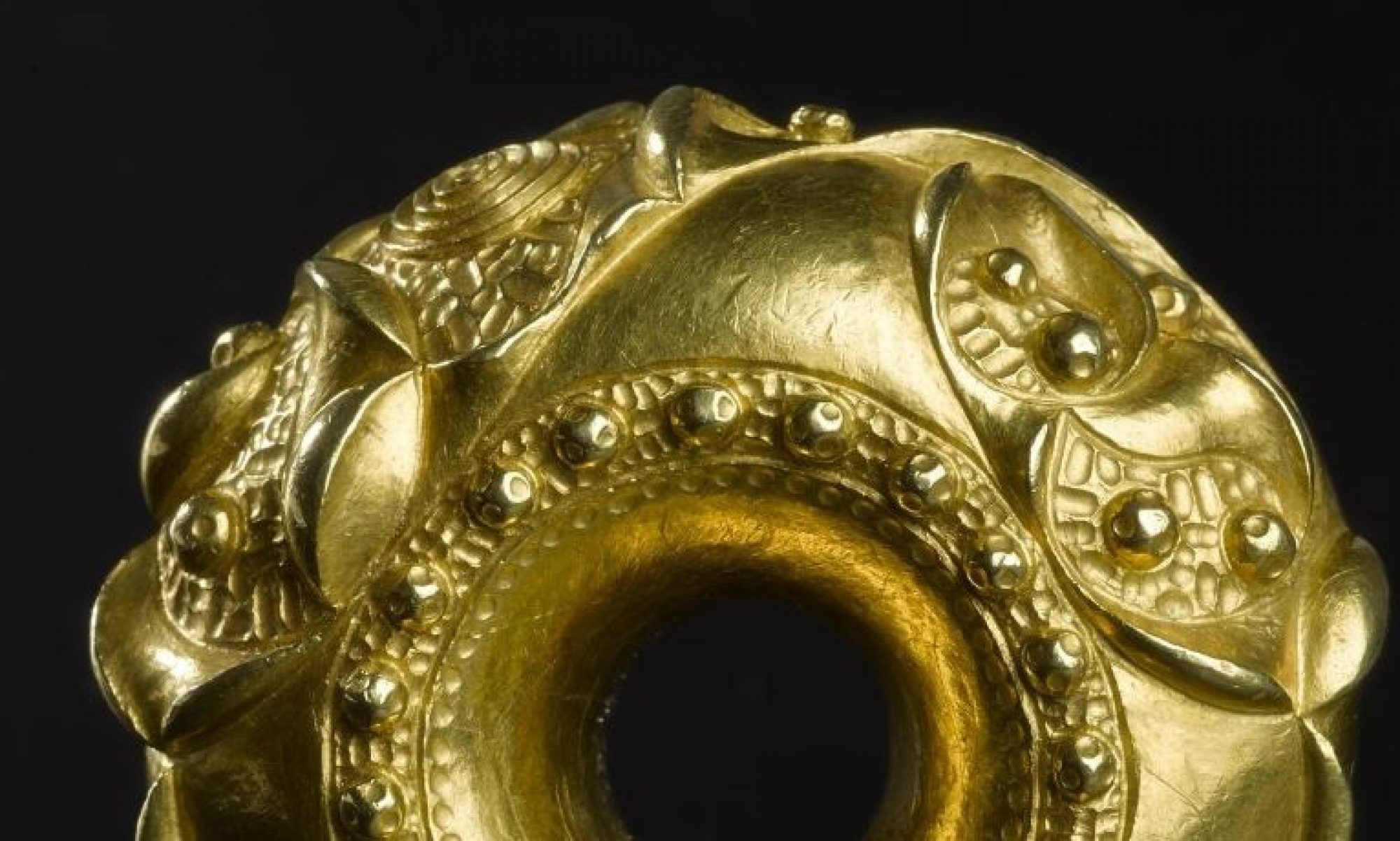
This little capped terminal is of similar size, has the same coiled three plain wires and three twisted square cross-section wires, has the same folded over sheet gold cap and what is more, it is decorated. That the torc terminal is decorated would suggest that it is finished and I see no reason to doubt this, either for the Snettisham or Alrewas capped terminals.
[The similarities between Alrewas F and Snettisham 1991,0501.214 are marked: are we looking at the same maker? I’ve requested to go and see the Snettisham terminal up close, so will let you know more when I have…]
So do we have a date in the Iron Age for their making? In short, no, but my gut says earlier in the period rather than later. My reasoning for this is that the torcs were manufactured using a hammered and sheet gold tradition: there is no casting present on any torc, with the sheet gold cap F hammered to fit. I believe this hammered and sheet work to be early.
In addition, twisted square cross-section wires appear to be a tradition of earlier torc making, perhaps in around the 3rd century BC, as attested to by their use in the early, ‘Plastic Style’ Snettisham Grotesque torc:
Summary
Alrewas comprises three fascinating torcs which raise many more questions than answers. I am away to have think now: have we got a different ‘multi-bend’ torc making technique in this area of Staffordshire or are there others from elsewhere? Is there anything more we can say from where the Alrewas torcs were found? Are there any more parallels for this kind of deposition in a) the Iron Age b) the time of the Viking Great Army? Do we really now need to stop saying that torcs are mainly found on high ground or hill slopes? So many thoughts and questions!
So, until next time, keep torcing and if you fancy a challenge, go to the British Museum online catalogue HERE search ‘Ken Hill’ (the catalogue name for the Snettisham hoards site) and see if you can find me any more multi-bend torcs created by bending a single wire several times!
And don’t forget to click ‘Subscribe’: it’ll be Needwood Forest and Middleton Hall up close next time and you won’t want to miss them 🙂


3 Replies to “The Staffordshire Torc Odyssey: 11 Alrewas up close”