
by Tess Machling
[A download/print PDF version can be found at the end of the paper]. This paper can be cited as DOI 10.5281/zenodo.15181375
A friend (thank you David!) today reminded me of something I’ve been intending to write about for quite a long time, but never quite got round to. As it’s Christmas and everyone is in need of light entertainment, I thought it might be time.
The long and the short of it is that, for three pieces of torc from Snettisham, it looks like an Iron Age person gave them a bit of a chew! Yes, really! But approaching this subject is not easy. It’s a bit of a toothy topic that really needs drilling into, so I’ll stop filling time and get on with it… [stop groaning at the back!].
A strange bit of evidence
Back in April 2021, I was looking for something else (these things always involve ‘looking for something else’…) when I noticed some strange marks on one of the pieces of torc from Hoard F at Snettisham. Torc F63 (British Museum accession number 1991,0501.33) , a piece of dorsal muff from a tubular torc, jumped out at me (Fig. 1). I couldn’t help but think that the torc had been bitten, but that was a crazy idea, wasn’t it?
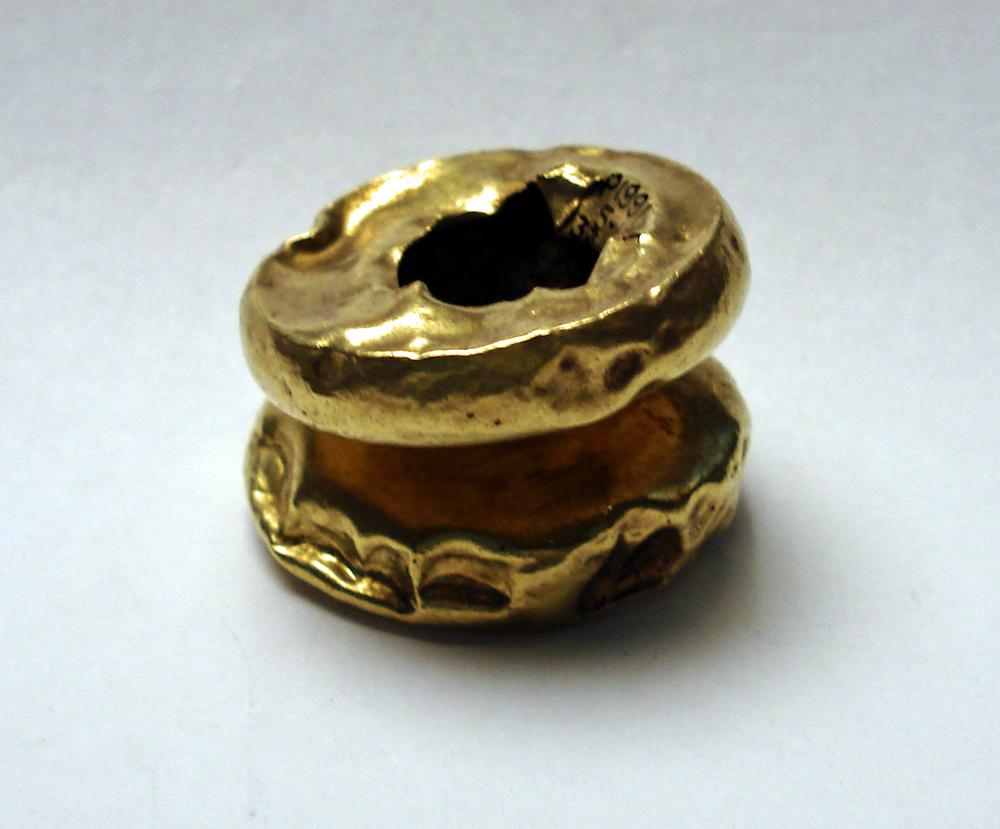

I then looked for other photos of this torc and, on the other side of the edge from the tooth marks, there were yet more marks that could not be easily explained as tooling marks (Fig. 2).
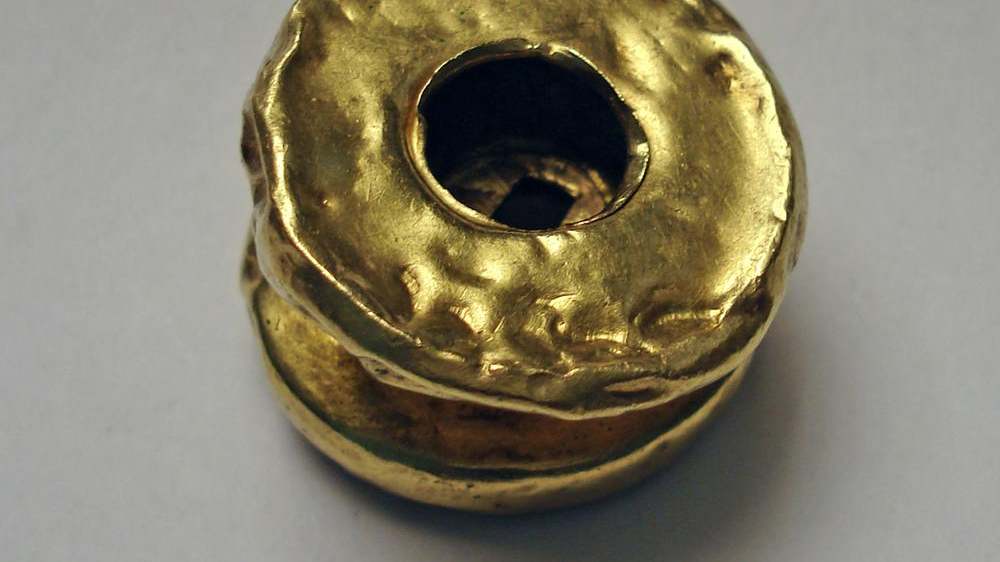

From both sides it really did look like someone had bitten down hard on the edge (Fig. 3) of this torc:

Honestly, I still didn’t believe that this could be so, but it was amusing so I thought I’d check if there were any more torcs from Snettisham that could have been munched and…
… sure enough, there were more, two more (Fig. 4) to be precise: Torcs F52 (British Museum accession number 1991,0501.76) and F53 (British Museum accession number 1991,0501.118) both of which looked like they’d been given a hefty chomp!


Torc F52 in particular made me chuckle. It reminded me of that thing that I – and I suspect a lot of us – do of absent mindedly folding and then biting flat a bit of tin foil, or cake wrapper (try it with a foil mince-pie case folks… it’s very satisfying!).
Torc F53 looked like it had been bitten to seal the end of the tube, which had contained five gold coins (Fig. 5) when originally found […and yes, I did nearly sing ‘five go-old rings’ then…].
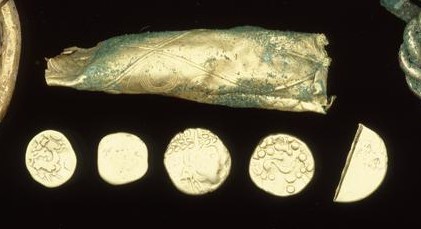
So now I had three possible bitten torcs. But could you actually bite gold? Although the idea of pirates biting pillaged gold coins to establish their authenticity is long standing, gold is a pretty tough metal and I suspect that there would be way more broken pirate teeth than accurately tested gold […or is that where the pirate ‘arrrrrrrrrrrrrrrrrr, me hearties!’ refrain comes from? Perhaps it was more correctly ‘arrrrrrgggghhhhhhh!’ if they were biting gold coins…???].
But I digress…
Experimental archaeology
Any good archaeologist working with artefacts looks to skilled craftspeople for their research or, in the absence of a skilled craftsperson, has a go themselves, with varying levels of success. Biting torcs was once such experiment that could not be missed. Firstly we need to answer whether such marks looked right for bite marks. For this, my lovely Torc Apprentice daughter – her of the straight teeth – had a go (Fig. 6).
In cheese.
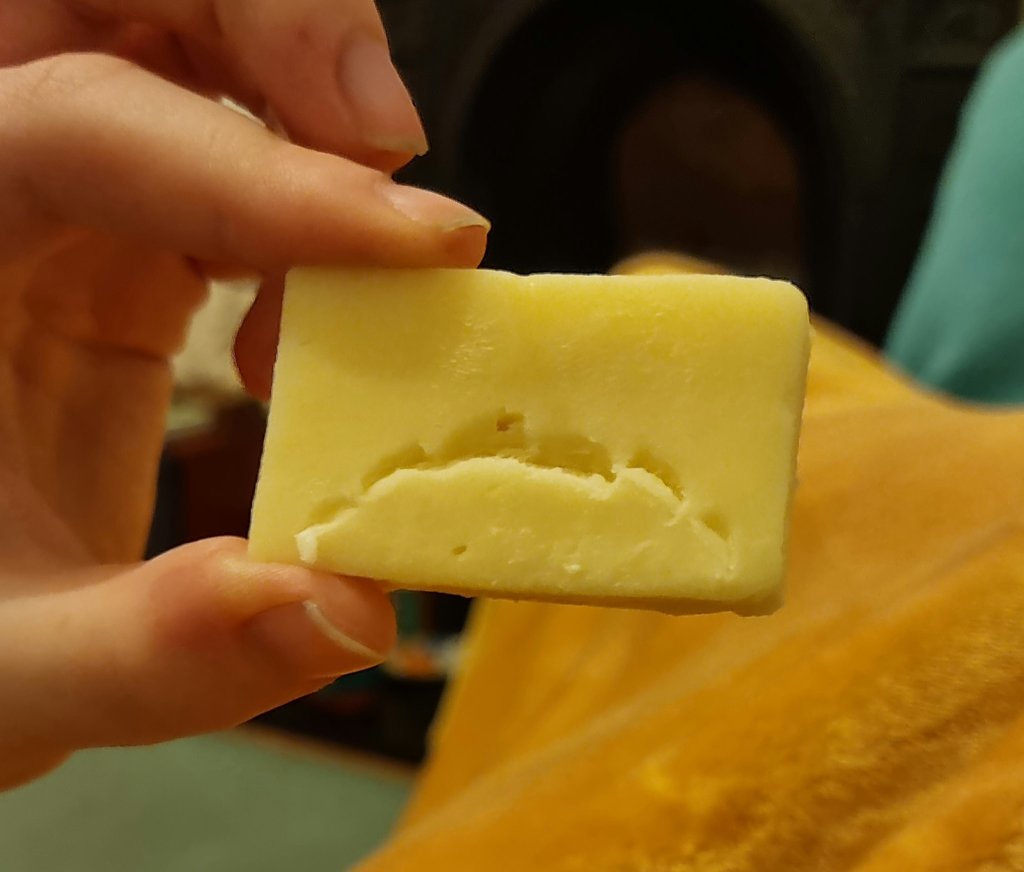
And yes, the marks looked remarkably like those seen in Torc F63 (Fig. 3). Having a bit of gold sheet to hand (as you do) we decided to further experiment and found that (Fig. 7) we could make a reasonable facsimile of Torcs F63 and F52 in bitten 0.1mm thick fine gold sheet.
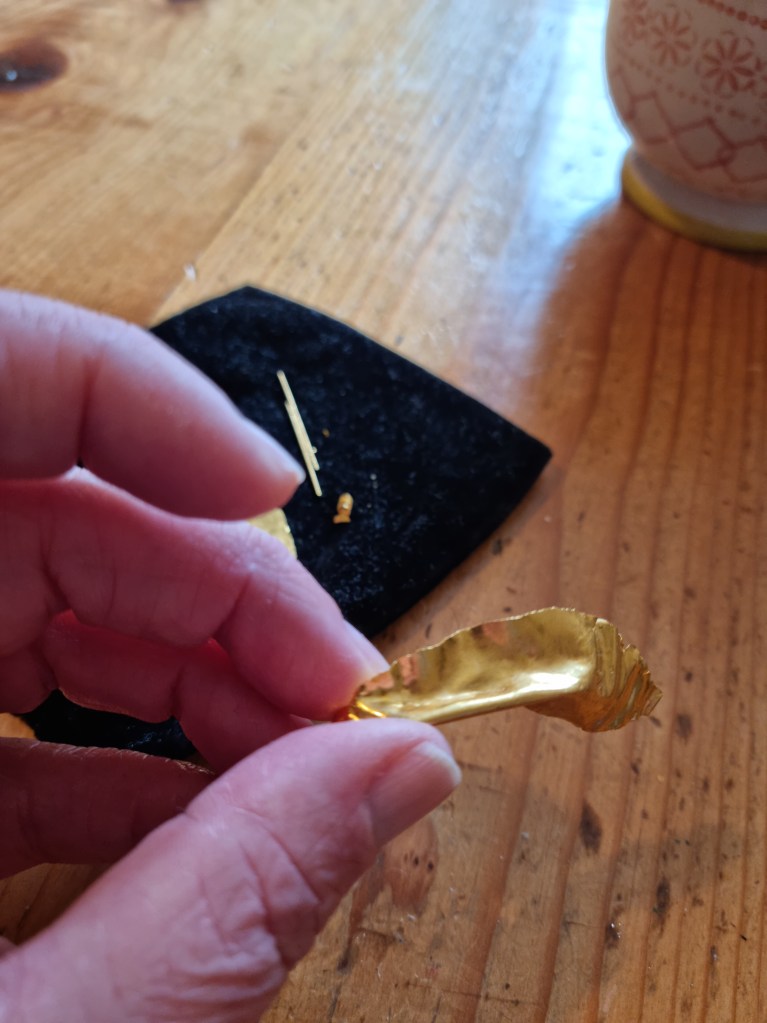

And there we left it.
In September 2022, I happened to be in the British Museum looking at some other gold (oh, its a hard life) and was able to get Torc F63 off display and have a look at it under a microscope (Fig. 8).


There was nothing in what I saw that disproved the biting theory: these just did not look like ‘tool’ marks. ‘Tooth’ marks however? Maybe??
So what does this all mean? To be honest I have no idea! Were they carrying out some bizarre biting ritual on torcs? Were they checking if something was really gold? Or were they – if these really are bite marks – just doing that very human thing of doing something just because they could? Perhaps the absent minded action of an Iron Age person 2000 or so years ago?
More work will be needed to tell if these pieces really were bitten, but they are certainly different to anything I’ve seen before on torcs, and only appear on these few from Snettisham. I would love it if they really were bitten. What do you think?
As ever, it’s good to torc!
 The Big Book of Torcs