by Tess Machling
I had the very great pleasure of being able to visit this intriguing torc recently and, as you’ll see from below, it has a rather fabulous story to tell us, both in the past… and in the present.
I must first say thanks to curator Sarah Williams at Tamworth Castle museum, who let me know that the Glascote torc was on loan to them from Birmingham Museum and Art Gallery, and who arranged permissions and access for me. During our visit, it was also wonderful to meet Leigh Waite, who is a guide in the castle, and Lee Bates – whose grandfather actually found the torc!
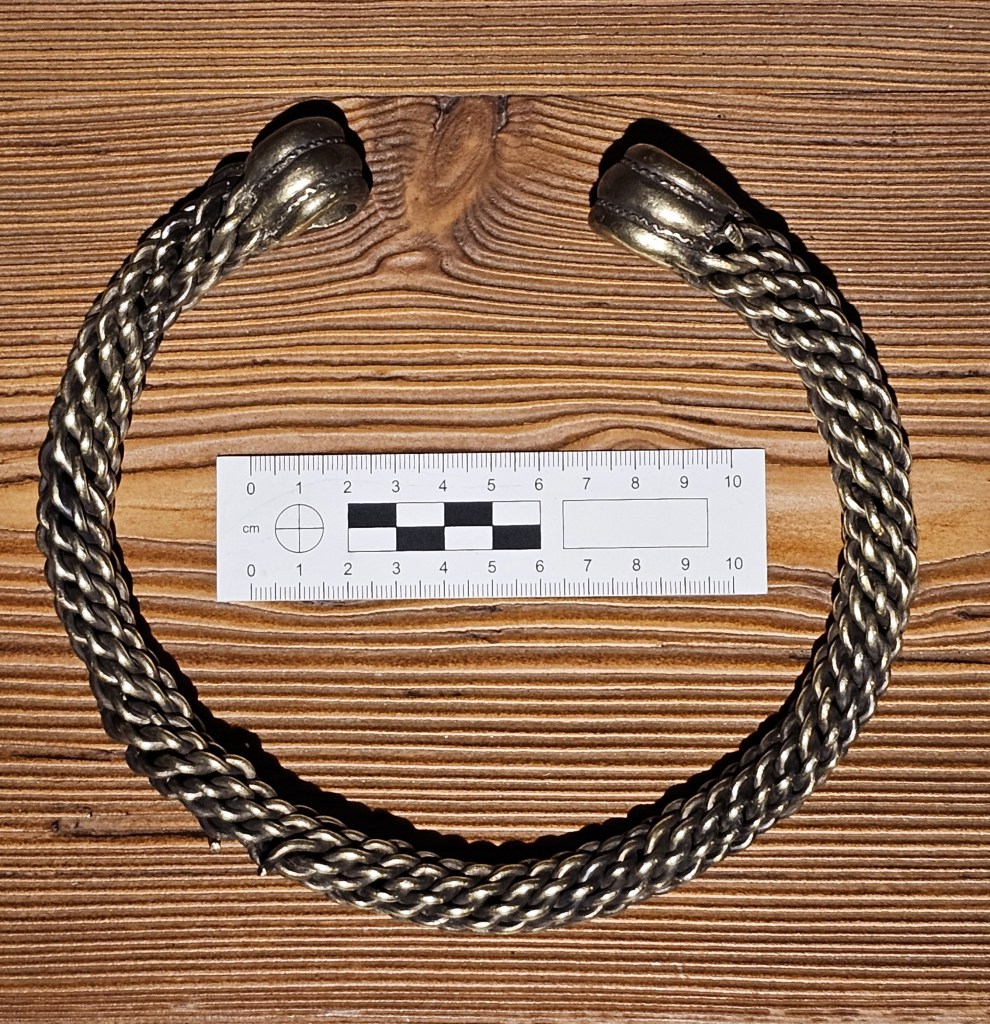
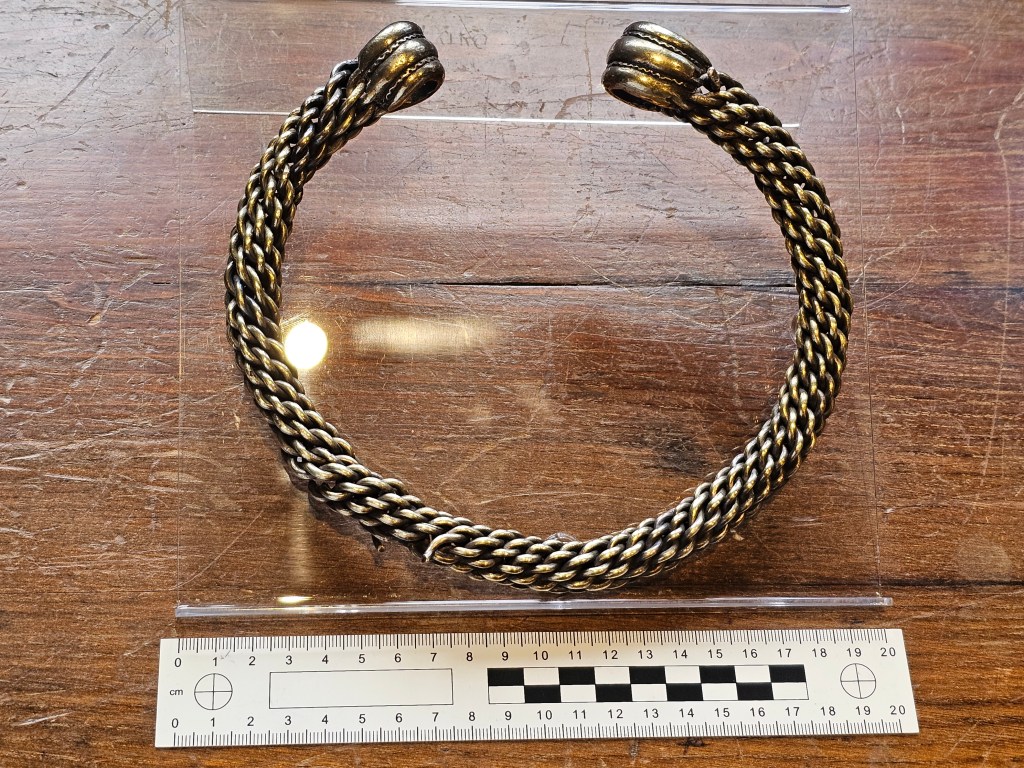
As previously discussed in an earlier blog in this series, the Glascote torc (Fig. 1) was found in around 1943, but was only recognised as being a torc in 1969 (thanks to Lee’s nan!), when it subsequently went through Treasure Trove and was bought by Birmingham Museum and Art Gallery, where it has been ever since. However, it is currently on loan to Tamworth Castle Museum until 2028, although this may be extended. Tamworth Castle is a lovely museum, set in beautiful grounds and I would highly recommend a visit to go see the torc and take in the lovely locale!
The torc
The Glascote torc is a gold alloy torc with c.29% gold, c.41% silver, and c.27% copper and weighs 463g. The torc has an external diameter of 179mm x 165mm and an internal diameter of 149mm x 131mm. The neck ring is approximately 15mm thick and made from twelve hammered wires that have been twisted into six pairs. Each single wire is c.2.4mm to 2.7mm thick.
These paired twisted wires have then been twisted around a former to create a hollow neck ring, similar to the neck ring of Snettisham torc H7 , although that torc neck ring is a more complex twist of multiple strands. The paired wire strands have been attached to the terminals with three strands on either side of each terminal (Fig. 2).
The terminals
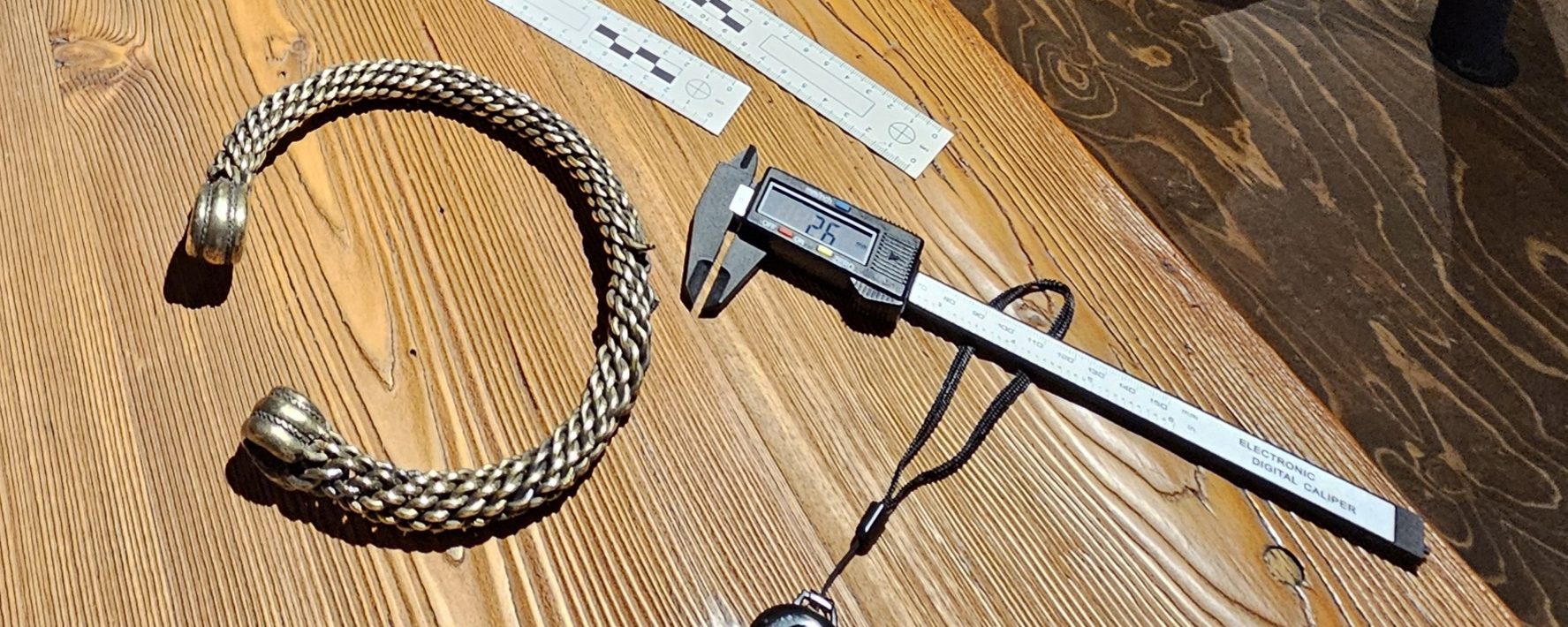
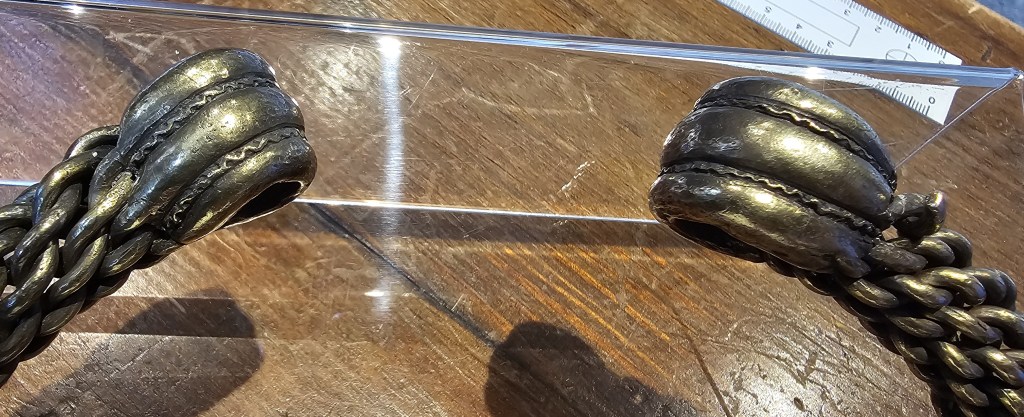
The two terminals are of different sizes (Fig. 3): Terminal 1 is slightly larger at c.28.3mm x 21mm, with an internal measurement of c.16.2mm x 11.4mm. Terminal 2, the smaller terminal, is c. 21.2mm x 19.2mm, with an internal diameter of c.16.5mm x 10.9mm.
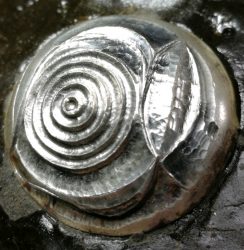
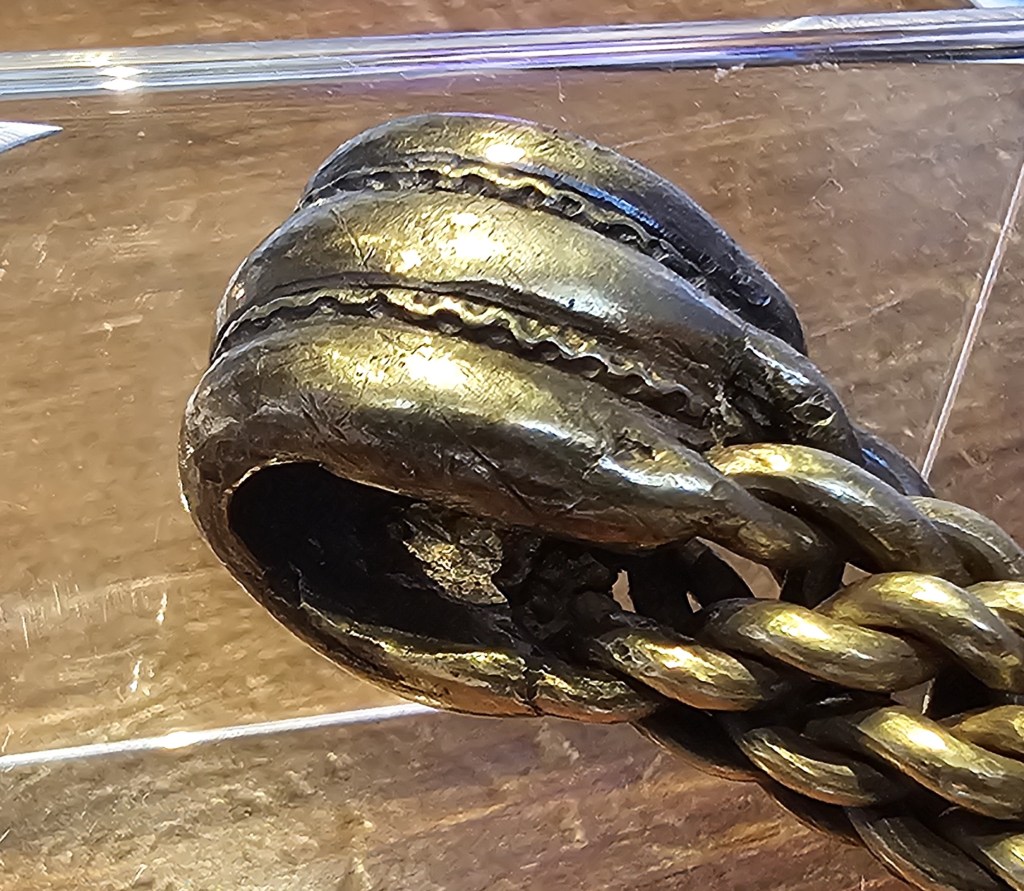
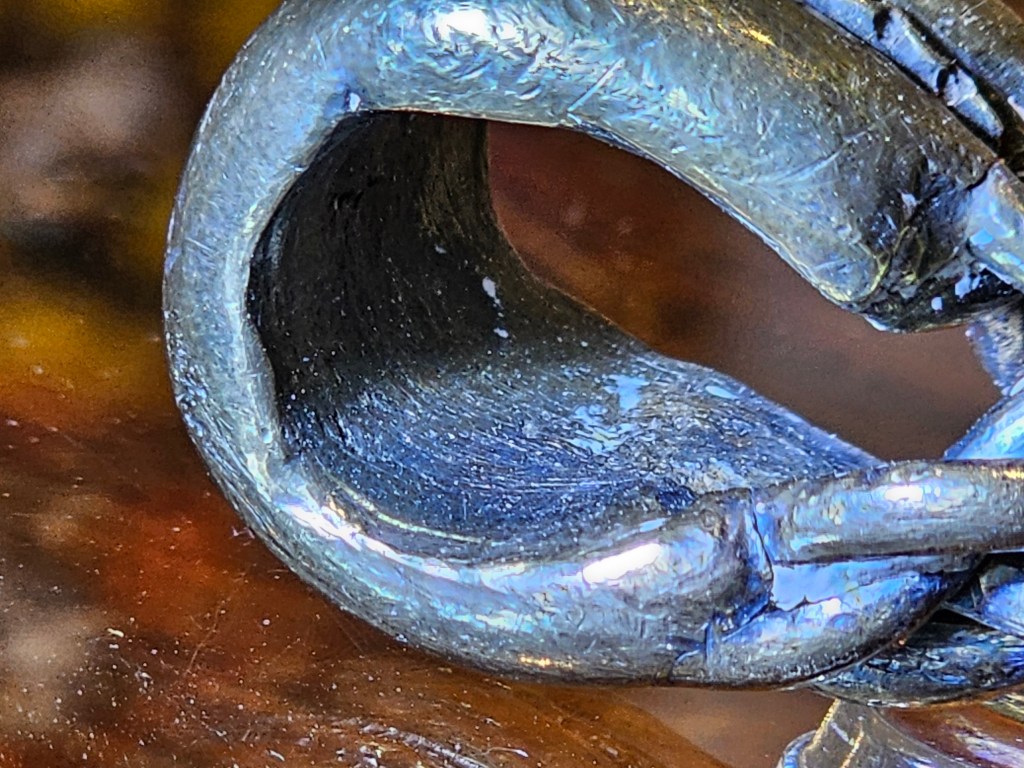
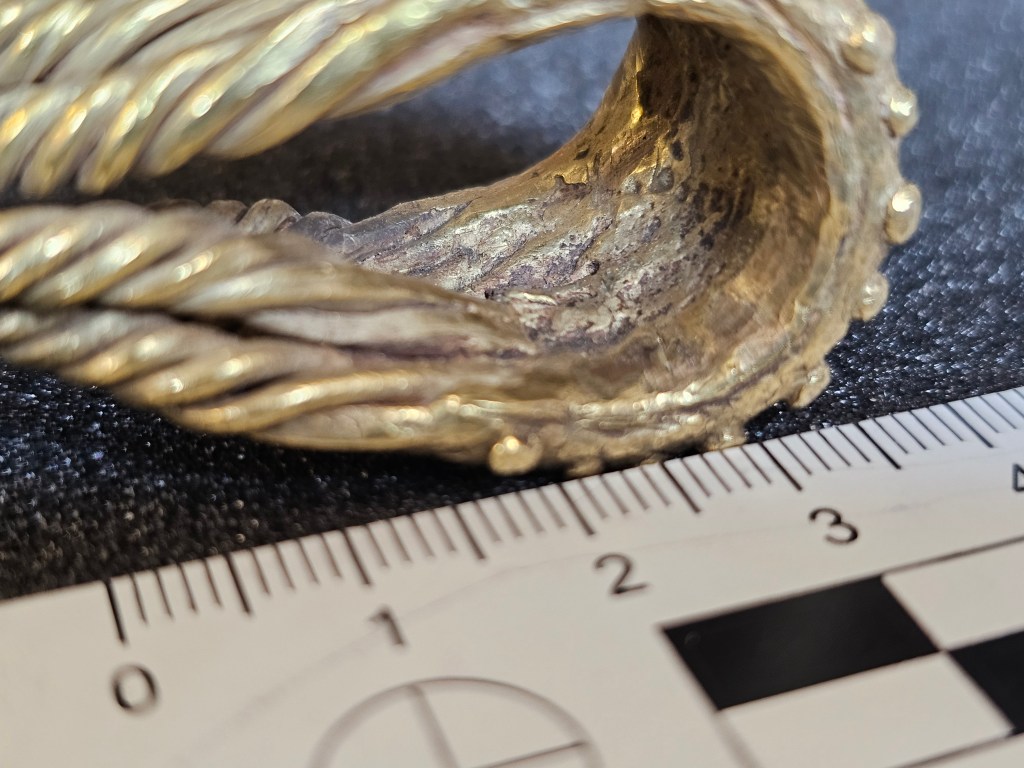
The terminals are u-shaped and are cast in one piece onto the ends of the wires, with the three raised areas (with decoration between) following the line of the three attached wire strands on each side. The evidence that the terminals are cast-on – rather than being created from the wires – can be seen in Terminal 1, which has a small section of wire, that has broken free from of the cast (Fig. 4). Had the terminals been made from the wires, this would not be possible.
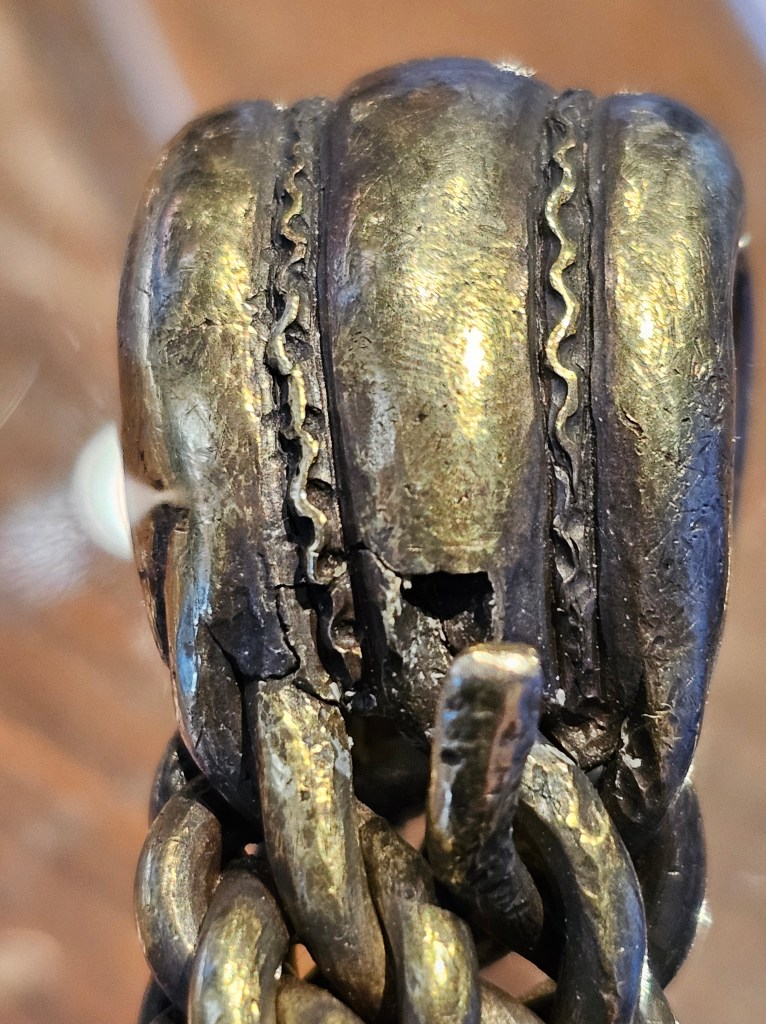
In Painter’s write up of the torc from 1969, this damage is suggested as having occurred when the torc was originally made but, despite this clearly being an ancient break, there is nothing to suggest that this did not occur later in the torc’s lifetime (the thick wires of the neck ring are under huge tension and it is not impossible the wire gave way during the lifetime of the torc).
Although looking similar to the terminals of the Needwood Forest torc (Fig. 5), the casting of the Glascote terminals is far more precisely executed which might further support a different terminal manufacturing method for Needwood Forest, with melted wires being used to create the torc terminals, rather than added metal which was cast on as in Glascote.
Of interest, the internal diameters of the Needwood and Glascote terminals are similar, and the thickness of each terminal ‘wall’ is comparable. The weight of each torc, at 463g for Glascote and 427g for Needwood Forest might also suggest a relationship. Taken with the different thickness of wires and decoration, are we looking at a similar form of torc, but by two different makers?
Decoration
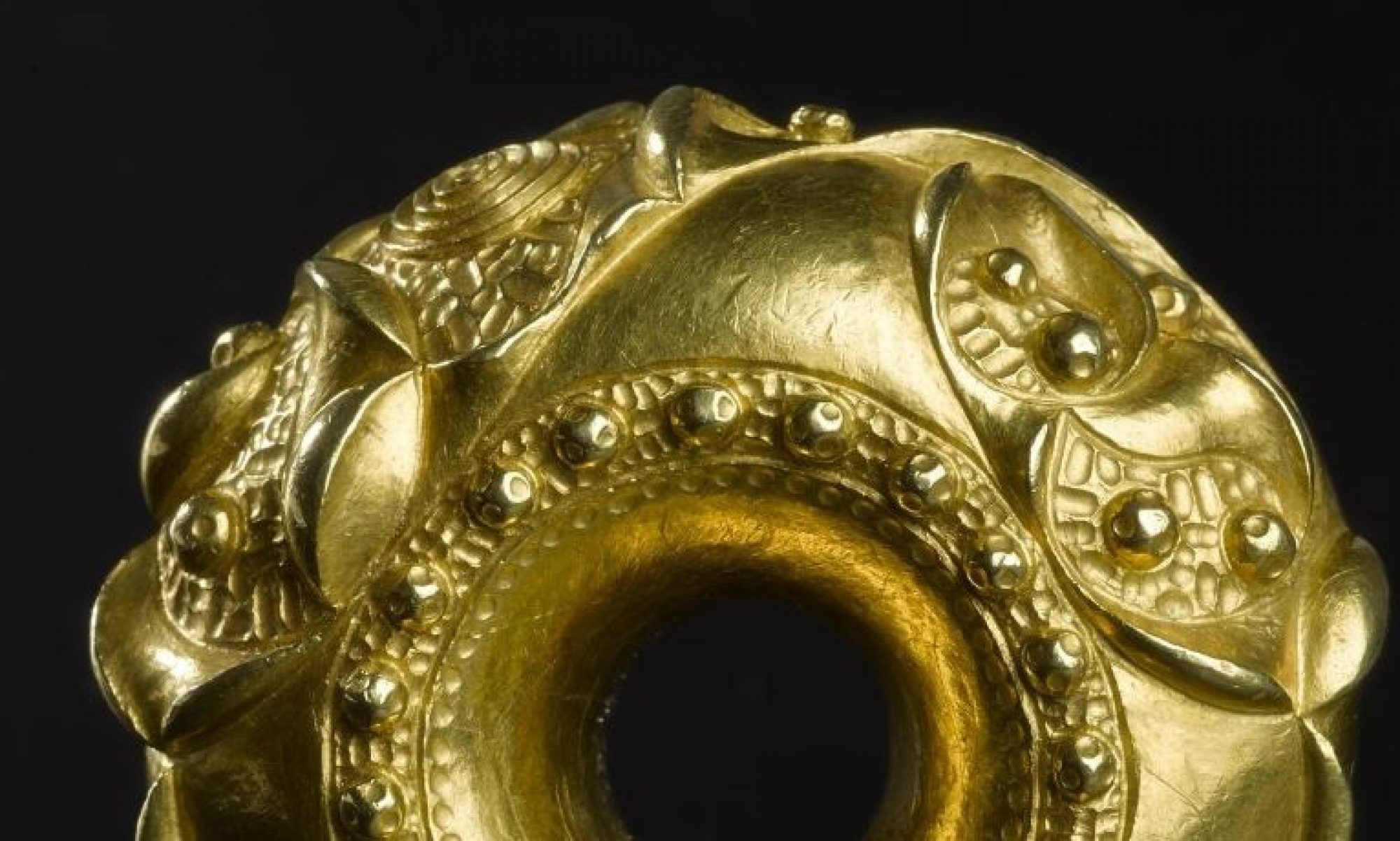
Both terminals are decorated with two bands created from two parallel lines, with a rick-rack line running between each set of parallel engraved lines (Fig. 6). The rick-rack line has been created by alternately punching opposite sides of a raised straight line.
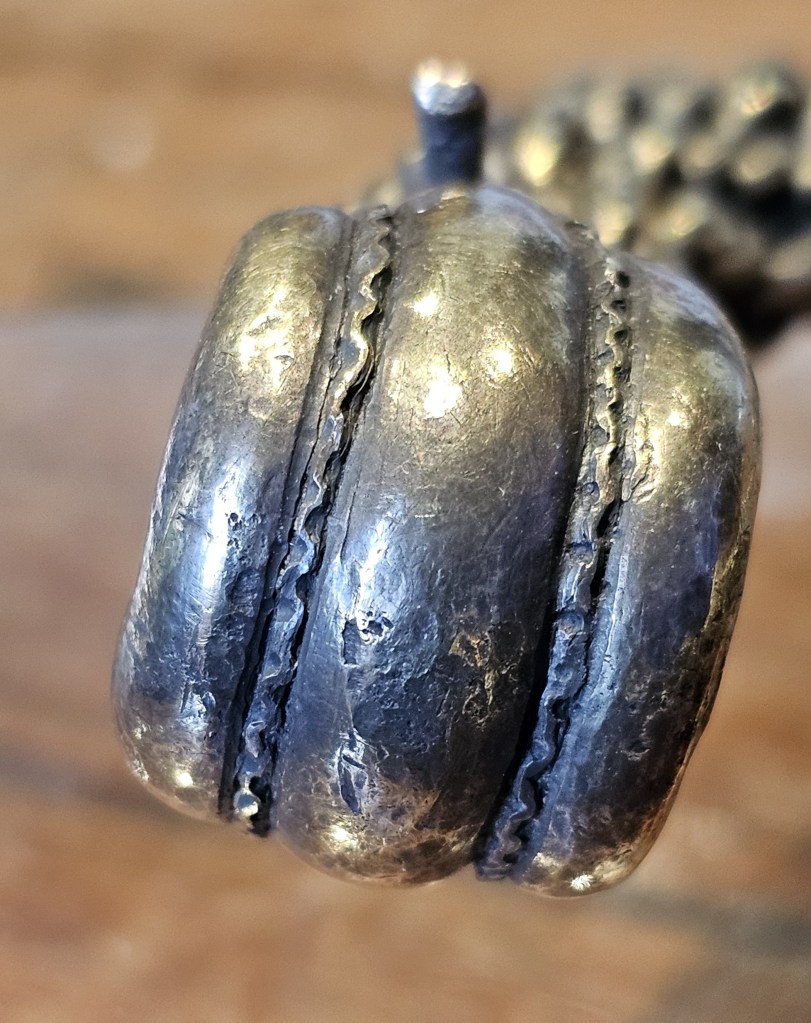
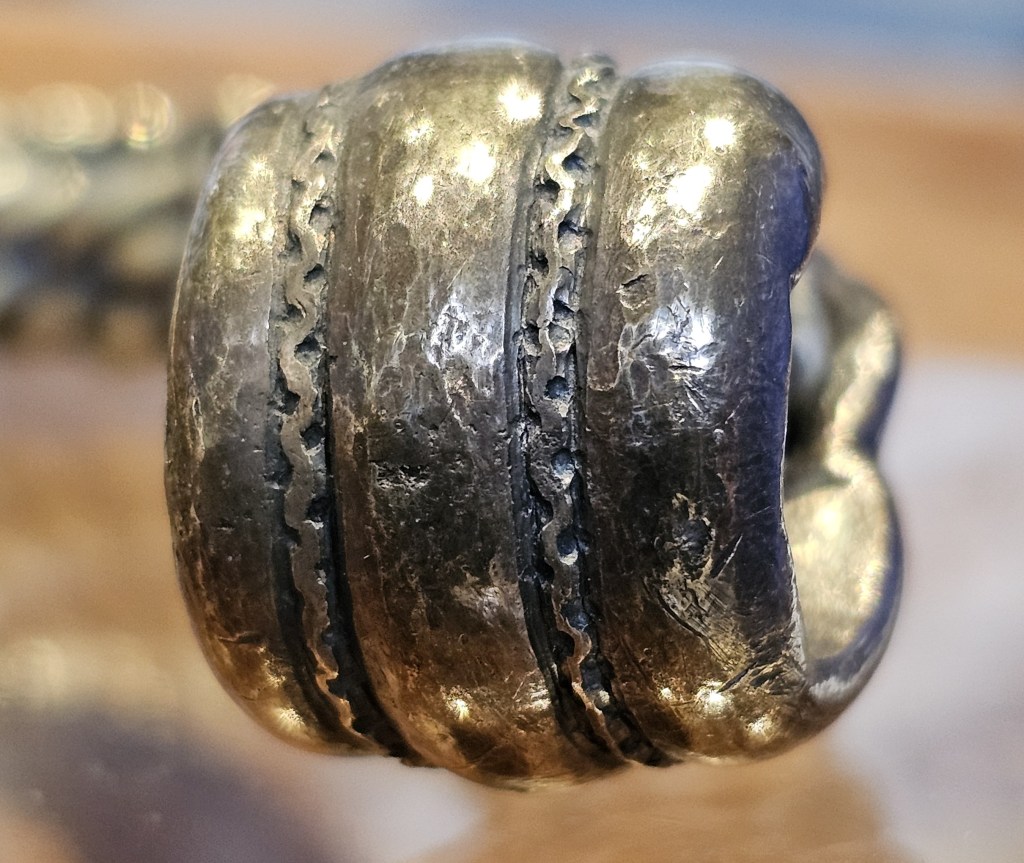
The rick-rack, can be seen on many other torcs such as the Snettisham Great torc, the South-West Norfolk torc, and more locally, the Needwood Forest torc. Interestingly, the rick-rack on Terminal 2 (Fig. 6) appears worn and flattened, although the means by which this has been achieved is uncertain, as the rick-rack lies lower than the metal surrounding it, which is not worn. Could this be some kind of intentional flattening/polishing? or a casting remnant? There is no obvious easy answer.
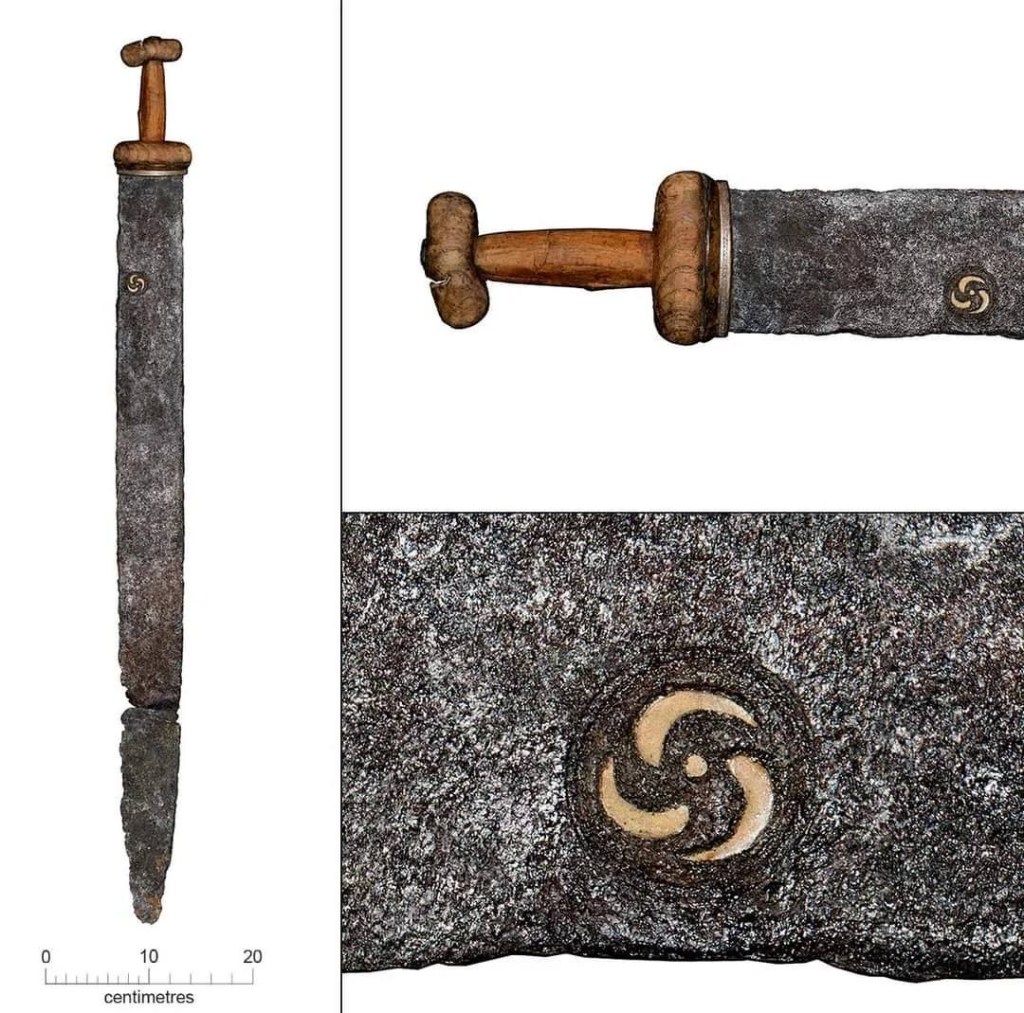
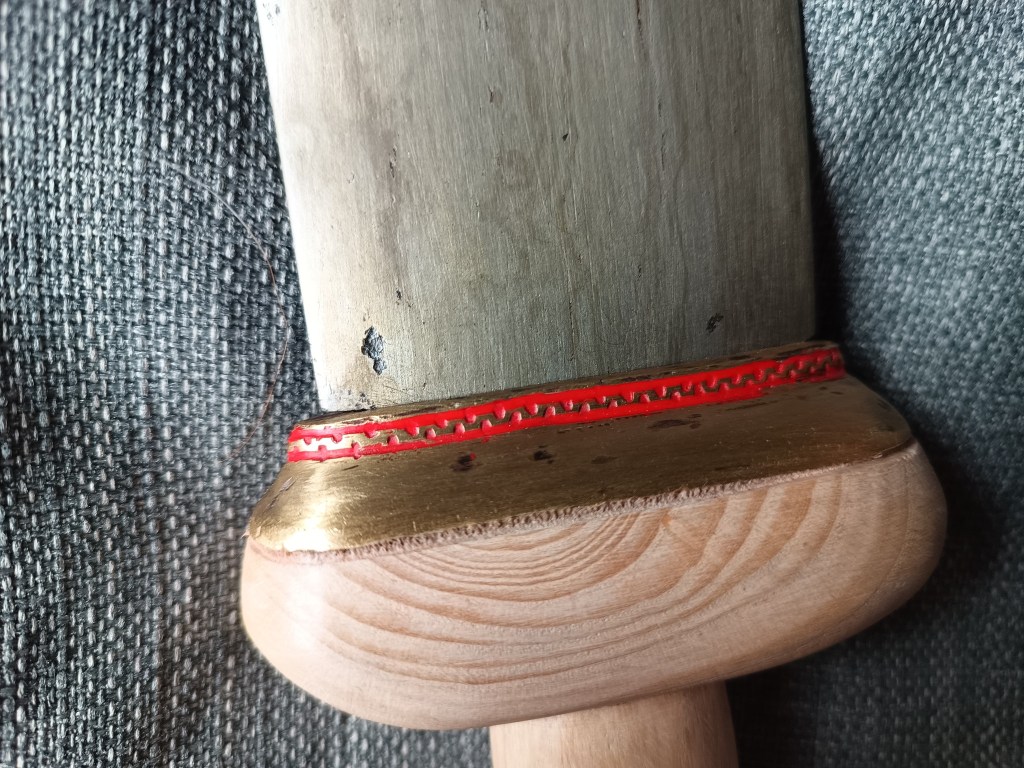
I also looked for evidence of enamel around the rick-rack, as this has been seen on an Iron Age sword (Fig. 7, left) recovered from a palaeochannel at Must Farm, Peterborough – and recently replicated by Rowan Taylor (Fig.7, right) – but, sadly, there was none apparent.
A discovery postscript
Although the torc was clearly well looked after by the Bates family (…and despite Lee’s dad, and his dad’s brothers, playing carefully with it from time to time!) there is a significant area of damage on the back of the torc neck ring (Fig. 8). The neck ring has been distorted, and there are a number of broken and scuffed wires.
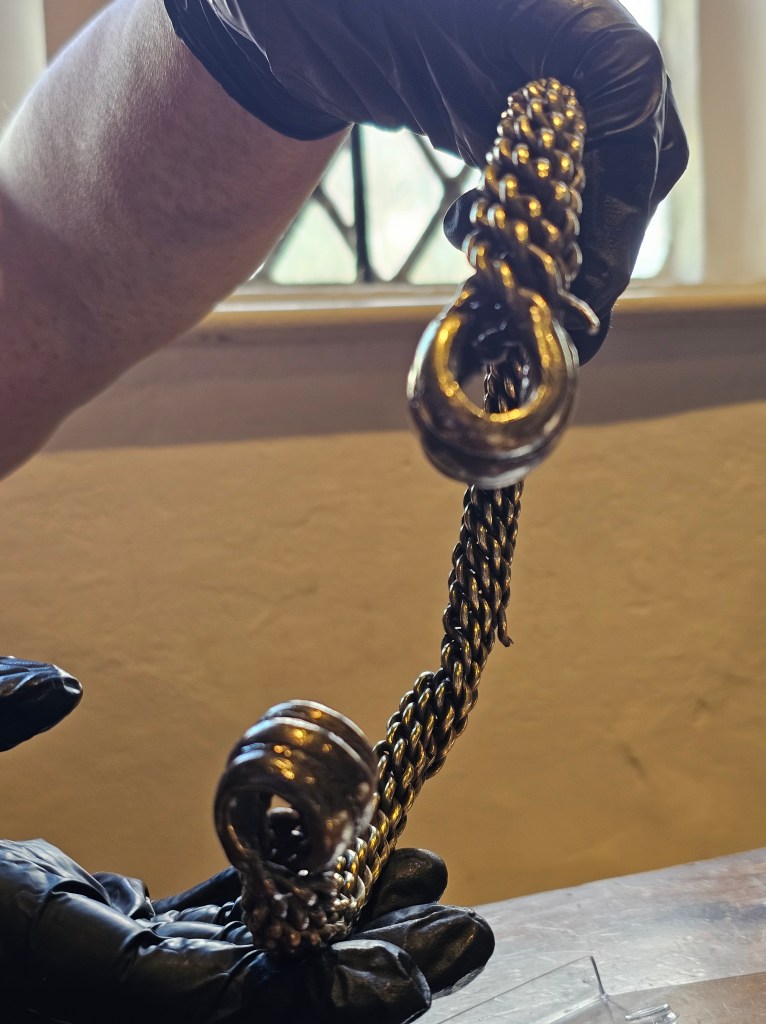
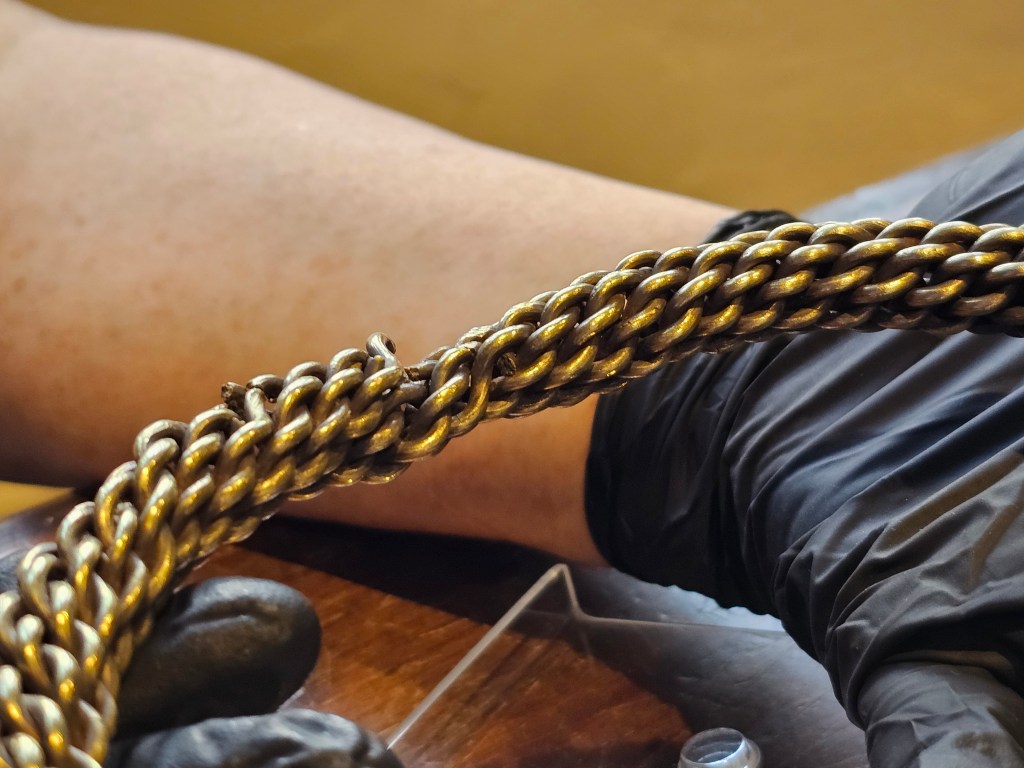
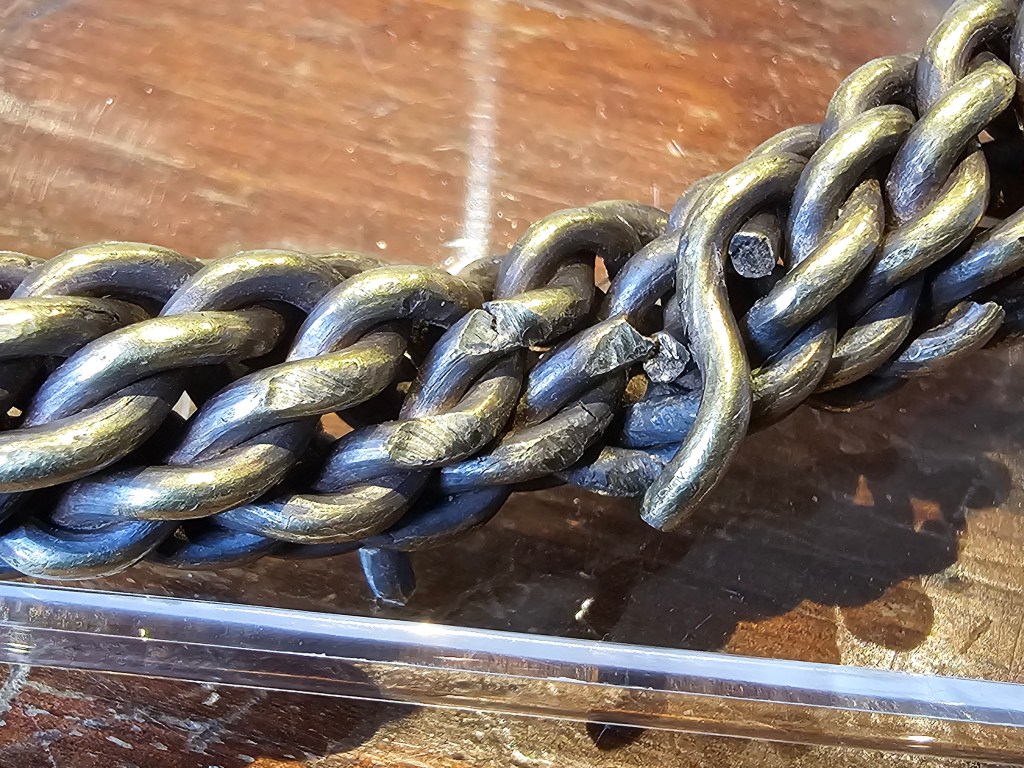
Close examination of this damage shows that it was likely to have been inflicted when the torc was dug up with several wires showing granular breaks where an impact has snapped the wires. The scuffs show where some kind of sharp tool has grazed down the neck ring (See Fig. 8, right), before likely impacting and forcing the breaks in the wires. This damage corresponds well with the account of the torc having been discovered during the hand digging of a drainage trench.
However, the location of the damage might offer clues to the way the torc was buried. Had the torc been hit by a spade digging downwards, the damage would appear to have occurred if the torc was buried upright in the ground in the position seen on the left photo of Fig. 8: the spade glancing down the neck ring, before becoming stuck and breaking the wires below the scuffing.
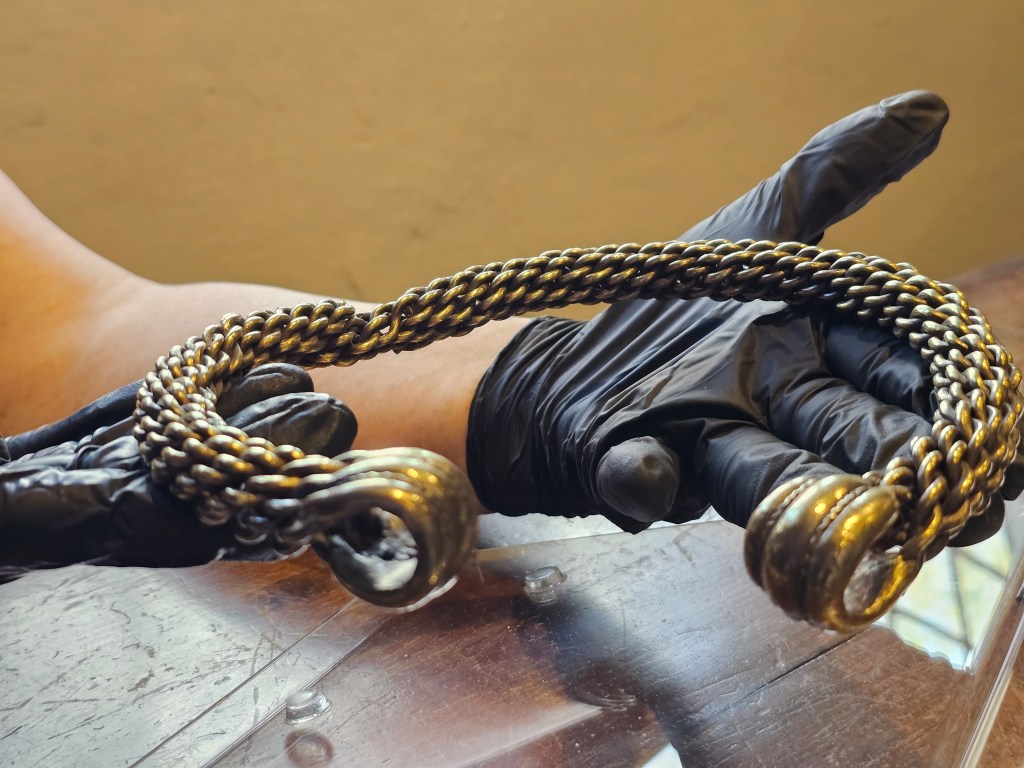
But if they were using a mattock to excavate the ditch, this could suggest the torc was lying flat, as in Fig. 9, with the mattock skimming the torc horizontally.
Establishing whether the torc was buried upright, or lying flat, in the ground may help to tell us more about who put the torc there: in typical Iron Age deposits, like Leekfrith or Snettisham, torcs were laid flat, and so a vertical deposit might – although this is by no means sure – be indicative of a deposit during another period of history (for more on that, see here). Lee is going to try to find out, but unless Lee’s uncles have a precise tool anecdote, we may never know!
A stray wire
Of further interest at the back of the torc neck ring, is a prominent broken wire (Fig. 10).
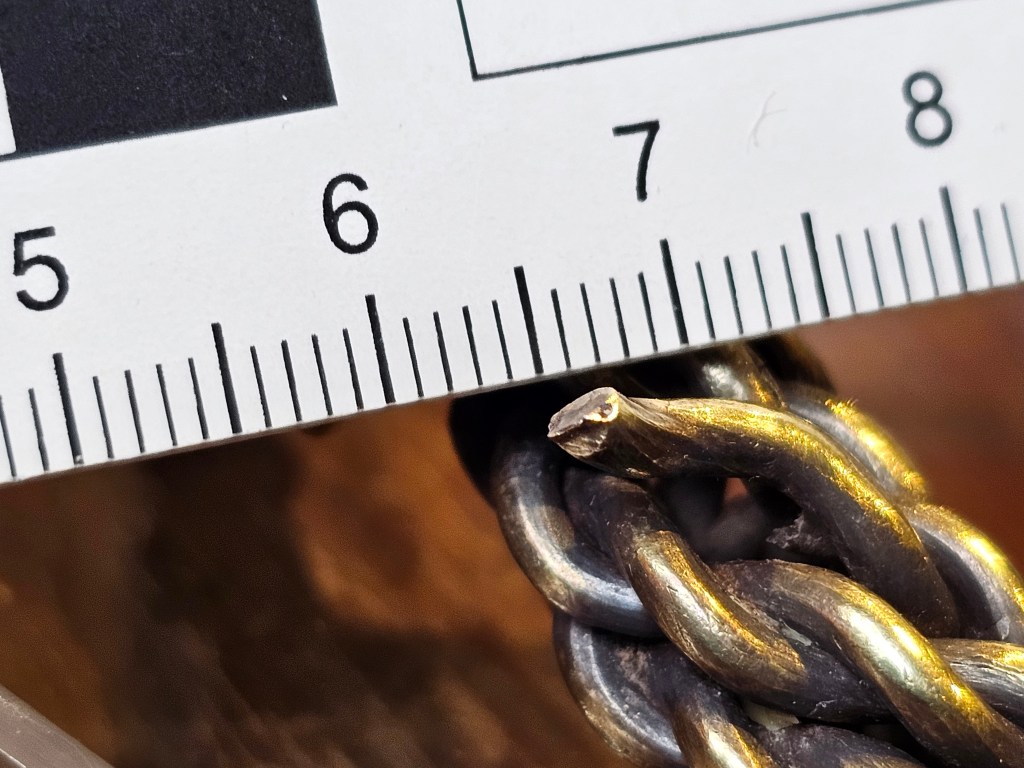
This wire is unusual as, although it is close to the other broken wires, it sits on the opposite side of the break (Fig. 10, left) and, unlike the granular character of the other broken wires has a very precise, cut, nature (see Fig. 10, right) unlikely to have been produced by being hit during excavation.
This might suggest that the torc wire was deliberately cut, and if so, that the cut (due to its snipped form) was not carried out in recent times. However, a reason for this cut is difficult to postulate. It is possible that this wire end was once tucked into the neck ring, only becoming loose when the torc was dug up in 1943, although this is difficult to imagine.
It also crossed my mind to ask if this might be a viking cut? But there’s more thought and research needed before anything else can be said…
Summary
The Glascote torc shares many features with other Iron Age torcs but, as with other torcs, is unique in its style and form. Echoing some elements of the nearby Needwood Forest torc, it is nonetheless different to it, and entirely different to the other torcs from Leekfrith, and from Middleton Hall, Alrewas and Shenstone, which have been the subject of this study.
There will be more to come on this as I pull together the work from the Staffordshire Torc Odyssey, but currently, the assumed model of a distinct group of makers in the Staffordshire area, as discussed in an earlier blog, really cannot be supported by what I’ve seen in the torcs from this vicinity.
One interesting finding from this work, which goes beyond the West Midlands, is the finding of several torcs (for example, Needwood Forest, Glascote, the Snettisham Great torc and Snettisham torc H7) which have non-identical terminals on the same torc. In Glascote, one terminal is larger than the other, in Needwood Forest and Snettisham torc H7, there are different numbers of dummy rivets on each terminal and on the Snettisham Great torc, the decoration on each terminal is entirely different. Is this a quirk of making, or is this intentional? In some torcs, like the Snettisham Great torc, this seems to be evidence of torcs being reworked and remodelled at a later date, although this does not seem to be the case in the majority of torcs with non-matching terminals, like the Glascote, Needwood Forest and Snettisham H7 torcs.
Onwards
Now that the torc examinations are complete, I’m going to go away and have a ponder and think about everything I’ve learned from the Staffordshire Torc Odyssey torcs, and how they fit the pattern of wider torc finds across these islands, before trying to tie it all together.
Until then, as ever… it’s good to torc! 🙂
For ten years I’ve offered the results of all my research for free and open access. I’m an independent researcher and have no funding, so all museum trips, research visits, writing up, conferences etc are funded by my scraping together savings and lecture fees etc.
Thanks to a few recent changes in circumstance, this is getting more and more difficult for me to fully support and, even though I’ll still be doing everything open access and always will, if you do have a bit of spare cash (…and really only if!!) buying me the occasional ‘coffee’ to support my gold research would be really fabulous. You can buy me a ‘coffee’ here!
References:
Painter, K. S. 1971. An Iron Age gold-alloy torc from Glascote, Tamworth, Staffs. Transactions of the South Staffordshire Archaeological and Historical Society 11, 1969-70, 1-6.

