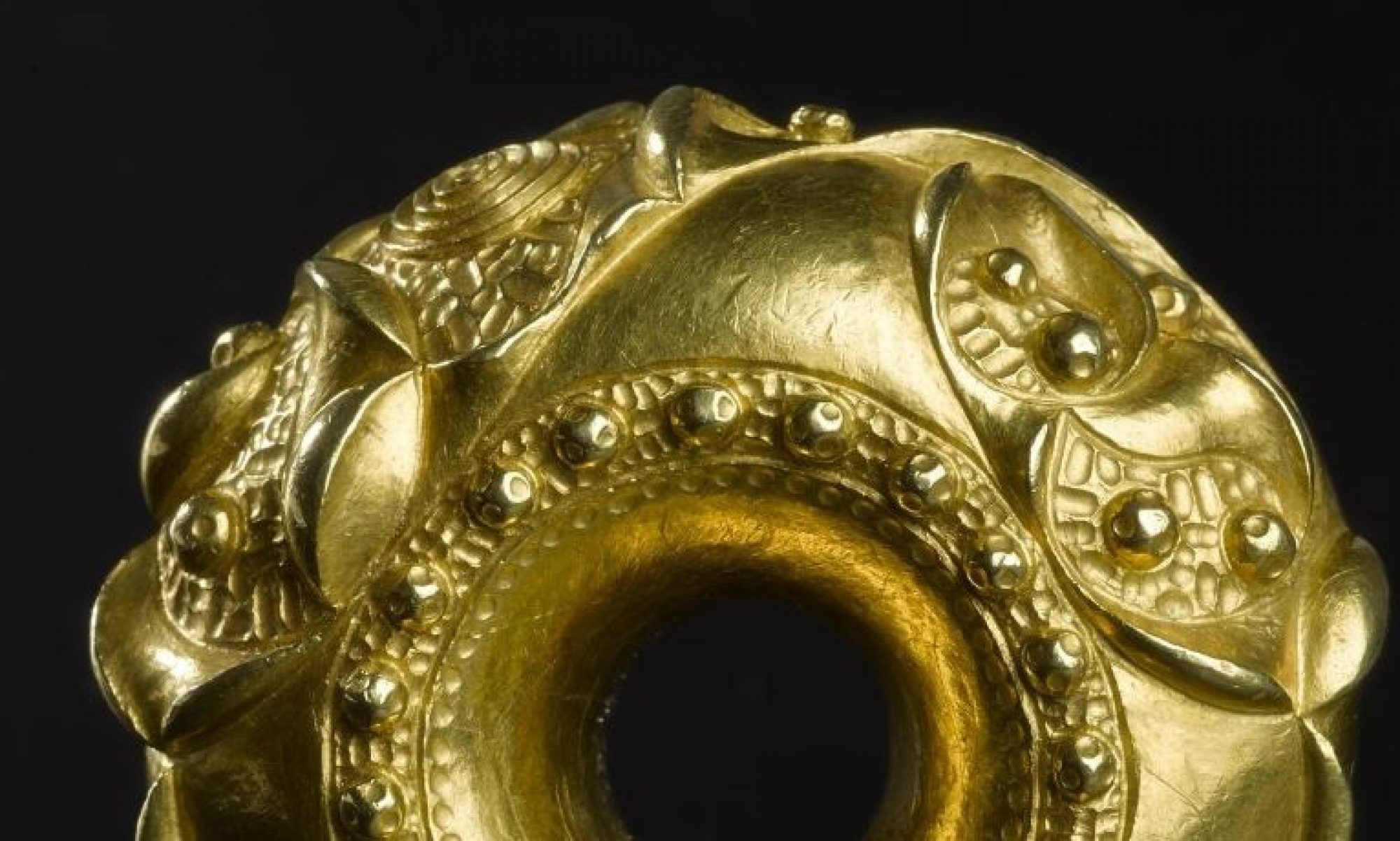
This is a (by no means definitive) reading list, compiled up to February 2026, of all things Iron Age UK/Ireland torcs and a few related extras….
—————
Adams, S., Craddock, P., Hook, D., La Niece, S., Meeks, N., O’Flynn, D. and Perucchetti, L. 2024 The Pulborough Gold Torc: a 4th to 3rd century BCE artefact of European significance, Internet Archaeology 67.
Allan, J. 1948. The Snettisham find. The Numismatic Chronicle and Journal of the Royal Numismatic Society, SixthSeries, Vol. 8, No. 3/4, 233-235
Armbruster, B. 2015. Approaches to metalwork: The role of technology in tradition, innovation, and cultural change. In T. Moore & X-L. Armada (eds), Atlantic Europe in the First Millennium BC: Crossing the Divide, 417-438. Oxford, Oxford University Press.
Armbruster, B. 2021. Les ors de l’Europe Atlantique à l’âge du Bronze: Technologie et ateliers. APC.
Armbruster, B. and Warmenbol, E. 2024. “Des torques à New York. Les torques de Frasnes-lez-Buissenal (prov. de Hainaut, Belgique) pris en main,” Lunula. Archaeologia protohistorica XXXII.
Armbruster, B & Guerra, M. F. 2012. Annular gold ornaments from western Gaul: Archaeometallurgical aspects of the Lasgraȉsses ensemble, Tarn, France (3rd century BC). Historical Metallurgy 46 (2), 55–65
Armbruster, B., Nordez, M., Blet-Lemarquand, M., Milcent, S-Y., Nieto-Pelletier, S., Schönfelder, M. and Schwab, R. 2021. Celtic gold torcs – An interdisciplinary and diachronic perspective. Monographies Instrumentum 73, 433-456
Atherton, R. 2016. The Newark Iron Age torc. Transactions of the Thoroton Society of Nottinghamshire. 120, 43-53
Avery, M. 1997. The Patterns of the Broighter Torc. Journal of Irish Archaeology, Vol. 8, 73-89
BBC. 2022. Celtic ruler’s ring goes under hammer for £36,000 at auction. https://www.bbc.co.uk/news/uk-england-york-north-yorkshire-63660018
Bayley, J, 1992. Goldworking in Britain from Iron Age to Medieval times. Interdisciplinary Science Review 17 (4), 314-321
Blackwell, A; Goldberg, M & Hunter, F. 2017. Scotland’s early silver: Transforming Roman pay-off to Pictish treasures. National Museums of Scotland, Edinburgh.
Brailsford, J.W. 1951. The Snettisham Treasure. British Museum Quarterly 16(3), 79–80
Brailsford, J.W. 1971. The Sedgeford Torc. British Museum Quarterly 35(1), 16–19
Brailsford, J. 1975. Early Celtic masterpieces from Britain in the British Museum. London: British Museum Publications.
Brailsford, J.W. and Stapley, J. E. 1972. The Ipswich Torcs. Proceedings of the Prehistoric Society 38, 219-234
Burnham, B. C. and Burnham H. B. 2004. Dolaucothi-Pumsaint: Survey and Excavations at a Roman Gold Mining Complex, 1987–1999, Oxford: Oxbow Books
Burns, J.E. 1971. Additional torcs from Snettisham, Norfolk, Proceedings of the Prehistoric Society, Volume 37, Issue 1, 228-229
Bushe Fox, J.P. 1915. Excavations at Hengistbury Head, Hampshire in 1911-12. Oxford: Society of Antiquaries of London
Cahill, M. 2010. Safe Secrets 2 – a newly discovered Iron Age Gold torc. Archaeology Ireland 24(2), 6–7
Cartwright, C., Meeks, N., Hook, D., Mongiatti, A. & Joy, J. 2012. Organic cores from the Iron Age Snettisham torc hoards: Technological insights revealed by scanning electron microscopy. In C. Cartwright, N. Meeks, D. Hook & A. Mongiatti (eds), Historical Technology, Materials and Conservation, 21–9. London, Archetype.
Celtic Gold Project. 2022. https://celticgold.hypotheses.org/the-celtic-gold-project
Chadburn, A. 2006. Aspects of the Iron Age coinages of northern East Anglia with especial reference to hoards. Unpublished PhD thesis, University of Nottingham.
Chittock, H. 2019. Iron Age antiques: Assessing the functions of old objects in Britain from 400 BC to AD 100. In C. Gosden, H. Chittock, C. Nimura & P. Hommel (eds), Art in the Eurasian Iron Age: Context, connections, and scale. Oxford: Oxbow. 77-97.
Choate, S. 1966. Creative Casting. London: George Allen & Unwin
Clarke, B. 2014. Unlocking the Secrets of the Ribbon Torc. Ribbon torc productions, Ireland. Video available at: https://vimeo.com/116055183.
Clarke, R.R. 1951. A Celtic torc terminal from North Creake, Norfolk. Archaeological Journal 106, 59–61
Clarke, R.R. 1951. Notes on Recent Archaeological discoveries in Norfolk, 1943-48. Norfolk Archaeology.
Clarke, R.R. 1954. The early Iron Age treasure from Snettisham, Norfolk. Proceedings of the Prehistoric Society 20, 27–86
Clarke, R.R., 1956. ‘The Snettisham treasure’, in Bruce-Mitford, R.L.S. (ed.), Recent Archaeological Excavations in Britain, 21-42
Craddock, P.T. 2009. Scientific Investigation of Copies, Fakes and Forgeries, Oxford: Butterworth Heinemann.
Crawford, H.S. 1925. The Engraved Bone Objects Found at Lough Crew, Co. Meath, in 1865. The Journal of the Royal Society of Antiquaries of Ireland. 15/1, 15-29
Creighton, J. 2000. Coins and Power in Late Iron Age Britain. Cambridge University Press.
Dennis, M. 2006. Silver in late Iron Age and early Roman East Anglia. Unpublished PhD thesis, University of Oxford.
Echt, R., Marx, M., Megaw, V., Thiele, W.-R., Van Impe, L. and Verhart, L. 2011. An Iron Age gold torc from Heerlen (prov. Limburg/NL). Archäologisches Korrespondenzblatt. 31. 31-49
Ellis, H. 1849. Account of a Gold Torquis found in Needwood Forest in Staffordshire, in a Letter to the Viscount Mahon, President, from Sir Henry Ellis, K.H. Secretary. Archaeologia. 1849, 33(1), 175-176
Eluère, C. 1983. Prehistoric Goldwork in Western Europe. Gold Bulletin 16 (3), 82–91.
Eluère, C. 1985. Goldwork of the Iron Age in `Barbarian’ Europe. Gold Bulletin 18 (4), 144–155.
Eluère, C. 1987. Celtic gold torcs. Gold Bulletin 20, 22–37.
Eogan, G. 1983, ‘Ribbon Torcs in Britain and Ireland’, In Clarke, D.V. & O’Connor, A. (eds.) From the Stone Age to the ‘Forty-five: studies presented to R B K Stevenson, Edinburgh: Donald, 87-126.
Farley, J. 2021. The Hallaton Ingot: Silver in Iron Age Britain. Oxford Journal of Archaeology, 40: 87–104.
Farley, J & Hunter, F (eds). 2015. Celts: Art and identity. The British Museum & National Museums of Scotland.
Farley, J. and Joy, J. 2024. The Snettisham Hoards, British Museum Research Publication 225, London: The British Museum Press.
Farley J, Gilmore T, Sutherland Z and Nicolls A 2018, ‘The Leekfrith torcs’ Transactions of the Staffordshire Archaeological and Historical Society 50, 110 – 114.
Feachem, R.W. 1958. The ‘Cairnmuir’ hoard from Netherurd, Peebleshire. Proceedings of the Antiquaries of Scotland 91, 112–116
Fitzpatrick, A.P. 1992. The Snettisham, Norfolk, hoards of Iron Age torques: sacred or profane?. Antiquity, 66, pp 395-398
Fitzpatrick, A. 2007. Dancing with dragons: fantastic animals in the earlier Celtic art of Iron Age Britain. In Haselgrove, C and Moore, T (eds). The Later Iron Age in Britain and beyond. Oxford: Oxbow Books, 339-357
Flynn, D. 2017. X-ray imaging of the Snettisham Great Torc. British Museum Scientific Research Newsletter, 3. 1.
Fox, C. 1958. Pattern and Purpose: A Survey of Early Celtic Art in Britain. Cardiff: The National Museum of Wales.
Fregni, E. G. 2014. The Compleat Metalsmith: Craft and technology in the British Bronze Age. PhD thesis, University of Sheffield.
Fregni, E. G. 2019. Looking over the shoulder of the Bronze Age metalsmith: Recognising the crafter in archaeological artefacts. In C. T. Burke & S. M. Spencer-Wood (eds), Crafting in the World: Materiality in the Making, 37–49. Cham, Springer.
Garrow, D., Gosden, C. & Hill, J.D. 2008. Rethinking Celtic Art. London: Oxbow.
Garrow, D., Gosden, C., Hill, J.D. and Bronk Ramsey, C. 2009. Dating Celtic Art: a Major Radiocarbon Dating Programme of Iron Age and Early Roman Metalwork in Britain. Archaeological Journal 166:1, 79-123
Garrow, D. & Gosden, C. 2012. Technologies of Enchantment? Exploring Celtic Art: 400BC to AD 100. Oxford: Oxford University Press
Giles, M. 2012. A Forged Glamour: Landscape, Identity and Material Culture in the Iron Age. Windgather Press
Gosden, C. 2013. Technologies of Routine and of Enchantment. In Chua, L and Elliott, M (eds) Distributed objects: meaning and mattering after Alfred Gell. Berghahn, New York. 39-57
Hansen, L. 2007 ‘Ein Frühlatènezeitliches Goldhalsringfragment Von Dornburg-Wilsenroth (Kr. Limburg-Weilburg)’, Archäologisches Korrespondenzblatt 37(2), 233-46.
Hartmann, A. 1970 Prahistorische Goldfunde aus Europa: Spektralanalytische Untersuchungen und deren Auswertung, Berlin: Mann.
Haselgrove, C. 2009. Noughts and crosses: The Archaeology of ‘globules-à-la-Croix’. In J. van Heesch & I. Heeren (eds), Coinage in the Iron Age: Essays in honour of Simone Scheers, 173–86. London: Spink
Haselgrove, C. & Moore, T. (eds). 2007. The Later Iron Age in Britain and Beyond. Oxford: Oxbow Books
Hautenauve, H. 1999. Les torques tubulaires de Snettisham. Importation continentale ou production insulaire? Lunala, Archaeologia Protohistorica 7, 89–100.
Hautenauve, H. 2001. Les torques de Fenouillet (Haute-Garonne) et celui de Gajić (Croatie) : l’hypothèse de l’atelier unique. Bulletin de l’Association française pour l’étude de l’âge du fer, AFEAF, 19, 15-16
Hautenauve, H. 2004. Technical and metallurgical aspects of Celtic gold torcs in the British Isles (3rd–1st c. BC). In A. Perea, I. Montero & Ó. García-Vuelta (eds), Tecnología del oro antiguo: Europa y América [Ancient Gold Technology: Europe and America], 119–26. Anejos de Aespa 32. Madrid, Consejo Superior de Investigaciones Científicas, Instituto de Historia, Departamento de Historia Antigua y Arqueología.
Hautenauve, H. 2005. Les Torcs D’Or du Second Âge du Fer en Europe: techniques, typologie et symbolique. Rennes: Association du Travaux du Laboratoire d’Anthropologie de l’Université de Rennes 1
Hawkes, C. F. C. 1936. The Needwood Forest Torc. The British Museum Quarterly 11(1), 3-4
Hawkes, C. F. C. 1940. An Iron Age Torc from Spettisbury Rings, Dorset. The Archaeological Journal 97, 112-114
Hill, J.D. 2004. Sedgeford torc terminal. Portable Antiquities Scheme, record number: PAS-F070D5. Available at: https://finds.org.uk/database/artefacts/record/id/508203 [Accessed: 28/6/22]
Hill, J.D. 2005. Newark torc. Portable Antiquities Scheme, record number: DENO-4B33B7. Available at: https://finds.org.uk/database/artefacts/record/id/751306 [Accessed: 28/6/22]
Hill, J., Spence, A., Niece, S., & Worrell, S. 2004. The Winchester Hoard: A Find of Unique Iron Age Gold Jewellery from Southern England. The Antiquaries Journal, 84, 1-22.
Hunter, F. 1997. Iron Age coins in Scotland. Proceeding of the Society of Antiquaries Scotland 121, 513–25
Hunter, F. 1997. Iron Age hoarding in Scotland and Northern England. In Gwilt, A and Haselgrove, C. (eds) Reconstructing Iron Age Societies. Oxford: Oxbow monograph 71, 108-134
Hunter, F. 2007. Artefacts, regions and identities in the northern British Iron Age. In Haselgrove, C and Moore, T (eds). The Later Iron Age in Britain and beyond. Oxford: Oxbow Books, 286-296.
Hunter, F. 2010. A unique Iron Age gold hoard found near Stirling. PAST: The Newsletter of the Prehistoric Society 65 (July 2010), 3–5
Hunter, F. 2014. Auldearn. Discovery and Excavation in Scotland 15, 97
Hunter, F. 2014. Art in context: The massive metalworking tradition of north-east Scotland. In Gosden, C., Crawford, S. and Ulmschneider, K (eds). Celtic art in Europe: Making connections. Oxford: Oxbow, 325-340
Hunter, F. 2018. The Blair Drummond (UK) hoard: Regional styles and international connections in the later Iron Age. In Schwab, R; Milcent, P-Y; Armbruster, B & Pernicka, E (eds), Early Iron Age Gold in Celtic Europe: Science, technology and Archaeometry. Proceedings of the International Congress held in Toulouse, France, 11-14 March 2015, 431-440. Rahden: Verlag Marie Leidorf GmbH
Hutcheson, N. 2003. Material Culture in the Landscape: A New Approach to the Snettisham Hoards. In Researching the Iron Age, J. Humphrey (eds), 87–97. Leicester Archaeology Monograph 11.
Hutcheson, N. 2004. Later Iron Age Norfolk: Metalwork, Landscape and Society. British Archaeological Reports, British Series 361
Hutcheson, N. 2007. An archaeological investigation of Later Iron Age Norfolk: Analysing hoarding patterns across the landscape. In Haselgrove & Moore 2007 (eds), 358-370.
Hutcheson, N. 2011. Excavations at Snettisham, Norfolk, 2004: Re-Investigating the Past. In The Iron Age in Northern East Anglia: New Work in the Land of the Iceni, J. A. Davies (eds), 41–8. British Archaeological Reports, British Series 549
Ireland, A. 1992. The Finding of the ‘Clonmacnoise’ Gold Torcs. Proceedings of the Royal Irish Academy, 92C, 4, 123-146.
Jacobstahl, P. 1969. Early Celtic Art. Oxford: Clarendon Press.
Joachim, H-E. 1995. Waldalgesheim: Das Grab einer keltischen Furstin (Kataloge des Rheinischen Landesmuseums Bonn) Rheinland-Verlag in Kommission bei R. Habelt
Joffroy, R. 1969. Le torque de Mailly-le-Camp (Aube). In Monuments et mémoires de la Fondation Eugène Piot, 56, 45-59.
Jope, M. 1995 ‘A gold finger-ring found at Arras, gone missing long since’ in B. Raftery, I.M. Stead, J.V.S. Megaw and V. Rigby (eds) Sites and Sights of the Iron Age: Essays on Fieldwork and Museum Research Presented to Ian Mathieson Stead, Oxford: Oxbow Books. 111-18.
Jope, M. 2000. Early Celtic Art in the British Isles. Oxford: Oxford University Press
Joy, J. 2010. The Towton torc. Portable Antiquities Scheme, record number: SWYOR-CFE7F7. Available at: https://finds.org.uk/database/artefacts/record/id/392736
Joy, J. 2010. Iron Age mirrors: A biographical approach. British Archaeological Reports, British Series, 518
Joy, J. 2015. Approaching Celtic art. In J. Farley & F.Hunter (eds), Celts: Art and identity, 37–51. London: British Museum Press.
Joy, J. 2015. Connections and separation? Narratives of Iron Age art in Britain and its relationship with the continent. In H. Anderson-Whymark, D. Garrow & F. Sturt (eds), Continental Connections: Exploring cross- Channel relationships from the Mesolithic to the Iron Age, 145–65. Oxford: Oxbow Books
Joy, J. 2016. Hoards as collections: Re-examining the Snettisham Iron Age Hoards from the perspective of collecting practice. World Archaeology 82(2), 239–53
Joy, J. 2018. Snettisham: Shining new light on old treasure. Jewellery History Today 31, 3-5
Joy, J. 2019. A power to intrigue? Exploring the ‘timeless’ qualities of the so-called ‘Grotesque’ Iron Age from Snettisham, Norfolk. Oxford Journal of Archaeology. 38(4), 464–475.
Joy, J. 2023. More (or Less) Than Meets the Eye? Torcs of the European Iron Age”. In The Matter of Mimesis. Leiden, The Netherlands: Brill.
Kershaw, J. 2018 – 2024. Viking Metal: Researching Viking-Age metalwork from Britain and Scandinavia. Blog.
La Niece, S; Farley, J; Meeks, N & Joy, J. 2018. Gold in Iron Age Britain. In Schwab, R; Milcent, P-Y; Armbruster, B & Pernicka, E (eds), Early Iron Age Gold in Celtic Europe: Science, technology and Archaeometry. Proceedings of the International Congress held in Toulouse, France, 11-14 March 2015, 407-430. Rahden: Verlag Marie Leidorf GmbH
Leeds, E.T. 1933. Torcs of the Early Iron Age in Britain. The Antiquaries Journal. 13, 466-468
Leeds, E.T. 2002(1933). Celtic Ornament in the British Isles. New York: Dover
Longworth, I. 1992. Snettisham revisited. International Journal of Cultural Property 1(2), 333–42
Macdonald, P. 2007. Perspectives on insular La Tène art. In Haselgrove & Moore (eds), The Later Iron Age in Britain and Beyond. Oxford: Oxbow 329–38
MacGregor, M. 1976. Early Celtic Art in Northern Britain. Leicester: Leicester University Press.
Machling, T. 2022. Pattern and purpose: a new story about the creation of the Snettisham Great torc. Available HERE DOI 10.5281/zenodo.10511411
Machling, T. 2024. The Snettisham torcs and the British Museum. Available online OPEN ACCESS
Machling, T. 2024 ongoing. The Staffordshire Torc Odyssey. A ‘live’ blog of my latest torc project, looking at five torcs found in a small area of Staffordshire/Warwickshire. Part 1 & onwards: Available online OPEN ACCESS
Machling, T. 2024. Excavated by Victorian foxes: the stunning Needwood Forest torc. PAST: The Newsletter of the Prehistoric Society 108 (Autumn 2024), 1-3. Available online OPEN ACCESS
Machling, T. 2024. The mysterious case of the West Tilbury torc from Essex. Available online OPEN ACCESS DOI 10.5281/zenodo.14193776
Machling, T. 2025. Fused, melted and dripped on: Snettisham Hoard F. Available online OPEN ACCESS
Machling, T. & Fregni, G. 2024. Fake or fortunate? The insecure provenance of the ‘Pulborough Area’ torc. Available online OPEN ACCESS DOI 10.5281/zenodo.13911434
Machling, T & Frieman, C. 2024. The Springhead Clump lanceolate flint dagger from Parham, Sussex: a genuine find or a planted object? PAST: The Newsletter of the Prehistoric Society 107 (Summer 2024), 12–14. Available online OPEN ACCESS
Machling, T. & Williamson, R. 2016. The Netherurd torc terminal – insights into torc technology. PAST: The Newsletter of the Prehistoric Society 84 (Autumn 2016), 3–5. Available HERE
Machling, T & Williamson, R. 2018. Did Vikings ‘nick’ the Newark torc…and the West Lindsey and Towton torcs too. Available HERE
Machling, T & Williamson, R. 2018. Did Vikings ‘nick’ the Newark torc…and the West Lindsey and Towton torcs too. Available HERE
Machling, T & Williamson, R. 2018. ‘Up Close and Personal’: The later Iron Age Torcs from Newark, Nottinghamshire and Netherurd, Peeblesshire. Proceedings of the Prehistoric Society. 84. CUP. doi:10.1017/ppr.2018.7
Machling, T & Williamson, R. 2019. ‘Damn clever metal bashers’: The thoughts and insights of 21st century goldsmiths, silversmiths and jewellers regarding Iron Age gold torus torcs. In C. Gosden, H. Chittock, C. Nimura & P. Hommel (eds), Art in the Eurasian Iron Age: Context, connections, and scale. Oxford: Oxbow. Available HERE
Machling, T. & Williamson, R. 2019. ‘”Cut and shuts”: The reworking of Iron Age gold torus torcs’, Later Prehistoric Finds Group Newsletter 13 (Summer 2019), 4-7 Available HERE
Machling, T. & Williamson, R. 2020. Thoughts on the Grotesque torc and the Snettisham (Ken Hill) hoards in the light of new research. Available HERE DOI 10.5281/zenodo.4039629
Machling, T. & Williamson, R. 2020. ‘Investigating the manufacturing technology of later Iron Age torus torcs’. Historical Metallurgy. 52, 2 (for 2018), 83-95. Available HERE
Machling, T. & Williamson, R. 2020. A rediscovered Iron Age torus torc terminal fragment from ‘Near Stowmarket’, Suffolk. Available HERE DOI 10.5281/zenodo.10511422
Machling, T. & Williamson, R. 2021. Rings of truth: New insights into torc technology. British Archaeology. September/October 2021, 42-47.
Machling, T. & Williamson, R. 2023. Beyond Snettisham: a reassessment of gold alloy torcs from Iron Age Britain and Ireland. (Pre-print) Available HERE
Machling, T & Williamson, R. 2023. The sheet torus torcs from Britain: an update. Available online. OPEN ACCESS DOI 10.5281/zenodo.10511424
Machling, T, Williamson, R & Fregni, G. 2023. ‘All the right notes, but not necessarily in the right order’: The riddle of the ‘Pulborough Area’ torc from Sussex. Available online. OPEN ACCESS DOI 10.5281/zenodo.10511405
Machling, T., Williamson, R. & Randerson, M. 2024. Nicked and ‘nicked’: The Knaresborough gold ring and a possible Viking-redeposited Iron Age hoard from eastern England. Available online OPEN ACCESS DOI 10.5281/zenodo.10973036
Martin, T & Morrison, W (eds). 2020. Barbaric Splendour : The use of image before and after Rome. Archaeopress, Oxford.
Maryon, H. 1944. The Bawsey Torc. The Antiquaries Journal, 24, 149-151
Meeks, N., Mongiatti, A. & Joy, J. 2014. Precious metal torcs from the Iron Age Snettisham treasure: Metallurgy and analysis. In E. Pernicka & R. Schwab (eds), Under the Volcano: Proceedings of the International Symposium on the Metallurgy of the European Iron Age (SMEIA), 135–56. Rahden: Verlag Marie Leidorf GmbH
Megaw, J.V.S & R. 1995. The nature and function of Celtic art. In Green, M. (ed) The Celtic World. London: Routledge, 345-375
Megaw, J.V.S. 2001. Celtic Art from its Beginnings to the Book of Kells. New York: Thames & Hudson
National Museum of Scotland. 2018. AHRC Research Network on gold in Britain’s auriferous regions, 2450–800 BC. Available at: https://www.nms.ac.uk/collections-research/collections-departments/scottish-history-and-archaeology/projects/prehistoric-gold-in-britain/ [Accessed 28/6/22]
Nørgaard, H. W. 2018. Bronze Age Metalwork: Techniques and Traditions in the Nordic Bronze Age 1500–1100 BC. Archaeopress.
Northover, P. 1992. Materials issues in the Celtic coinage. In Mays, M (ed) Celtic coinage: Britain and beyond. British Archaeological Reports British Series 222, Oxford, 235-299
Northover, P. 1995. The technology of metalwork: Bronze and gold. In Green, M. (ed) The Celtic World. London: Routledge, 285-309
Northover, J.P. & Anheuser, K. 2000. Gilding in Britain: Celtic, Roman and Saxon. In Drayman-Weisser T.(Ed) Gilded Metals: History, Technology and conservation. 109 – 121 Archetype Publications, London.
Norwich Castle Museum & Art Gallery. 2018. The south-west Norfolk torc. Available at: https://www.artfund.org/supporting-museums/art-weve-helped-buy/artwork/9502/electrum-torc [Accessed 28/6/22]
Oddy, A.W. 1978 ‘Hand-made wire in antiquity: a correction’, Museum Applied Science Center for Archaeology Journal 1(1), 44-45.
Ogden, J. 1991 ‘Classical gold wire: some aspects of its manufacture and use’, Jewellery Studies 5, 9-105.
Ogden, J. 1999 Age and Authenticity: The materials and techniques of 18th and 19th century goldsmiths, London: National Association of Goldsmiths.
Ogden, J. 2004 ‘Revivers of the lost art: Alessandro Castellani and the quest for classical precision’ in S. Weber Soros and S. Walker (eds) Castellani and Italian Archaeological Jewelry, New York: Yale University Press. 180-98.
Ogden, J. 2023 Jewelry Technology in the Ancient and Medieval World, Brunswick, Maine: Brynmorgen Press.
Ott, D. 1997. Handbook on Casting and Other Defects in Gold Jewelry Manufacture, World Gold Council: London.
Owles, E. 1969. The Ipswich gold torcs. Antiquity, 43, 208-212
Owles, E. 1971. The sixth Ipswich torc. Antiquity. 45, 180
Painter, K. S. 1971. An Iron Age gold-alloy torc from Glascote, Tamworth, Staffs. Transactions of the South Staffordshire Archaeological and Historical Society 11, 1969-70, 1-6.
Palmer, L. 2023. Gold Occurrences in the UK: A gold prospector’s guide. Gold publications, Scotland.
Parfitt, K 1995. Iron Age Burials from Mill Hill, Deal. British Museum Press, London.
Piggott, S. 1959. The Carnyx in Early Iron Age Britain. Antiquaries Journal 39, 19–32
Piggott, S. 1970. Early Celtic Art: From its origins to its aftermath. Edinburgh: Edinburgh University Press.
Raftery, B. 1983. A catalogue of Irish Iron Age antiquities. Marburg: Druckerei Kempkes.
Schönfelder, M. 2003 ‘Eind Goldener Fingerring der Fruhlatenezeitaus Veringgenstadt, K.R. Sigmaringen’, Archäologisches Korrespondenzblatt 33, 363-74.
Schwab, R; Milcent, P-Y; Armbruster, B & Pernicka, E (eds). 2018. Early Iron Age Gold in Celtic Europe: Science, technology and Archaeometry. Proceedings of the International Congress held in Toulouse, France, 11-14 March 2015, 431-440. Rahden: Verlag Marie Leidorf GmbH
Sealey, P.R. 1979. The later history of Icenian electrum torcs. Proceedings of the Prehistoric Society 49, 165–78
Sheridan, A. 2018. The Knowes of Trotty Discs. Available at: https://www.nms.ac.uk/collections-research/collections-departments/scottish-history-and-archaeology/projects/prehistoric-gold-in-britain/gold-object-of-the-week/gold-object-of-the-week-no-3/ [Accessed 28/6/22].
Snell, K. D. M. 1996. The apprenticeship system in British history: The fragmentation of a cultural institution. History of Education 25(4), 303–21.
Spratling, M. G. 1972. Southern British decorated bronzes of the late pre-Roman Iron Age. Ph.D. thesis, University of London.
Standish, C. D., Dhuime, B., Hawkesworth, C.J., Pike, A. W. G. 2015. A Non-local source of Irish Chalcolithic and Early Bronze Age gold. Proceedings of the Prehistoric Society. 81. 149-177. CUP.
Stead, I. M. 1985. Celtic Art in Britain before the Roman Conquest. 1st ed. London, British Museum Press.
Stead, I.M. 1991. The Snettisham treasure: Excavations in 1990. Antiquity 65, 447–64
Stead, I. M. 1996. Celtic Art in Britain before the Roman Conquest. 2nd ed. London: British Museum Press
Stead, I. M. 2009. The Chronology of La Tène Art in Britain. In Relics of Old Decency: Archaeological Studies in Later Prehistory. Festschrift for Barry Raftery, G. Cooney, K. Becker, J. Coles, M. Ryan, and S. Sievers (eds), 323–32. Dublin: Wordwell.
Stead, I. M. 2014. Snettisham Swansong. In Celtic Art in Europe: Making Connections, C. Gosden, S.Crawford, and K. Ulmschneider (eds), 297–303. Oxford: Oxbow Books
Swift, E. 2021. ‘Bracelets and Torcs’ in A Social Archaeology of Roman and Late Antique Egypt: Artefacts of Everyday Life by Swift, E; Stoner, J & Pudsey, A. Oxford University Press. Oxford.
Taylor, J. J. 1980. Bronze Age gold work of the British Isles.
Taylor, J. J. 1983. An unlocated Scottish gold ore source or an experiment in alloying ? Knowes of Trotty discs and some dagger-hilt bands and their tin content. In Clarke, D.V. & O’Connor, A. (eds.) From the Stone Age to the ‘Forty-five: studies presented to R B K Stevenson, Edinburgh: Donald, 57-64.
Tylecote, R.F. 1986. The Prehistory of Metallurgy in the British Isles. London: Institute of Metals.
Untracht, O. 1975 Metal Techniques for Craftsmen. A basic manual for craftsmen on the Methods of Forming and Decorating Metals, New York: Doubleday & Co. Inc.
Untracht, O. 2011. Jewellery concepts and technology. Robert Hale, London.
Warmenbol, E. 2018 ‘Iron Age gold in Belgium and the southern Netherlands’ in R. Schwab, P-Y. Milcent, B. Armbruster and E. Pernicka (eds) Iron Age Gold in Celtic Europe: Society, Technology and Archaeometry, Proceedings of the International Conference in Toulouse, 11-14 March 2015, Forschungenzur Archäometrie und Altertumswissenschaft 6(1), Rahden: Verlag Marie Leidorf. 385-405.
Warner, R. 1982: The Broighter hoard: a reappraisal and the iconography of the collar. In Scott, B. (ed), Studies on Early Ireland, 1982, 29-38
Warner, R., Chapman, R., Cahill, M. & Moles, N. 2009. The gold source found at last? Archaeology Ireland 23 (2). 22
Webley, L., Adams, S. and Brück, J. 2020 The Social Context of Technology: Non-ferrous metalworking in later prehistoric Britain and Ireland, Prehistoric Society Research Paper 11, Oxford: Oxbow
Whitaker, T.D. 1816. Leodis and Elmete. Leeds: Robinson, Holdsworth & Hurst
Wyss, R. 1975. Der Schatzfund von Erstfeld: frühkeltischer Goldschmuck aus den Zentralalpen. Archäologische Forschungen. Gesellschaft für das Schweizerische Landesmuseum.
 The Big Book of Torcs