by Tess Machling
[A download/print PDF version can be found at the end of the paper]
For the eagle eyed among you, you will recall that I wrote about the Sutton Scotney brooch back in November 2025, when this gorgeous artefact was subject to an Export bar following an attempt to export it to the USA.
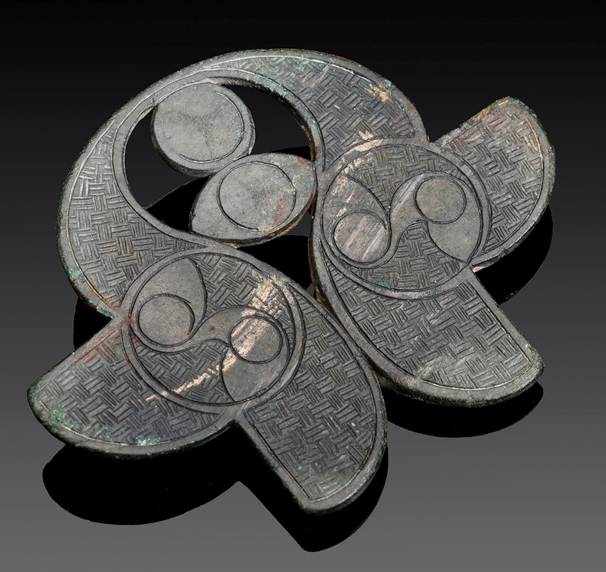
In recent days, the brooch has again been making headlines as it went on display at the Museum of the Iron Age in Andover, Hampshire.
Donated to the museum by Costas Paraskevaides and Jethro Sverdloff, directors of ArtAncient (a London based gallery and antiquities dealership) the story is one of philanthropy and generosity as the museum received the brooch for free. In the words of Paraskevaides and Sverdloff ‘This is a wonderful example of what can be achieved when the art and antiquities trade works collaboratively with museums and public institutions.”
But is everything quite as straightforward as that?
Finding the brooch.
In 2020, a detectorist found the brooch close to Sutton Scotney, near Andover, in Hampshire. Reported to the Portable Antiquities Scheme (PAS), the find was given reference SUR-738A17. Although in good condition, as can be seen from the PAS photos, it appears to show a covering green patina (to be expected from the copper alloy metal it was made from) (Fig. 2):
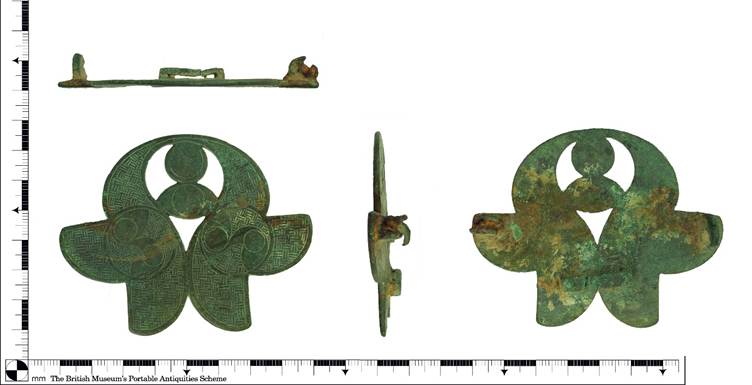
As the artefact was made of copper alloy, the brooch, despite its rarity and artistic quality, was handed back to the finder. Had the find been made after 2023, it almost certainly would have qualified under the ‘significance’ criteria of the Treasure Act amendment of that year. But sadly, this was three years before that time and there was no law governing single copper alloy finds, no matter how special.
Going to auction.
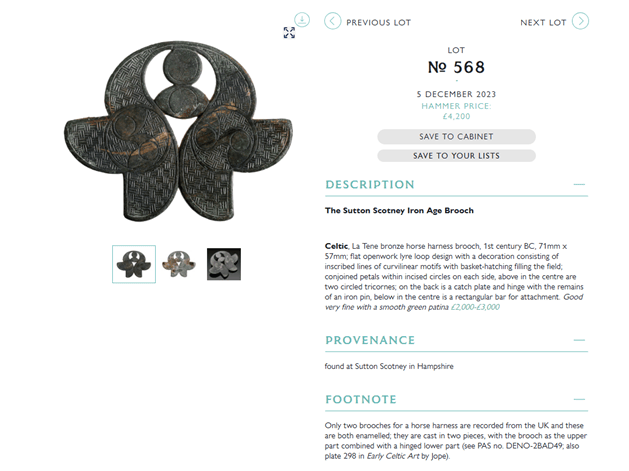
The location of the brooch for the next three years is unknown, but in December 2023, the brooch appeared at Noonan’s auction house in London, Lot 568 in their Ancient Coins and Antiquities Auction of 5th December of that year. The brooch appears to have been ‘cleaned’ by this stage. The estimate was £2000-£3000 and the brooch sold for £4200. The buyer is unknown.
The Export Bar.
Again, little was heard of the brooch until 10th January 2025, when the brooch became subject to an export bar by the Department of Culture, Media and Sport. The export bar was granted as the brooch met all three Waverley criteria (for more about this, see here) and banned its proposed sale to the USA, giving British museums the opportunity to buy the item for £22,500 (£18,500 plus VAT of £3700) before March 2025. Should this price not be met by the time allotted, the brooch, as with many other artefacts before it, would go abroad, likely not to be seen again.
However, by July 2025, the Export of Works of Art and Objects of Cultural Interest Annual Report 2024-25 stated that ‘During the first deferral period, Hampshire Cultural Trust submitted a serious expression of interest to acquire the brooch. The owner accepted the offer and granted Hampshire Cultural Trust an Option Agreement. The decision on the export licence application was therefore deferred for a further three months’.
It then went on to state that, ‘Costas Paraskevaides and Jethro Sverdloff, on behalf of ArtAncient Ltd, donated the brooch to Hampshire Cultural Trust for the museum collections owned by Hampshire County Council’.
Although it is not certain that ArtAncient purchased the brooch at the Noonan’s auction in 2023, in an Instagram post of 27th February 2026, ArtAncient stated that ‘In 2023, while in the collection of ArtAncient the brooch was considered to meet all three of the Waverley criteria’. This would suggest that it was ArtAncient who were trying to export the brooch to the USA…
Now safe.
The good news from all of this is that the brooch is now safe: I particularly like the basketwork on this piece and the late, somewhat flat, 2D decorative style so typical of the latest Iron Age. Thankfully, now that it’s in public hands it can be studied for many years to come.
However, it is well worth remembering that, from its finding through to its donation, there have been several times when it could have been – legally – sold, cut up, melted down, lost or damaged.
Thank goodness it wasn’t, eh?
(If you’d like to support my work as an unfunded independent researcher, then please buy me a ‘coffee’. Thank you 🙂 )


There is a small god somewhere I would like to thank for this…
LikeLike