(This was cropped from a previous paper as it didn't fit, but thought it was worth putting here as a blog: not peer reviewed, not definitive, but might spark some ideas....) At present, the sourcing of gold used to make Iron Age artefacts from the United Kingdom is unresolved. For Irish material, work by Warner …
Torc fragment cross-joins AKA how to make a torc jigsaw!
During the process of creating the Torc Treasury database, I kept noticing multiple fragments of the same, very distinctive, gold alloy torc coming up in Snettisham Hoard F. [Well, I think they're all from Hoard F, the problem being that although they all - bar one, but more about that later! - have a 1991 …
Continue reading "Torc fragment cross-joins AKA how to make a torc jigsaw!"
Thoughts on the Grotesque torc and the Snettisham (Ken Hill) hoards in the light of new research.
by Tess Machling & Roland Williamson. [A download/print PDF version can be found at the end of the paper] This paper can be cited as:Â DOI 10.5281/zenodo.4039630) Abstract This paper examines the Grotesque torc and its repairs in relation to the hoards from Ken Hill, Snettisham. It looks at the materials used to repair/modify torcs, and …
Heinz 57: an unusual torc terminal from Snettisham.
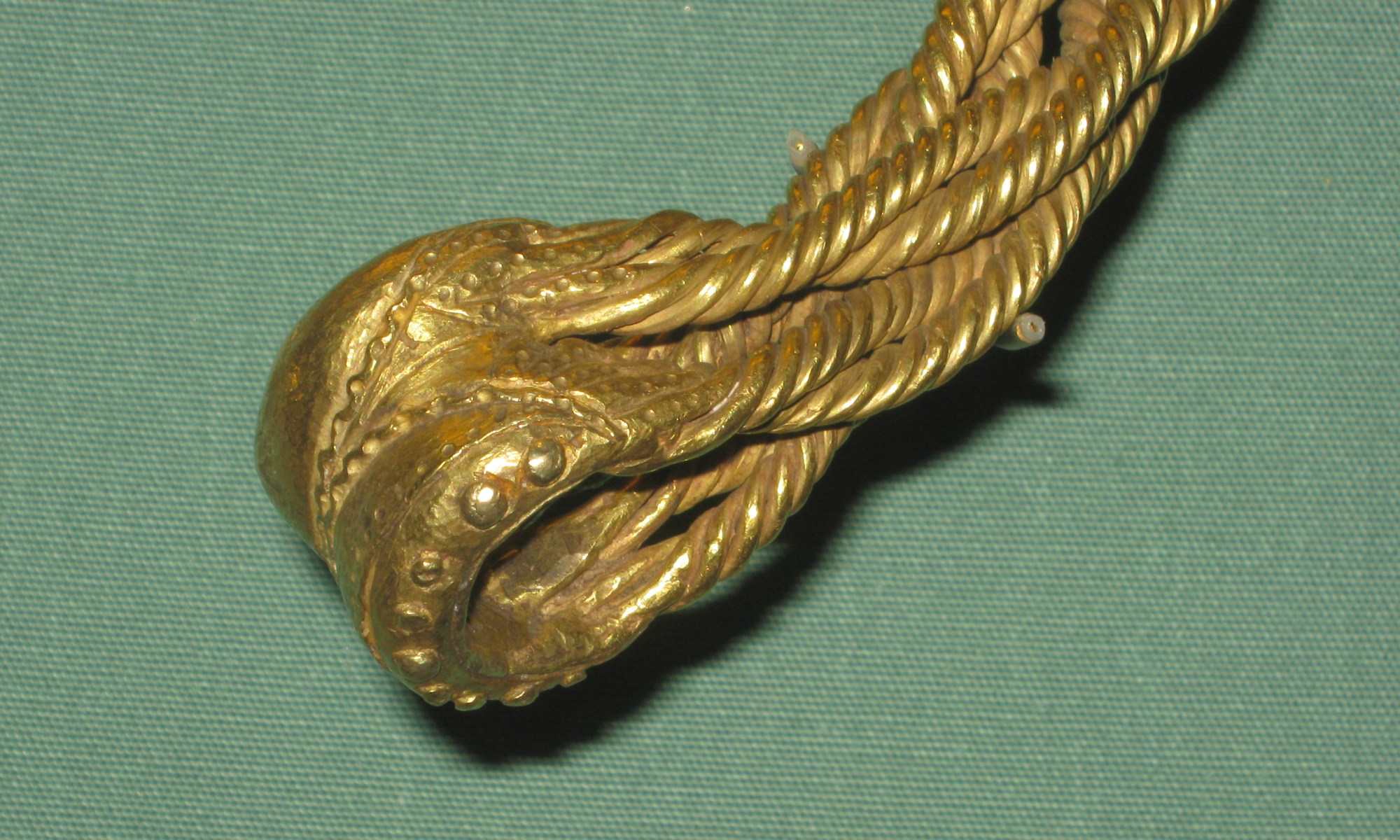
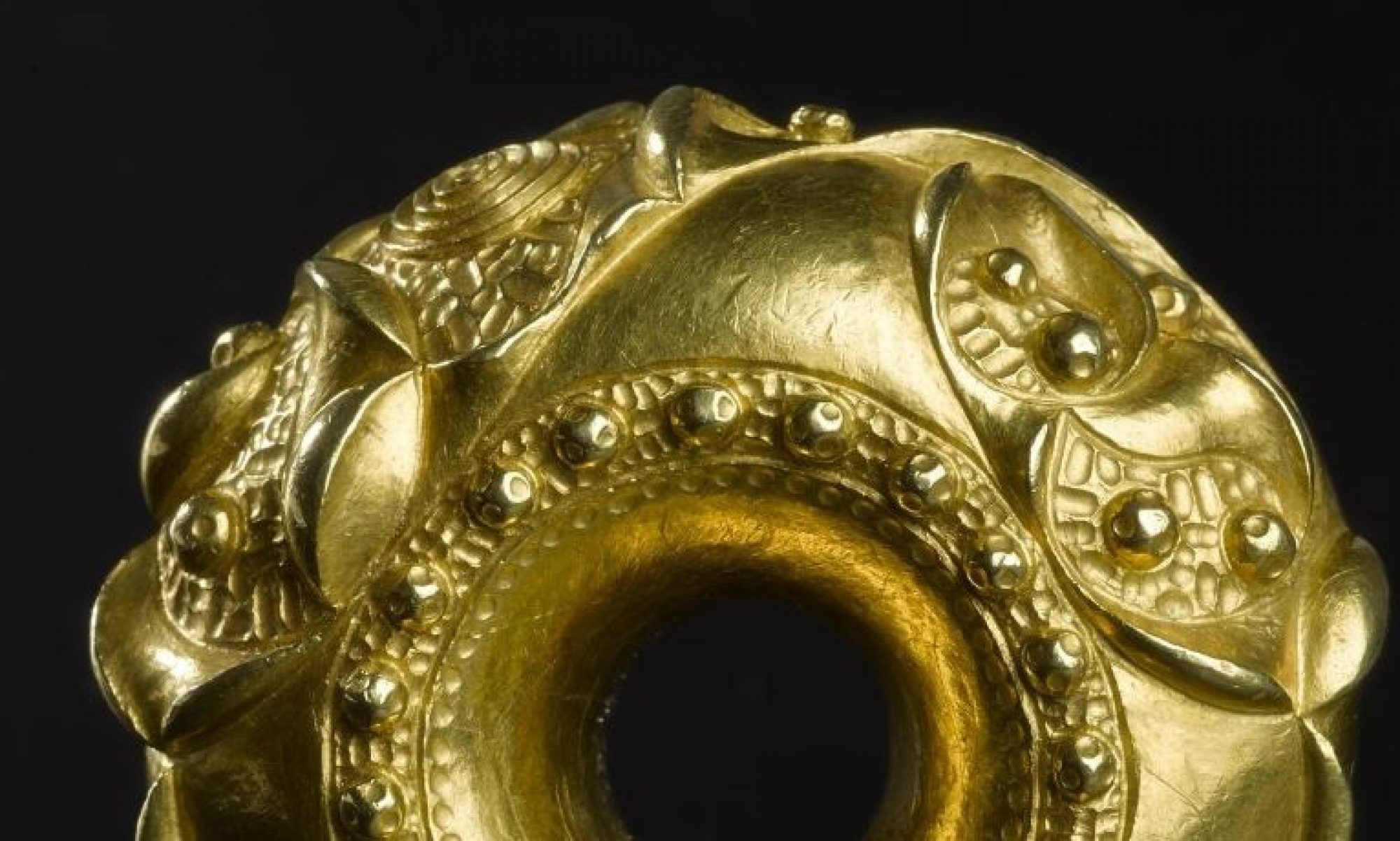
The Heinz 57 terminal from Snettisham (thus named by us according to its place in the Norwich Castle Museum display and its rather unusual form) has been largely ignored in academic literature. Being known more formally as 1991,0501.45 in the British Museum catalogue, this terminal was found in the mixed Hoard F from Snettisham. This …
Continue reading "Heinz 57: an unusual torc terminal from Snettisham."
No goldfinches were harmed in the making of this blog…..
Gold is a very unusual material. Created by supernovae, and deposited on earth by asteroids, it is a finite resource. Estimates suggest that the total amount of gold mined to date is around 190,000 metric tons: but due to the density of the material (it is denser than lead) this would create a single cube …
Continue reading "No goldfinches were harmed in the making of this blog….."
Looking at torcs: The B52, first steps.
When we look at torcs, the first stage of analysis usually involves photos. We have a lot of photos: my Kindle Fire currently contains about 6000 of them, cribbed from websites and online catalogues, or taken by Roll and myself. That's a lot of pics. By going through these photos on a regular basis we …
The Quest for Volume
Prehistoric goldworkers of any period exploited a variety of techniques to create torcs. There are a number of torcs which are in their rawest form just a torc – a generally round-section rod bent to make a neck ring and fitted out with the simplest of terminals. These range in type from the bar torcs …
A rediscovered Iron Age torus torc terminal fragment from ‘Near Stowmarket’, Suffolk.
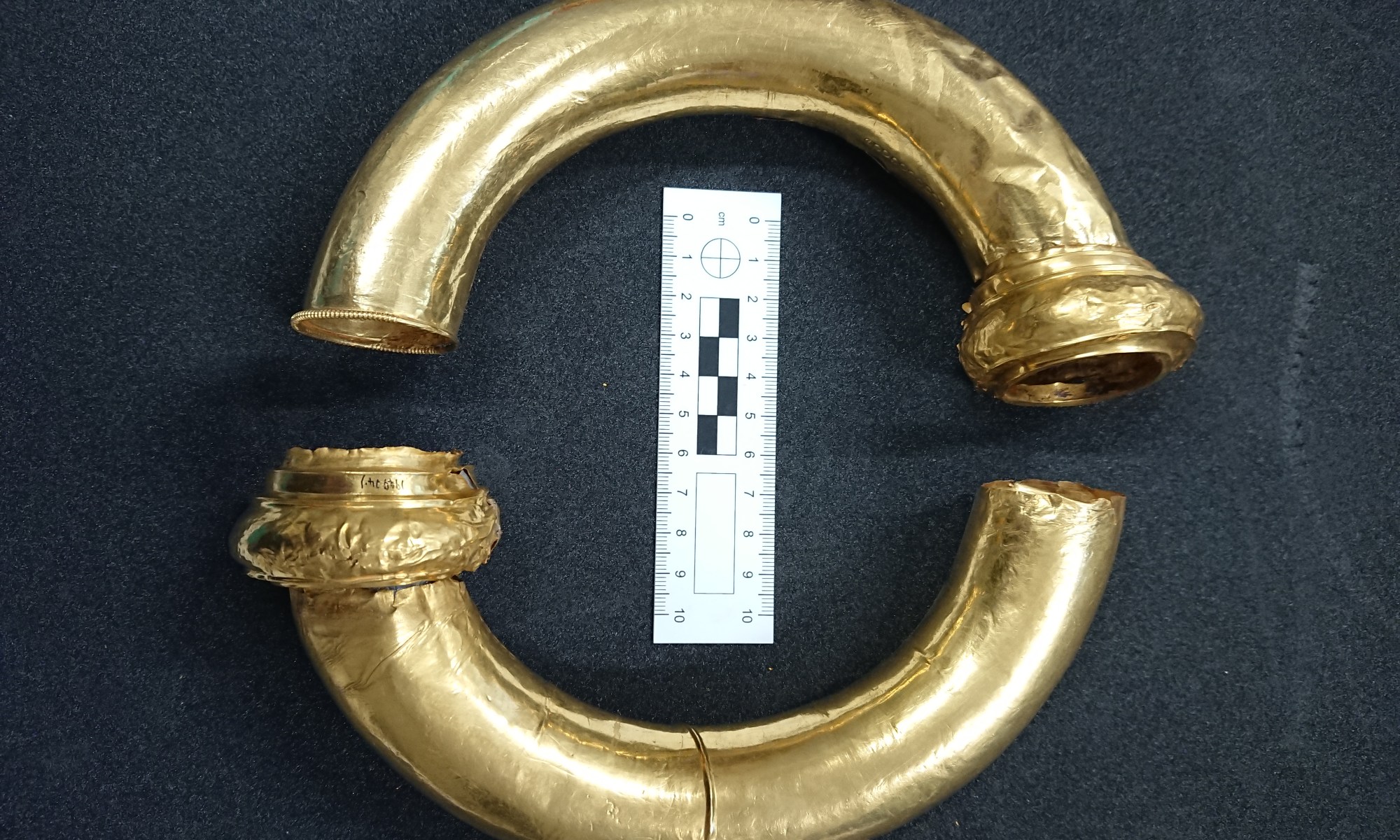
by Tess Machling & Roland Williamson [A download/print PDF version can be found at the end of the paper] This paper can be cited as: DOIÂ 10.5281/zenodo.10511422 Background: In May 1996, a metal detectorist working fields close to Stowmarket found a fragment of gold from a torus torc terminal. The field has been walked and …
Lesser spotted torcs 1: Cushion torcs
Snettisham inevitably - being the largest collection of torcs and torc pieces ever found and with the Great torc to the fore - tends to dominate the Iron Age torc world. It should not, however, be forgotten that there are upwards of fifty other torcs represented in other parts of Britain, when incomplete examples, or …
Confounded and bamboozled.
Part of the reason to commit our thoughts to ‘paper’ on the subject of torcs was that we have rather different approaches to the research to many in the field. I have a very much hands on approach which is tantalisingly difficult to achieve as you can’t really be too investigative with these delicate items! …