by Tess Machling, Roll Williamson & Giovanna Fregni
[A download/print PDF version can be found at the end of the paper]
Abstract
This paper can be cited as: DOI 10.5281/zenodo.10511405
The ‘Pulborough Area’ torc is a chimera: apparently made from the correct Iron Age material, using a valid construction technique and in a known form, however, the elements do not work together as an Iron Age torc. The alloy percentages would suggest the torc should be cast, and yet it is sheet; the decoration mimics continental examples from the 4th century BC, and yet the method is virtually unknown in torc studies, even in wider continental Europe. The quality of construction is poor and yet the making – in relatively high percentage gold – suggests an investment in this artefact.
Here we argue that to understand the ‘Pulborough Area’ torc fully, we must understand where the torc was found and must also examine the exploits of Harry Price – psychic researcher, ghost hunter, author, amateur dramatist and archaeological forger – who lived in Pulborough from 1908 until his death in 1948. We believe Harry Price holds the key to the ‘Pulborough Area’ torc: his involvement could explain why the torc was made, and also why the torc was found beyond the distribution range of other Iron Age torc finds.
Background
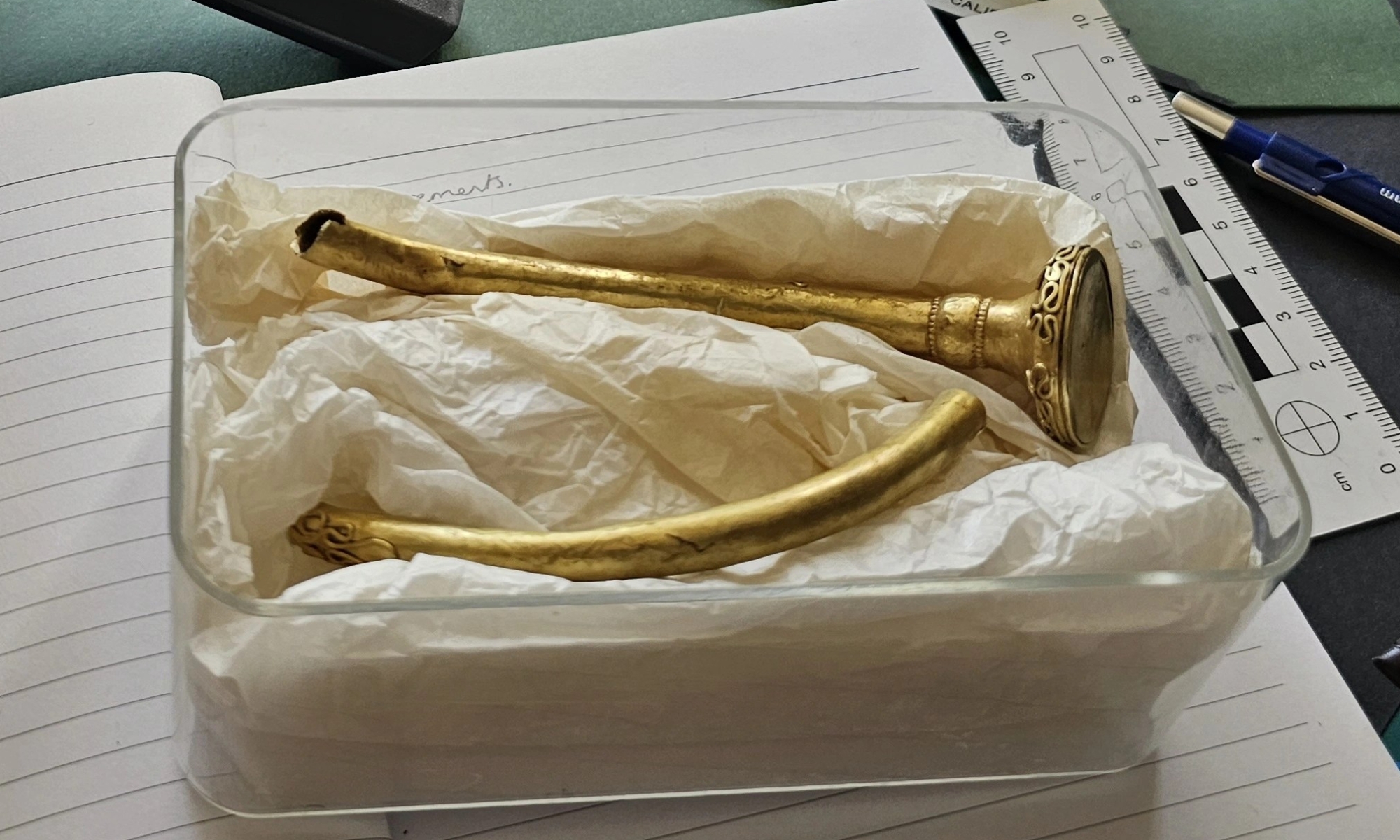
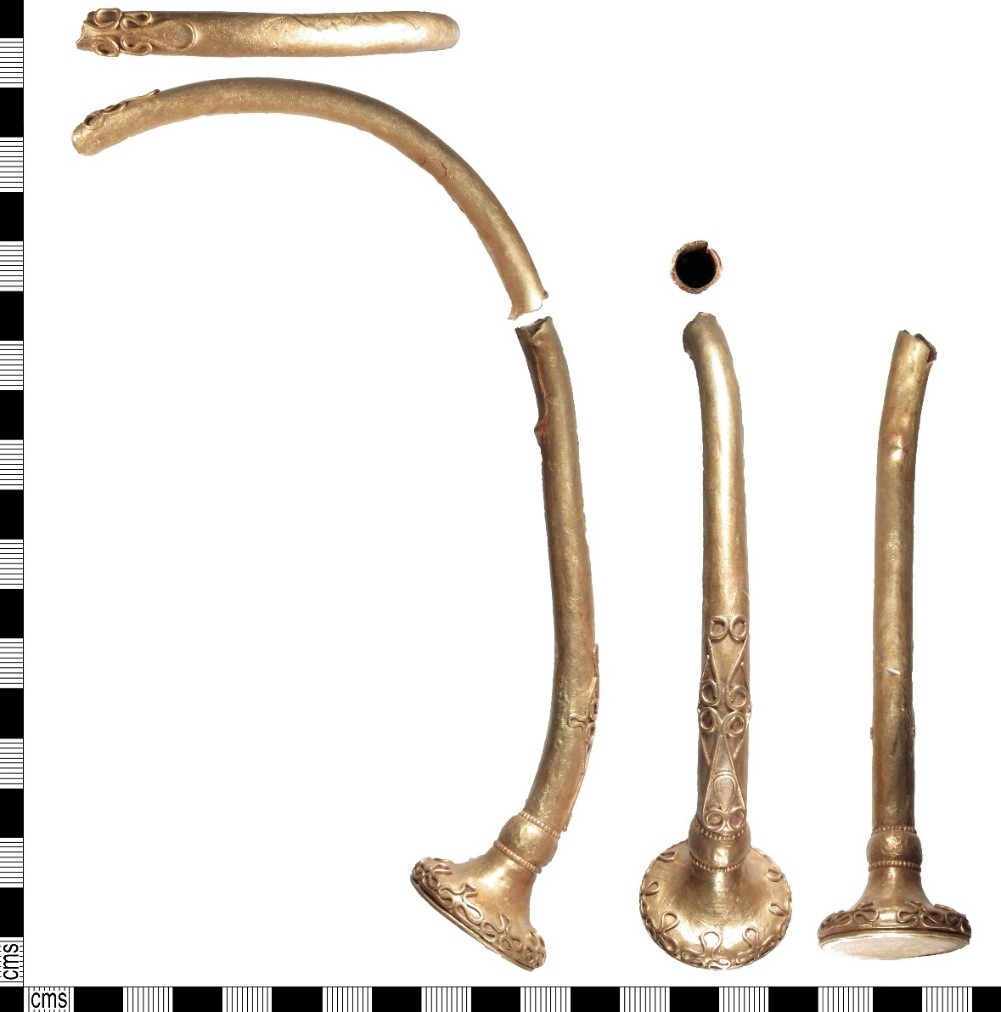
In March 2019, a detectorist working a dried out, usually boggy, area of field adjacent to a stream close to Pulborough found two conjoining torc pieces (Fig. 1) at a depth of around 30cm. Being made of gold alloy, the find was correctly reported to the Portable Antiquities Scheme and the find was logged as PAS number SUSS-24FBDB, and designated ‘treasure’ (Treasure Number 2019 T560). In February 2020, the find was posted on social media, and two of the authors (TM and RW) became aware of its existence. At this time we were asked, by the British Museum (email dated 24/2/2020), for our thoughts on the torc. We were unable to see the torc, but just photographs of it.
Even from photographs, we were able to note several aspects of the torc that appeared to be inconsistent with an Iron Age date – there were large areas of flooded solder, the wire application was crude, the tooled decoration appeared chiselled rather than made using a punch, the design wasn’t quite right, the gold alloy sheet was too thick and overall the item presented as too crude to be what it purported to be. The British Museum agreed, even discussing (email dated 24/2/2020) torcs which were acquired by the British Museum, in the 1930s, as being Iron Age examples (see British Museum accession numbers 1929,1221.1; 1930,0411.1 & 1930,0411.2) but which, using recent analysis methods, were discovered to be likely later 19th/earlier 20th century in date (Fig. 28). Following this exchange of emails, the Covid pandemic happened and the Treasure process slowed.
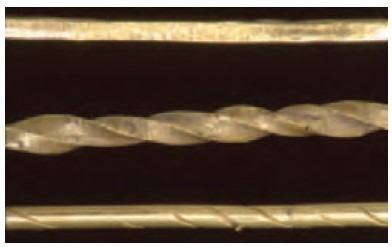
In September 2022, TM visited the British Museum for research on another torc, and was told that new information had come to light regarding the Pulborough torc: the wires had been examined and shown to be ‘strip twisted’ (a method of wire making which involves creating tight coils of wire from strips of alloy, which are then rolled to produce a single wire length. See Fig. 2) and as such, the torc had been designated Iron Age (see PAS number SUSS-24FBDB). To understand why this designation had occurred, a short digression on wire is necessary.

Although hammered wire is the method of choice used to make wire in Iron Age Britain and Ireland, the ‘strip twist’ method (Craddock 2009, 377; Oddy 1977, 84; Whitfield 1990, 18) was used widely in jewellery of the continental earlier Iron Age, for example, by the Etruscans (Oddy 1977, 85). This method is thought not to have been used in modern or antiquarian copies/fakes (e.g. La Niece 2009, 332), as it was not recognized by metallurgists as having been used in ancient examples until – at the earliest 1920 – but probably more widely when Herbert Maryon wrote about the technique in the late 1930s (Craddock 2009, 379).
As such, any item with ‘strip twist’ wire is assumed not to be a modern replica/fake as a modern maker would not have known of this wire technique. As Craddock states, ‘the presence of such wires on pieces with a known provenance dating back before the 1970s may be taken as supportive evidence of dating from antiquity’ (Craddock 2009, 379).
However, in Marcellin Berthelot’s widely read Collection des anciens alchimistes grecs, published in 1888, there is an ancient Greek technique mentioned which could be described as ‘strip twisting’: ‘Take fine silver, hammer it and cut it into strips and twist [?] it with a rounding [?] iron [?]’ (Ogden 1994, 165). As such, the knowledge of this technique could be later 19th century, some 40-50 years earlier than previously thought. Therefore, we would suggest that a secure date in antiquity could be questioned, if the only evidence for antiquity was ‘strip twisted’ wire.
In addition to the wire, according to the British Museum, ‘no evidence for modern elements’ (Adams 2021) had been identified in the surface X-Ray Fluorescence composition analysis. However, we (TM and RW) remained skeptical as there were still too many uncertainties (including the possibility of strip/block twisted wire being known of in the later 19th century) for us to believe it to be a secure Iron Age example.
However, with the identification of the ‘strip twist’ wire – alongside the apparently corroborating Iron Age form, composition and decoration and absence of ‘modern’ element inclusions in the gold alloy – the torc was written up by the British Museum, in the Treasure Report, to be of a tentative 4th -3rd century BC date (Adams 2021, 7). This report went to the Treasure Valuation Committee and the torc was valued at £16,000. In April 2023, the Sussex Archaeological Society started fundraising to acquire the torc for Barbican House Museum in Lewes, Sussex (SAS 2023).
The authors became aware of the Treasure decision in April 2023, and TM contacted the Treasure Valuation Committee (email dated 19/4/2023) raising the concerns we had regarding the identification of the torc as Iron Age. We were referred to the British Museum and Dr Sophia Adams kindly provided a copy of the Treasure Report (Adams 2021) which detailed the British Museum findings and made it clear that they were secure in the Iron Age identification. As such, the torc had completed the 1996 Treasure Act process and the discussion of the torc now became a matter of academic debate. In June 2023, the Sussex Archaeological Society reached its funding target and acquired the torc.
In August 2023, TM viewed the torc in person. During the investigation, an additional aspect – the apparent intentional and sustained abrasion of the terminal end – caused us to believe that the torc was not only not Iron Age, but an intentionally created forgery, and not a recent one at that. Our reasons for this decision are discussed in this paper.
The torc
The torc comprises two broken, conjoining, fragments: the first a cone shaped, buffer type decorated terminal on a length of tubular neck ring, the second a section of tubular neck ring with decoration at the end (Fig. 1). The first piece measures c.118.2mm in length, with the terminal being c.28.7mm in diameter. The diameter of the neck ring on this piece is c.7.3mm. The thickness of the sheet at the broken end of the neck ring is 0.4mm. It weighs 39.68g. The second piece measures c.94.1mm in length, has a tube diameter of c.7.2mm and weighs 17.86g. The thickness of the tube neck ring sheet is 0.4mm.
The combined weight of both pieces is 57.54g and the probable diameter of the torc – from measurement of the less distorted neck ring piece – is likely to have been around 200mm, suggesting that, if the torc had been complete, around 50% of the original torc is present in both pieces (Fig. 3). This is supported by the presence of decoration on one end of the neck ring fragment: such decoration is usually found on the back of a torc (see Fig. 12).

There are (at the time of writing this paper) two sets of surface X-ray Fluorescence readings available for the torc, both taken by the British Museum: one set reported in the PAS SUSS-24FBDB online report which gives the composition as 61-63% gold, 35-37% silver and the rest copper, the other in the Treasure Report (Adams 2021, 1) gives 56-61% gold, 37-40% silver and the rest copper.
The Treasure Report gives three sites where measurements were taken (on a nick on the terminal neck ring, the terminal side and on one of the wires decorating the terminal edge), however, there are no individual measurement readings given, although it is stated that all three sites ‘exhibited a similar composition’ (Adams 2021, 7). In addition, all three readings were taken only on the terminal section and only on the wires around the terminal edge. No measurements were taken on the neck ring tube fragment, the other decorative wires, or on the areas of solder.
Having requested clarification from the British Museum, the results in the Treasure Report were confirmed to be the correct readings and the three individual readings have been provided, which are as follows: a) nick on the terminal neck ring: Au: 56%; Ag: 40%; Cu 5%, b) side of terminal: Au: 61%; Ag: 37%; Cu 2%, c) wire on terminal: Au: 58%; Ag: 38%; Cu 4%. The significance of these readings is discussed in Alloys below. As the readings were taken for the purposes of the Treasure Act, the presence/absence of trace elements was not recorded, and no readings taken on the flooded solder or on wires from other parts of the torc.
An x-radiograph by the British Museum (Adams 2021, Fig. 2) within the Treasure Report reveals a separately made terminal piece attached to the neck ring, with a flared internal tubular collet supporting the join between the two elements. Such a collet is known from earlier Iron Age torcs and can be seen in the tubular torc of Mailly-le-Camp in France (Eluère 1987, Fig. 21b) and on a section of tubular torc from Mainz in Germany (Jacobstahl 61, pl.48). However, in both cases the sheet gold was extremely thin (less than 0.1mm) and so such support would be necessary. In thicker gold such as the ‘Pulborough Area’ torc, such a support is puzzling.
The example of the Snettisham Great torc mentioned in the Treasure Report (Adams 2021, 8) is inappropriate as in the Snettisham Great torc the cut-and-splay is on a sheet joint, rather than being part of a support, and additionally may be a naturally occurring splitting of the sheet due to overworking of the gold (Machling 2022).
The British Museum report also details a ‘thin, slightly concave disc, completing the buffer shape’ (Adams 2021, 3) on the end of the hollow, funnel shaped, terminal and collar. This disc is perforated by a central 0.6mm x 0.4mm hole. The neck ring is described as being made from sheet gold, and seamed along the internal face of the tube. The British Museum interpretation, given in the Treasure Report, is that the entire torc is made from sheet gold.
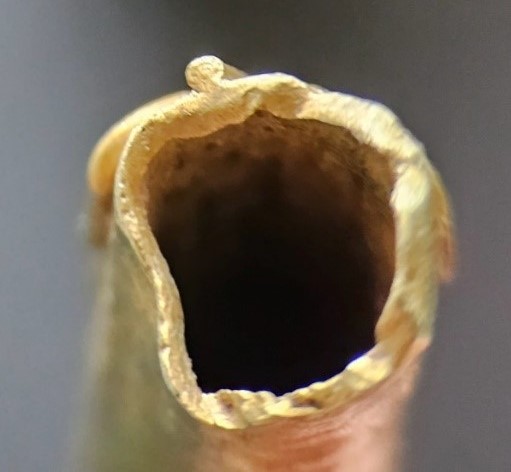
Visual analysis by TM confirmed that the tube is made from sheet gold, and seamed along the internal face of the neck ring. The seam is faintly visible along the interior side of both torc pieces, but prominent in the broken neck ring piece, where the sheet has come apart (Fig. 4).

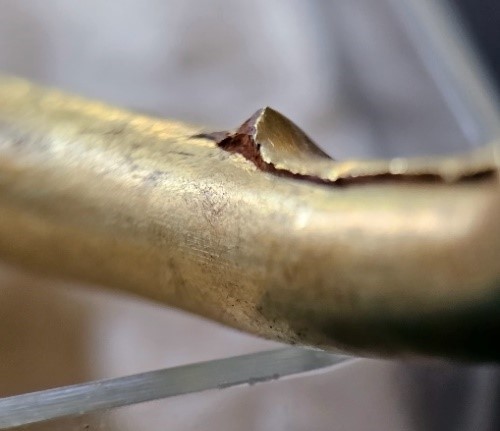
However, examination of the terminal showed a slightly different construction method to that described by the British Museum report. Although the terminal was clearly made separately to the neck ring, and then joined (there is a join visible), the precise method of the terminal’s construction is more complicated.
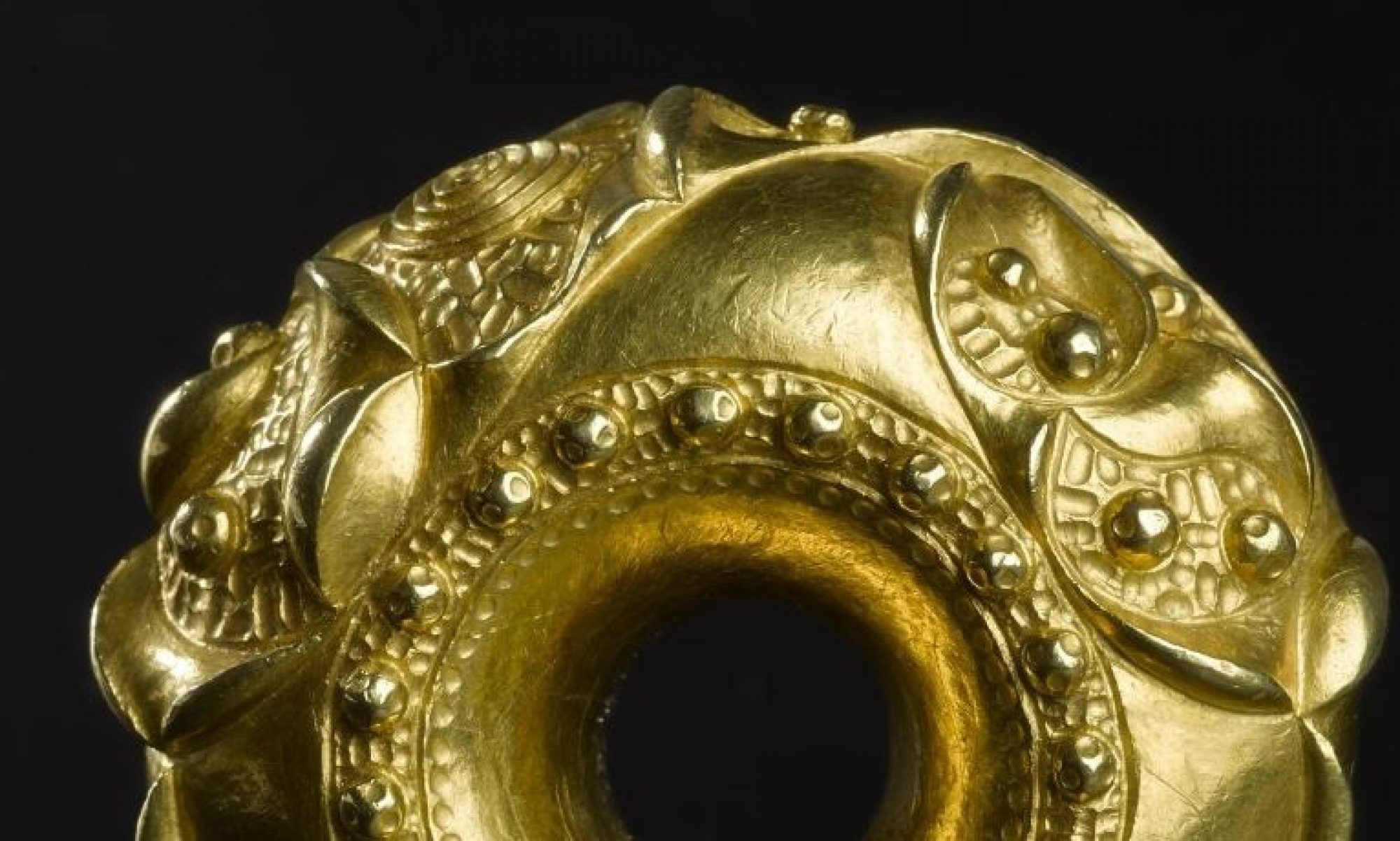
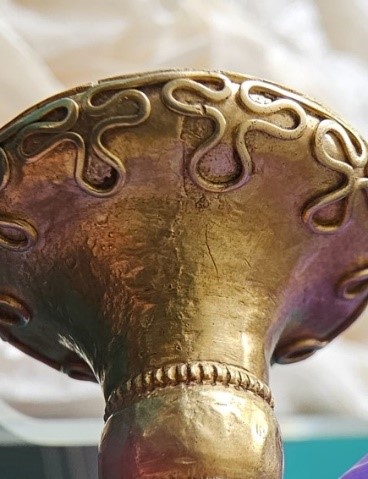
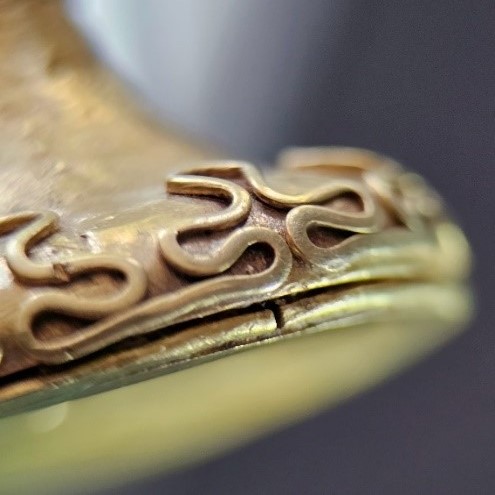
We believe the torc terminal funnel and collar could be hollow cast, and there is a visible crude fault or seam running along the external side of the terminal (Fig. 5). In addition, on the face of the terminal, the sealing disc appears to be a shallow bottle-top shaped cap inserted into the terminal cone.

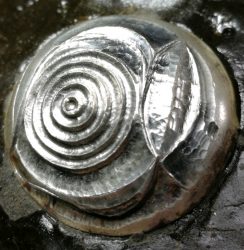
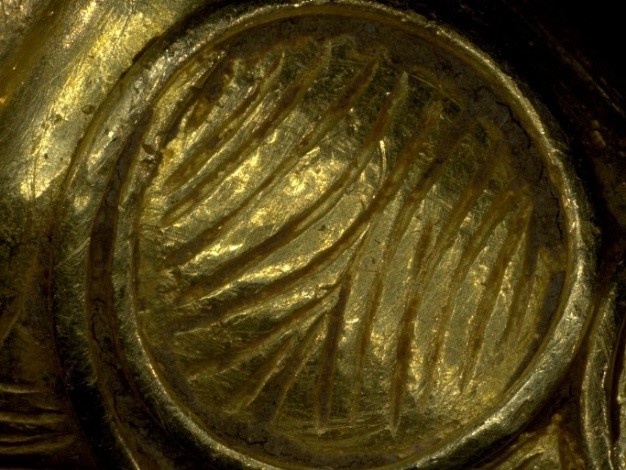
The face of this cap has been extensively abraded and in one section of the cap circumference, this abrasion has caused the cap to wear through enough to reveal the sidewall of the cap (Fig. 6).
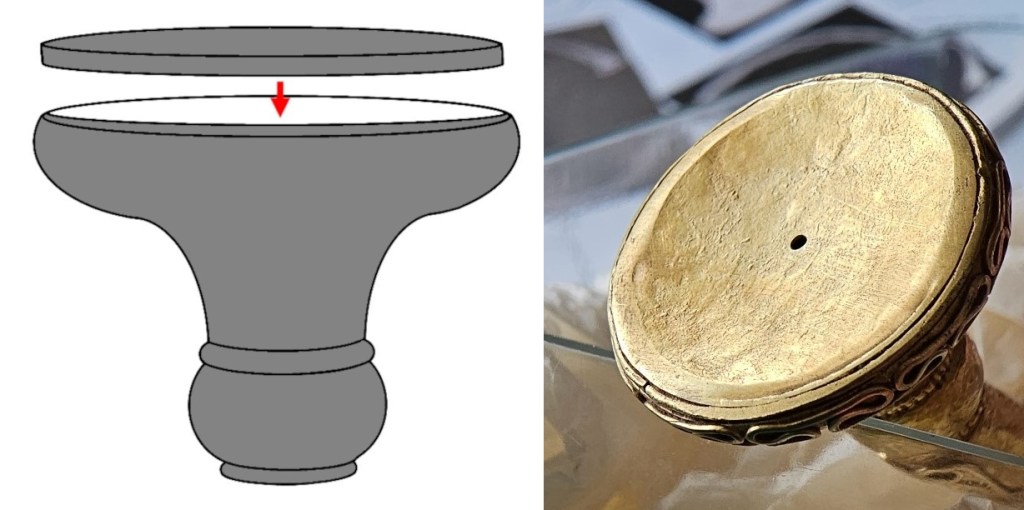
The damage on the terminal face is severe; so severe that there is a flattened zone – in places up to 2mm wide around the circumference of the terminal (Figs. 6 & 7) which has been highly abraded. This area shows multiple linear, regular, striations which suggest the face of the terminal was repeatedly rubbed against an abrasive surface: the regular and fine nature of the striations suggesting that whatever it was rubbed against was uniformly fine grained (Fig. 7). A fine-grained sandpaper, for example, would produce such a result. There is no apparent manufacturing reason for this treatment, but the abrasion would appear to be intentional, perhaps to ‘age’ the item.

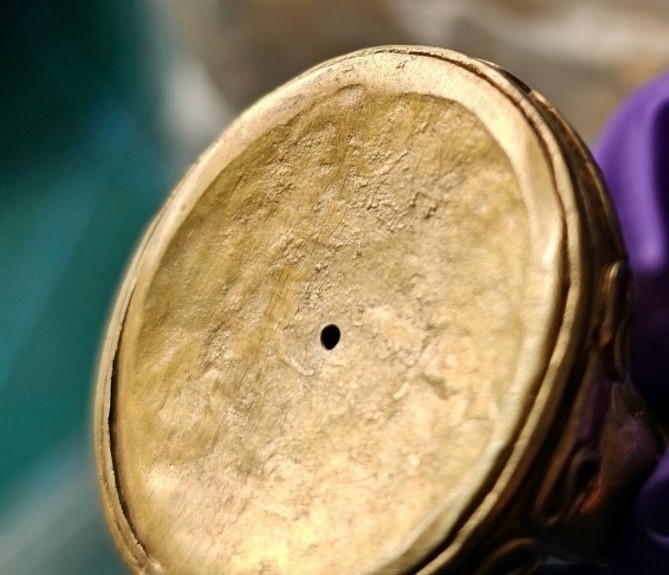
Such regular and intentional abrasive patterns are almost certainly not the result of use during the lifetime of the torc (smooth, and not striated, areas of wear would be expected on areas adjacent to the human body – that is, on the terminal edges, on the wire decoration, or perhaps on the neck ring – of which there is none, confirmed also by Adams (2021, 6)). Even finishing by the goldworker would not have been this clumsy, with the face having been so badly scoured that the cap has been worn through to the sidewall of the cap beneath the face.
In addition, use of abrasives is unknown in Iron Age gold working, where punches, burnishing tools and planishing hammers are used to smooth the surface (Machling & Williamson 2020). As mentioned in the British Museum report, the surface of the torc does show a number of scratches, nicks and roughened areas – as would be expected to have occurred during burial and finding – but the purposeful abrasion of the face can in no way be explained by such post-depositional actions.
The wires
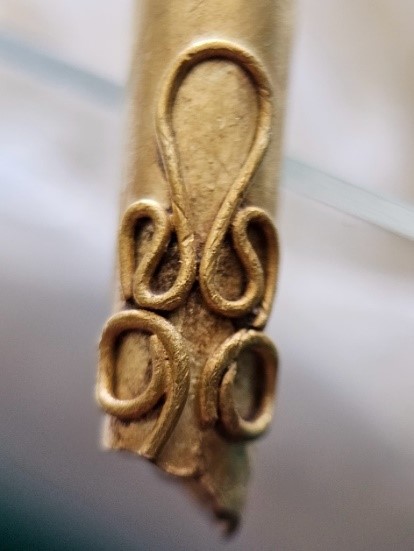
The torc is decorated with applied round-section wire in three areas: on the end of the broken neck ring portion, on the neck above the terminal, and around the terminal end circumference (Fig. 8). Three pieces of wire have been used on the neck ring, one long length on the circumference of the terminal, and seven pieces on the terminal neck. These wires have been arranged in various patterns (see Decoration below). In addition, there is a single wire which has been placed around the edge of the cap, presumably to cover the join between cap and terminal cone.
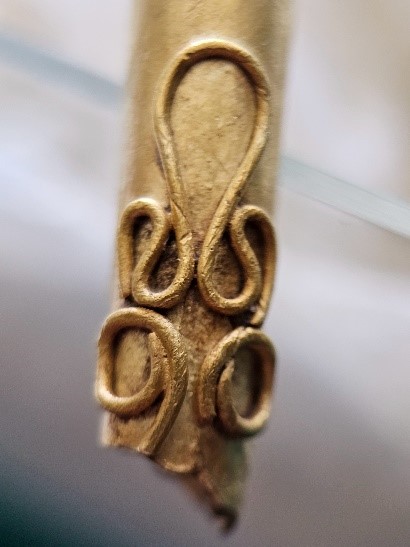
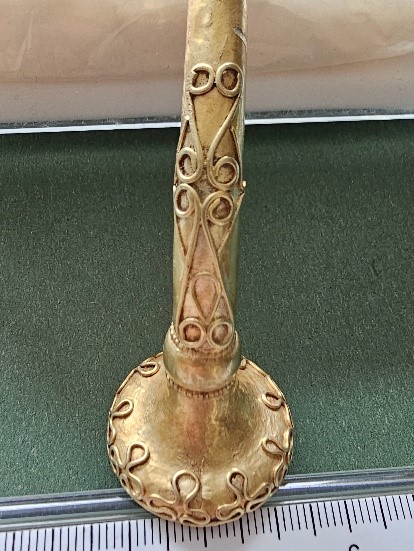
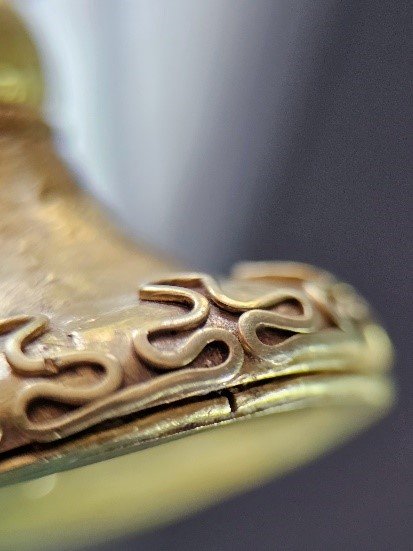
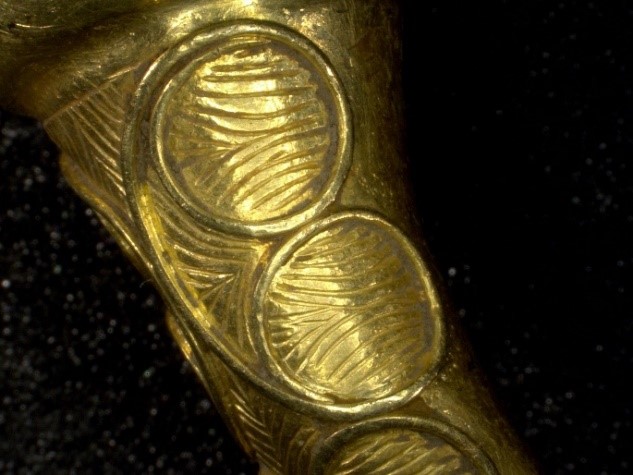
As discussed previously, within the Treasure Report (Adams 2021, 3), these wires are described as being ‘strip twist’ made. We suggest that this is not the case. Although some diagonal grooves can be seen on the wires of the end of the neck ring (Fig. 9), and on the trefoil decoration of the terminal circumference, there is one characteristic feature (Oddy 1977, 85) of ‘strip twist’ wires missing: the wires are not hollow.

There is a further wire making technique, ‘block twisting’ which can result in diagonal grooves, but on a solid, and not hollow, wire (Craddock 2009, 377; Oddy 1977, 83; Whitfield 1990, 14). This technique uses a square-section wire which is then continually twisted to make a round wire (Fig. 10). As such, if the grooves represent a kind of twisted wire, then ‘block twist’ is likely. ‘Strip twist’ appears to be ruled out.
However, the grooves are not at all consistent across the piece and there are a number of other nicks, marks and scratches: in several cases, the diagonal grooves are only on the outer face of the wire, and do not continue in the full circumference (Fig. 11). There also do not appear to be any grooves visible on the wire decoration of the terminal neck, although these may be obscured by the copious flooded solder in this area. Overall, the inconsistency of marks means that the use of ‘block twist’ wire is questionable.
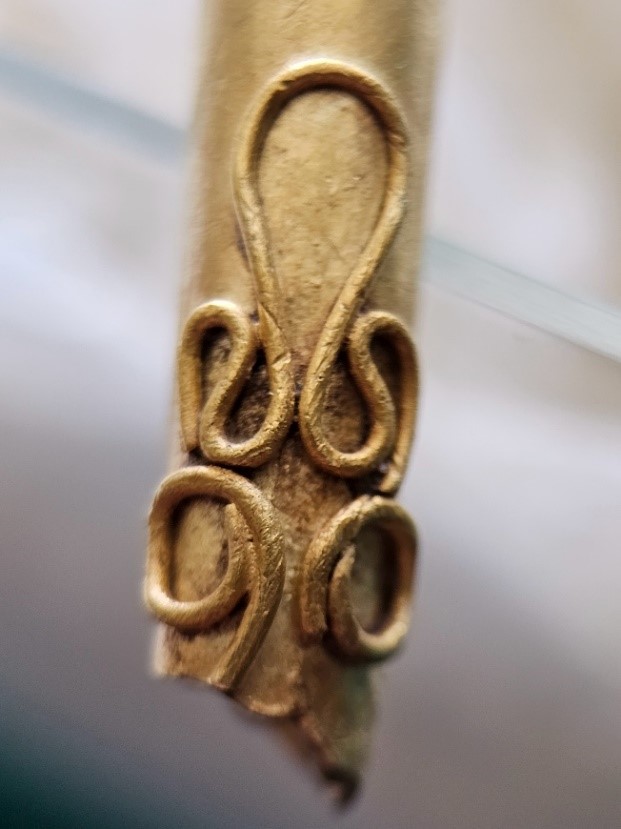
An alternative means of acquiring spiral grooves on wire is from wire drawing, where a damaged draw plate can leave a groove (Craddock 2009, 376) and – if the wire is twisted as it is pulled – this groove will show as a spiral on the wire. Although unlikely to occur in the work of an experienced, skilled, goldsmith (who would pull straight), it is possible in the hands of a less skilled maker and is consistent with the other less competent aspects of this torc. Drawn wire would also go against an Iron Age date, as it is an unknown technique at this date.
Decoration
The torc is decorated with several designs created from short lengths of wire which have been arranged in patterns on the end of the neck ring fragment, on the terminal neck, and circling the edge of the terminal. The placement of decoration on the terminal neck and back of a torc is well paralleled in earlier Iron Age torcs from continental Europe, for example, on the gold bracelets from Waldalgesheim in Germany (Joachim 1995) and Erstfeld in Switzerland (Wyss 1975). The style of the ‘Pulborough Area’ decoration is reminiscent of the Waldalgesheim style of the 4th century BC.
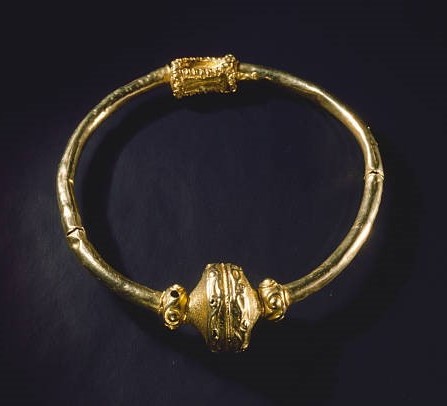
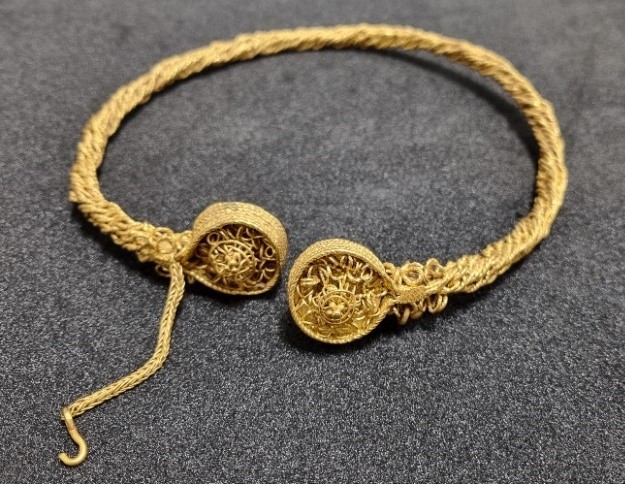
However, the use of applied wire to create these designs on torcs is extremely rare in Britain and Ireland. Applied wire can be seen on the back of the neck ring of one of the Knock torcs from Ireland (Jope 2000, pl. 106 & 107; Ireland 1992, 139; Raftery 1983, 169) and also on one of the Blair Drummond torcs from Scotland (Hunter 2018) which is made almost entirely from coiled and twisted fused wires (Fig. 12).
Also from Britain, the Leekfrith (PAS number WMID-FD08D9) bracelet (Fig. 13) appears to use applied wire to decorate the neck of the flared terminals although, in the view of the authors, it is also possible that this relief is in fact raised from the sheet body. However, this has yet to be confirmed.
The use of applied wire in Etruscan and other earlier Iron Age jewellery, for example, on the dorsal muff of the Mailly-le Camp torc from France (Joffroy 1969, Fig. 5) and on the pendants from the Bettelbühl site on the Heuneberg (Fig. 14) can be seen in examples from continental Europe. However, the style is quite different and more akin to the Knock torc wire decoration (Fig. 12, left).

In terms of decorative style the patterns on the ‘Pulborough Area’ torc most closely resemble those found on several torcs from the Marne area of France, like these examples from Bussy-le-Château (Jacobstahl 1969, 207, pl.125) and Reims (Reims 2023) (Fig. 15). However the Marnian examples are cast in solid bronze.
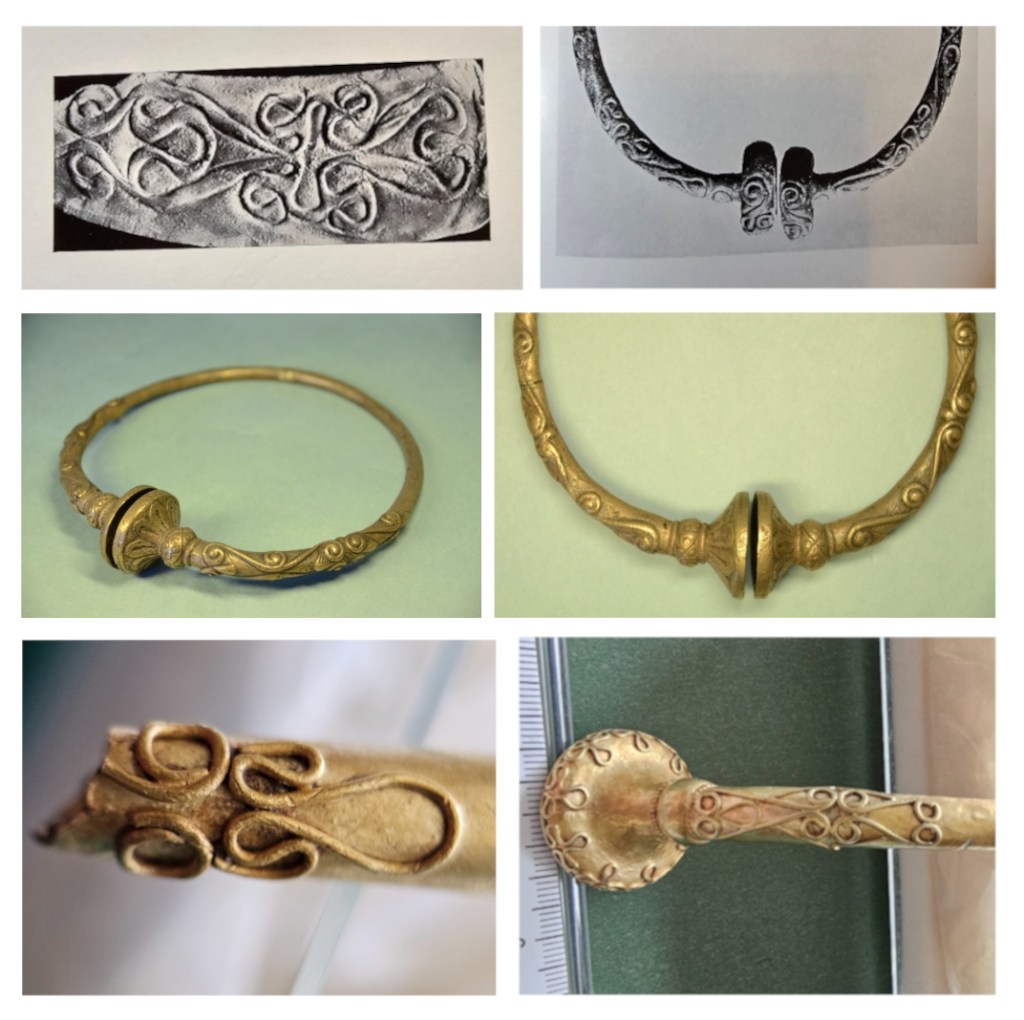
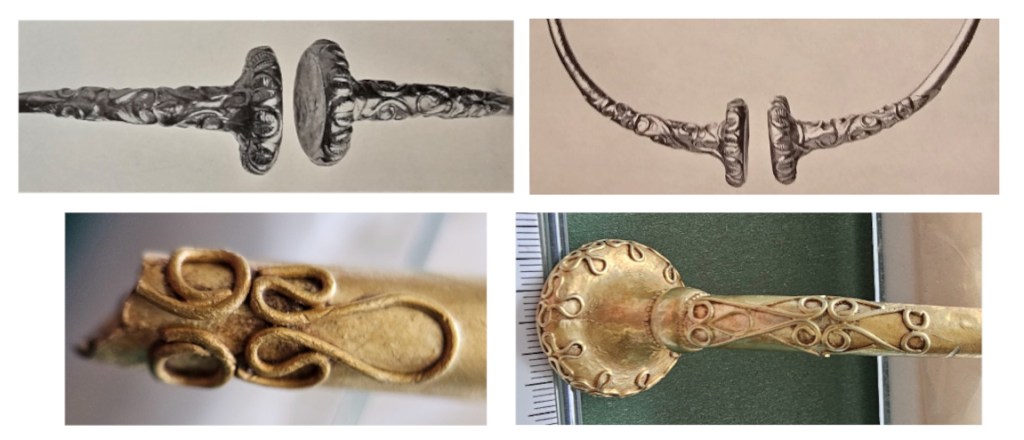
There is also a similarity to the design of the Waldalgesheim torc (Joachim 1995), perhaps particularly striking due to the similar gold alloy and terminal form (Fig. 16). A further similarity is the small, central, hole in the terminal face of both the Waldalgesheim and ‘Pulborough Area’ torc.
This hole would be a technical necessity during the soldering together of several hollow torc elements and would allow gases to escape during the process. This hole is not present, or necessary, on the solid, cast bronze, Marnian torcs.

A further torc with this central hole in the terminal comes from the Filottrano tomb in Italy (Jacobstahl 1969, 44, pl.38), whose curling decoration again resembles that of the ‘Pulborough Area’ torc (Fig. 17). This torc was also made using a gold alloy and – as with the above French and German torcs – with the decorative elements apparently cast in, in this case as hollow cast terminals similar to Waldalgesheim.
Form
When we examine the form of the Pulborough torc, again the torc shows characteristics of several continental European torcs. The thistle shape is most easily paralleled in several solid gold, and bronze, cast torcs of the c.5th– 4th centuries BC.
Most similar in form, the solid gold alloy torc from Meung-sur-Loire in France (British Museum accession number GR1867,0508.477) (Fig. 18) shows the same bulbous collar and tooled ‘beaded’ bands above and below it. The ‘Pulborough Area’ torc also resembles the partial similarly dated, ‘beaded’, Caistor gold torc from Lincolnshire (PAS number NLM-605352).
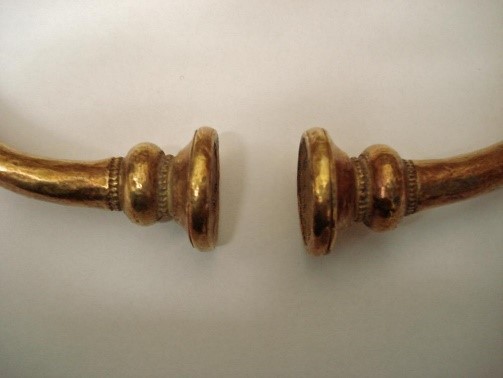
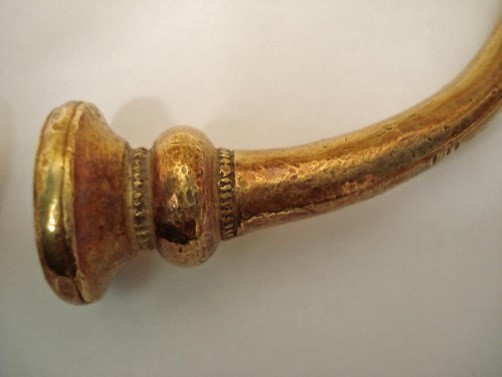
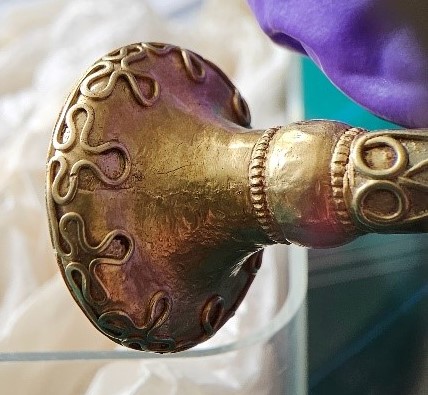
As discussed above, the decorated Waldalgesheim torcs (Fig. 19) also share a resemblance, with beading above and below the collar of the Waldalgesheim neck torc example. However, in this torc, the terminal is more buffer, than thistle, shaped.

A chimera
The overall impression of the ‘Pulborough Area’ torc is of a mix and match or, as Eric Morecambe would have put it, ‘all the right notes, but not necessarily in the right order’. Never was a phrase more aptly used. In connoisseurship terms, and for researchers who have looked at many torcs, in short, the ‘Pulborough Area’ torc just isn’t quite right! Trying to precisely articulate this is difficult, however, there are a number of aspects which can be detailed.
Alloys
Iron Age gold torcs from Britain and Ireland come in a range of alloy compositions: from the higher percentage gold torcs like the Netherurd terminal, Snettisham Great torc and Clevedon terminal (Machling & Williamson 2020, 84) to the lower percentage gold alloy torcs such as the North Creake terminal (Clarke 1951) and various examples from Snettisham (Stead 1991).
However, in prehistoric times – before controlled heat sources and easily refined alloys – one aspect holds true: how good your gold alloy was controlled what you could do with it. Sheet torcs are all made from gold alloys of around 70% gold or above. But if you have less gold in your alloy, thanks to the difficulty of working this material, then casting is the method of choice. This bears out across the spectrum of torc designs and types (Machling & Williamson 2019, 87).
In the case of the ‘Pulborough Area’ torc, the gold percentages of, at maximum, 61% within the alloy would be extremely difficult to work in the Iron Age as sheet gold and, with the neck ring tube testing at 56% gold it seems remarkable that the sheet tube shows no evidence of cracking, overworking or degeneration. Due to the difficulty of maintaining heat and alloy refining, such cracking etc has been noticed in all Iron Age sheet torcs we have examined, even in higher percentage gold alloys (Machling & Williamson 2019, 184). That there is no evidence of this in such a lower percentage gold alloy torc as the ‘Pulborough Area’ torc is suspicious. This theme is expanded below, in Revivals and replicas.
Shape/form
Despite their apparent range of types, forms and decoration, as discussed above, Iron Age gold torcs follow general patterns: they relate to each other in some way. Even though British and Irish examples vary slightly from those in wider continental Europe, there are links.
For example, many of the south-western French lobed torcs (Armbruster & Guerra 2012) are similar to the lobed torc from Blair Drummond (Hunter 2018) and cast thistle torcs, like those from Caistor in Lincolnshire and Leekfrith in Staffordshire, can be related to torcs from, for example, Heerlen in the Netherlands (Echt et al 2011) and Meung-sur-Loire in France. Even the apparently unique wire made torc from Blair Drummond shows affinities with other torcs, with the circular terminals echoing those of its Snettisham siblings. However, it should be noted that there are forms, such as torus torcs – like the Netherurd and the Snettisham Great torcs – which seem to be insular and are entirely unknown in continental Europe. But the ‘Pulborough Area’ torc is not insular in type.
The form of the ‘Pulborough Area’ torc is very much continental European inspired and, as such, should match those examples from, for example, Heerlen, Meung-sur-Loire, Caistor, Leekfrith etc. Except it doesn’t: they are solid cast, or sheet, whereas this is a hollow cast/sheet hybrid. Cast/sheet hybrids are known, for example, Waldalgesheim, but in that case the form is wrong, and the gold percentage of Waldalgesheim is higher, allowing the sheet neck ring construction. Even allowing for a poor insular Iron Age copy, the ‘Pulborough Area’ torc is unusual, especially as well executed, continental European related types, for example Leekfrith, Blair Drummond and Caistor, are known from Britain from this earlier Iron Age date.
Decoration
As noted above, the decoration of the ‘Pulborough Area’ torc is again problematic: these designs are only ever seen created in casting or raised sheet in examples such as Waldalgesheim, Erstfeld, Reims or Filottrano. Wire application is rare and never seen on this type of torc. In addition, the decorative patterns, although attempting those seen in Europe, are not well achieved.
Damage
Although the damage to the torc looks ancient, there are a number of factors which make us suspicious as to whether the torc was ever made complete. The broken end of the decorated tube portion looks unusual: there is no compression or warping of the tube, as might be expected in a sheet gold tube that has been bent to breaking (there are no cut marks either), and the applied wire appears neatly broken rather than bent or distorted (Fig. 20). In addition, there is also a suggestion that the solder continues over the break in what would have been the back of the torc, and perhaps some abrasion on the break end, although further work would be needed to confirm or disprove this.
The missing section of wire at the edge of the decorated tube break is also of interest: there does not seem to be a scar from where the wire was removed, suggesting it may not have ever been present and perhaps that the torc was made ‘broken’ (Fig. 20). Again this would need further work to clarify. It is also not certain when the break between the two pieces occurred, as the break is again forceful, and yet did not overly distort the tube shape.

Skill
The biggest problem with the ‘Pulborough Area’ torc is the absence of goldsmithing skill used in the manufacture (Fig. 21). With flooded solder, inexpertly applied wires that leave gaps, are uneven in length and have block – rather than tapered, see for example the Leekfrith torc (Fig. 13) – ends, filled gaps in the soldering between the collar and neck tube, a collet to support an insecure join, a fault running down the front of the terminal – the list goes on.


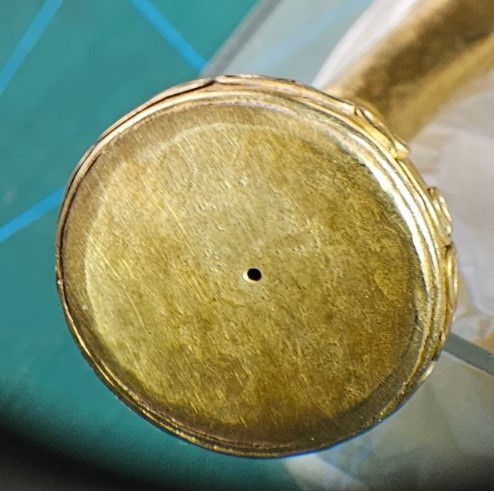
The severely abraded face of the terminal (Fig. 7), which could not be achieved in any other way than but intentionally, and which also rubbed through the cap surface, also adds to the overall impression that the maker of this torc was no skilled goldsmith.
It is always possible that, if the torc was Iron Age, it was created by more than one person, with variable skillsets. An alternative theory could be that the torc body was made earlier, and then decorated at a later date. However, the consistent problems with the torc, from the crude making of the terminal cone, through to the inexpertly applied decorative wires suggests that multiple makers can be ruled out. The similarity of alloy composition across the piece would also make later decorative additions unlikely.
However, the choice of an expensive gold alloy being used to make it, the use of a sheet work technique in the neck ring, the apparent earlier Iron Age date and the style suggest the goldsmithing should be at least competent, as all other Iron Age sheet torcs of this date are. And yet it isn’t.
Findspot
The ‘Pulborough Area’ torc was also found in the ‘wrong’ place. Although torc finds are constantly emerging – for example Newark in 2005, Blair Drummond in 2009, Leekfrith in 2016 – no other Iron Age gold torcs have been found east of Hengistbury Head, Dorset (Bushe Fox 1915) or south of Essendon in Hertfordshire (British Museum accession number: 1994,0401.1 to 1994,0401.52). So again, although entirely possible as a torc findspot, it is again unusual.
The finding of the torc in a flat, boggy area, close to water also does not match the usual site of deposition of Iron Age torcs, which are almost all found on slopes, or on raised ground (Machling & Williamson 2023). The find site, which we have visited, would however – with oak trees and a small pool in a glade – conform well to the Victorian/Edwardian ideal of a Celtic druidic sacred site.
Revivals and replicas
From the middle of the 19th century, inspired by the findings at Pompeii and other archaeological sites across Europe and the Near & Middle East, interest in archaeology flourished. Original artefacts from these periods increased in value and interest, with ‘The Great Exhibition’ of 1851 exhibiting many archaeological artefacts in the Fine Arts Courts (Auerbach & Hoffenberg 2008). From the late 1880s, first in Oxford and then in London, annual archaeological exhibitions were being held (Thornton 2015, 3) which showcased the latest finds from across the world.
Fashions in jewellery followed these trends. Coined ‘Revival’ or ‘Archaeological Revival’ jewellery, from the mid-19th to the mid-20th centuries, the works of popular ancient ‘cultures’ were replicated, pastiched – and forged – with Roman, Greek, Etruscan, Egyptian and Celtic works, amongst others, receiving a modern re-working in gold and gems (Craddock 2009, 1; La Niece 2009, 329).
At the peak of the craft was the Italian goldsmith dynasty of the Castellanis, founded by Fortunato Pio Castellani in 1814. His son, Alessandro Castellani, brought the company to its peak, re-creating and re-imagining complicated Etruscan pieces for collectors and connoisseurs in the later 19th century (Soros & Walker 2004).
Castellani junior also had an interest in repairing, improving – and even forging – copies of original Etruscan pieces and several of his works made their way, either by design or innocence, into the archaeological collections of museums and collectors across Europe (La Niece 2009, 332; Craddock 2009, 384; Fig. 22).
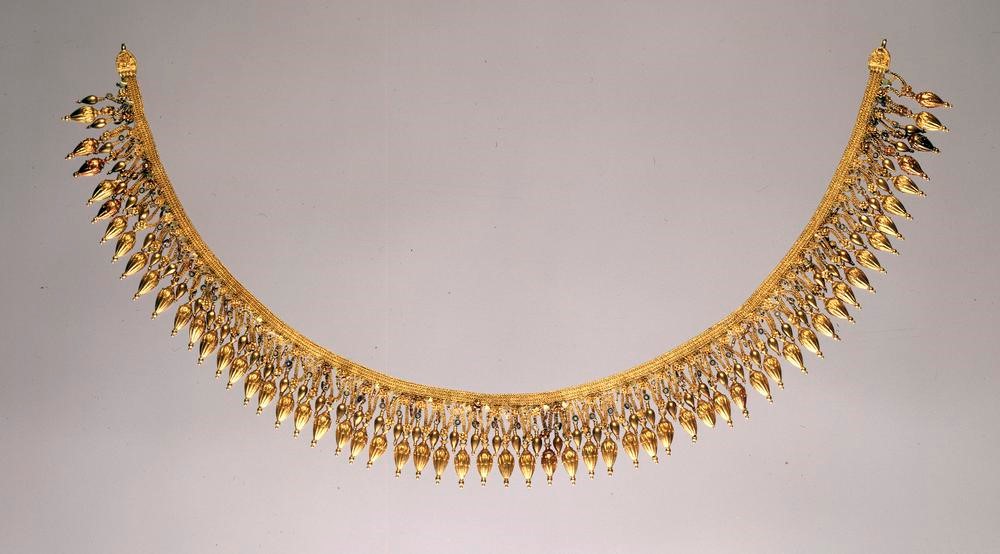
Many of Castellani’s replicas/forgeries were only uncovered due to his use of drawn, rather than ‘strip twisted’, wire (Meeks 1998). However, as has been discussed in Background above, the knowledge that Berthelot appears to have recognized – and wrote about – the ‘strip twist’ wire technique in the later 19th century suggests that there may be other replica/forgery makers out there who might be less easy to unmask using this technique.
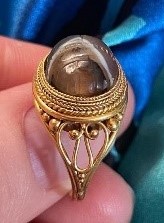
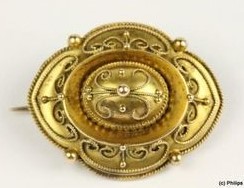
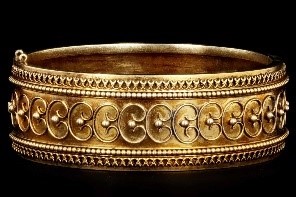
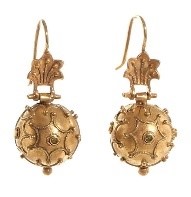
Even on the local High Street, mass produced and cheaper versions of ‘Archaeological Revival’ jewellery became a Victorian and Edwardian ‘must have’ item. Often featuring applied wire and granulation typical of the Etruscan period, a huge range of brooches, bracelets, rings, necklaces and earrings – of varying quality – was produced (Fig. 23).



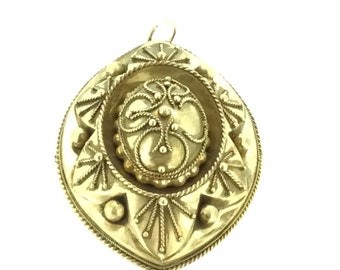
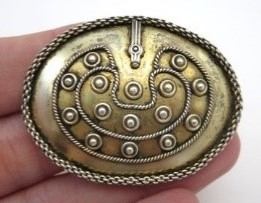


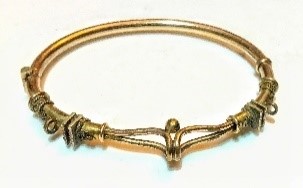


Beyond the world of jewellery, the fascination with archaeology spawned historically themed pageants (Bartie et al 2020), fairs and fancy dress balls. Many druid groups and lodges were also established at this time (Fig. 24).

There were even catalogues (for example, Schild 1881; Holt 1887) which described exactly what items to wear if you wished to portray, for example, Boudica (Fig. 25), an ancient Roman or a druidess.
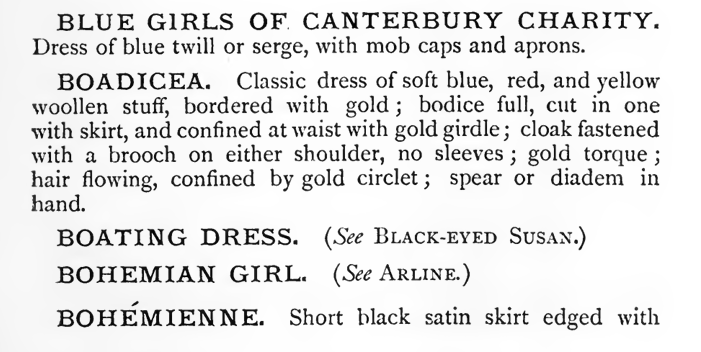
Helpfully, these catalogues also included details of where you could buy such apparel, including the appropriate accompanying jewellery (Fig. 26).

As Evelyn Gibson’s costume for the 1909 pageant shows (Fig. 24, top) there was often a reasonable understanding of the archaeological finds of the day, with her copy of the Waterloo helmet (British Museum accession number: 1998,1004.1) – found in the River Thames in 1868 – showing great skill in its bronze and enamelled, repoussé, early 20th century form (Fig. 27). However, as with the ‘Pulborough Area’ torc, it is not quite right.

Within this world of replicas, homages and fakes, it is possible that we have found the origins of the ‘Pulborough Area’ torc. As discussed, replicas and less ‘honest’ copies thrived during this period and, as mentioned previously, the British Museum holds such torcs, accessioned as genuine during the later 19th and earlier 20th centuries and only recognized as inauthentic recently thanks to developments in artefact analysis which show the gold alloy composition to be incorrect for the Iron Age (Fig. 28). These torcs are, however, very similar to the bracelets shown as being available to buy from various goldsmiths and silversmiths in the later 19th and earlier 20th centuries (Fig. 26).

In addition to the known fakes/forgeries there are a number of early 20th century genuine replicas of Iron Age torcs, including a copy of the twisted torc from Knock in Ireland (Fig. 29), which was made in gold by Dublin jeweller, Edward Johnson (Johnson 1901), in 1908 and is now held in the Met Museum collection in New York (Met Museum accession number: 08.23.23).
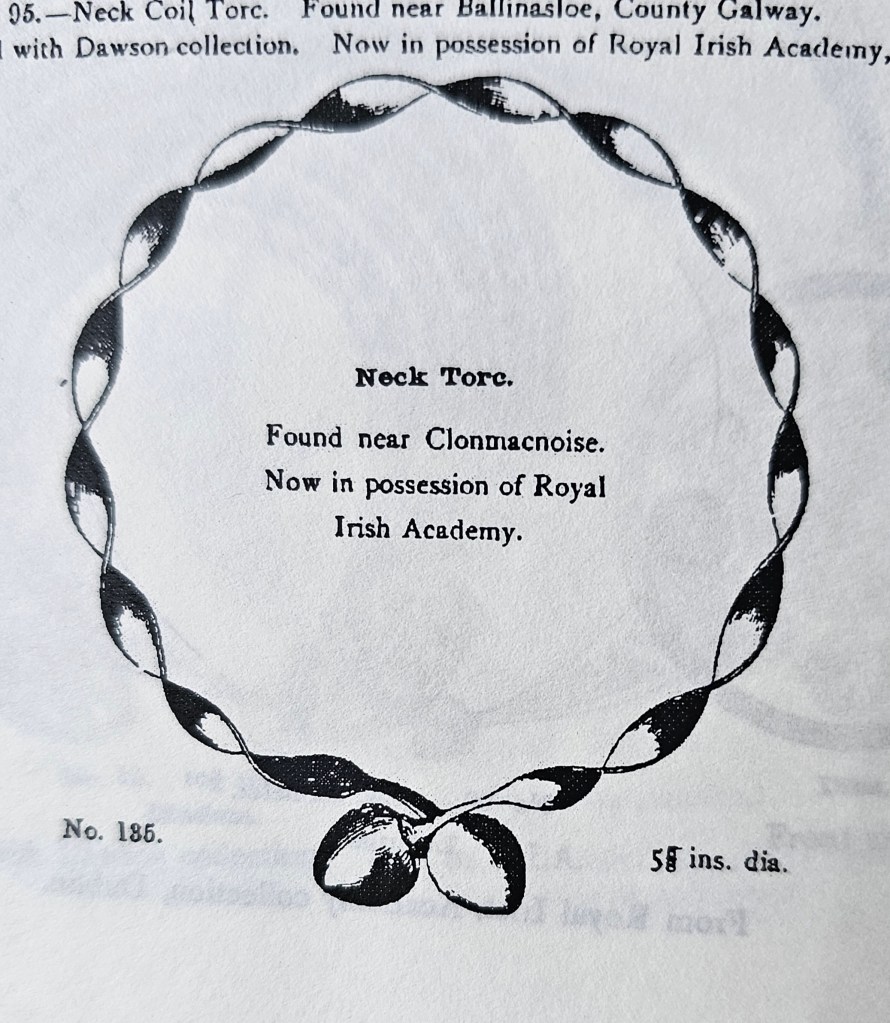
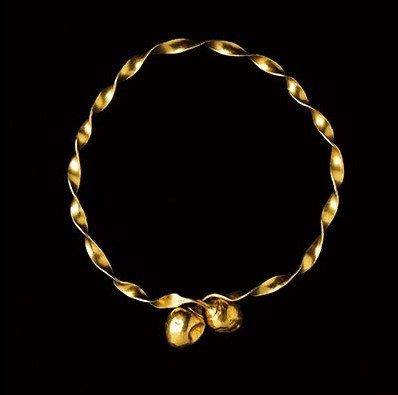
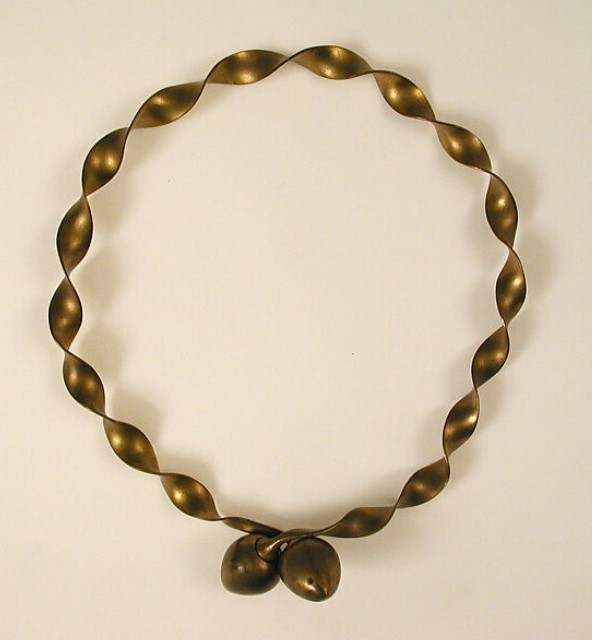
One of the troubling aspects of the ‘Pulborough Area’ torc could possibly be explained if we look at the alloy composition: much gold jewellery of the Victorian period was made using 14 carat, or often 15 carat, gold alloys. The composition of 14 carat gold is 58.3% gold and 15 carat – which was the legal standard in Britain between 1854 and 1931 – is 62.5% gold with the rest of the alloy being other metals. Both carats were in use in the later 19th and earlier 20th centuries.
If compared to the percentages of gold seen in the ‘Pulborough Area’ torc, the 56-61% gold content looks very similar. However, the copper amounts within the ‘Pulborough Area’ alloy are more suited to an Iron Age composition, although it would not be beyond the wit of a Victorian/Edwardian goldsmith to know – or be able to find – that out, particularly if they were using authentic Iron Age gold objects as an alloy source (see Iron Age coins below & Fig. 41). With modern tools and blow torches, the creation of sheet gold from an inferior gold alloy would also not be so difficult to achieve.
Inspiration
Interestingly, the number of torcs known in the later 19th and early 20th centuries was quite limited: the Snettisham torcs had yet to be found and it wouldn’t be until the first part of the 21st century that torcs like those from Newark, Leekfrith, Blair Drummond and Caistor would be found. As such, any maker in the Revival period would not have had these examples to call upon.
The discovery dates for all the torcs which are comparable to the ‘Pulborough Area’ torc fit with Revival dates: The Waldalgesheim burial was found in 1867, the Marnian torcs in the later 19th century. Filottrano was excavated in 1911. Meung-sur-Loire was found in 1836. The Knock torc, with the applied wire decoration, was found in 1861 and even advertised in The Queen magazine in that same year (Fig. 30). Interestingly, the Knock torc is also illustrated as broken.

There is, however, a further possible explanation for the oddities of the ‘Pulborough Area’ torc, which would seem to satisfy all aspects of this ‘all the right notes, but not necessarily in the right order’ torc. Living within the Revival period of the later 19th and earlier 20th centuries, Harry Price – author, ghost hunter, psychic researcher, amateur dramatist and archaeological forger – seems to be the most likely culprit.
Harry Price
Harry Price was born in London in 1881 but, as would become a habit, had invented an origin story for himself in which he had been born in Shropshire (Price 1942, 11). Having developed an early fascination for conjuring tricks and magic, in his younger years, by day he attended the Haberdasher Aske Hatcham boy’s school and in his spare time ‘enjoyed playing chess, collected old coins, kept small animals and could recite strange and sinister facts of history or nature’ (Morris 2006, 5).
An avid reader, Harry soon started writing too, contributing many articles to the school magazine, The Askean, on the topic of coin collecting, archaeology and mechanics (Morris 2006, 7). Similarly attracted to amateur dramatics, Price claims to have staged his first play in 1898, although the ‘coach house’ venue within which were ‘crammed eighty persons’ (Price 1942, 28) was actually the Club Rooms in Brockley (Morris 2006, 10). Having witnessed his first ghost as a schoolboy, the play (The Sceptic) was based on this experience and gave a foretaste of his ventures into the psychic and spiritualist world, for which he would become so famous in later years (Fig. 31).
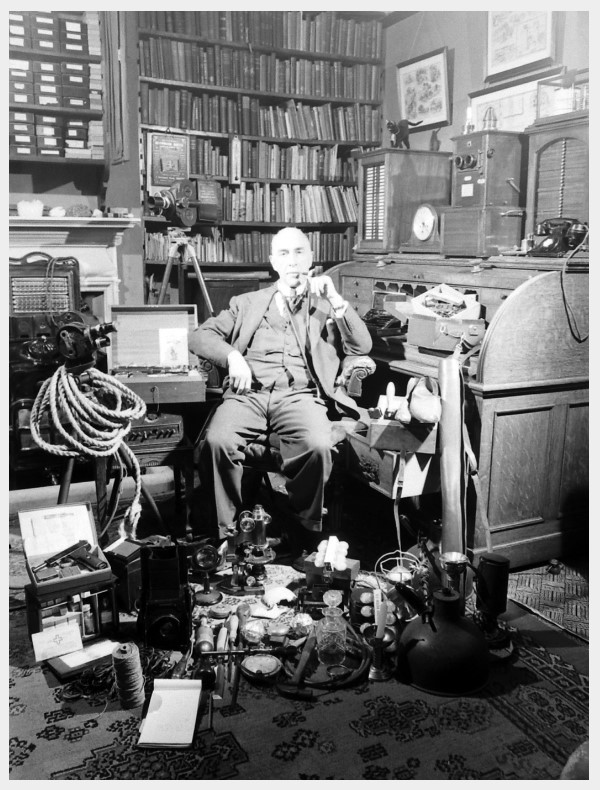
Apparently destined to be an engineer with ‘a life amongst the machine tools and in the drawing-office’ (Price 1942, 15), less than favourable school exam results led him to work within a paper factory. However, the desire to be an engineer remained: ‘If I could not be a professional engineer, I was at least determined to become an amateur one… I joined evening classes in mechanical engineering… establishing in my own home a laboratory and a power workshop’ (Price 1942, 16).
Further adventures in his younger years included founding a glue factory and being paid to photograph shop frontages for newspapers, whilst in his free time from working in paper, he wrote plays and light comedies. Having inveigled his way into the newspapers with an almost certainly false story about making the first portable radio transmitter and, relishing his success, he had paid to have his portrait painted by a friend (Morris 2006, 10).
Visiting Paris in 1902, he took in numerous illusion and conjuring shows (Morris 2006, 14). However, with his mother now sick, he was forced to work full time, becoming a commercial traveller, selling stationery and paper (Morris 2006, 14). Beyond work, magic and writing still filled his world. It was at this stage that Price’s move into archaeological notoriety began.
Harry the archaeologist
Between 1902 and 1904, Price wrote a series of articles on coins and tokens for the Kentish Mercury and the Wellington Journal (Senate House accession number HPF/3B/1). Claiming the work as his own, it would appear the articles were precis of William Boyne’s Trade tokens of the 17th century in England, Wales and Ireland. After joining both the Royal Astrological Society and the Numismatic Society, Price began falsely adding first MRAS and then MRAS FRNS as post-nominals (Hall 1978, 99). When the Ripon Naturalists Club and Scientific and Literary Association wrote asking him – on the back of his numismatic ‘fame’ – to become their Honorary Curator, Price leapt at the chance, not telling friends that the role was purely advisory, and nothing to do with the Ripon Museum (Morris 2006, 16). As Price states, ‘I had become an amateur archaeologist’ (Price 1942, 49).
By 1908, with his father dead and his London home sold, Price married heiress Constance Wright in Pulborough (Hall 1978, 52) and they moved into her mother’s house, Riverside, in the village, before having a home built at Arun Bank, Lower Street – the River Arun situated at the bottom of the garden.
Quickly throwing himself into village life, Price cultivated a circle of respectable friends, which included Canon Frederick Baggallay, rector of the local church, Romanist and collector of Roman antiquities (Morris 2006, 26). Price at this time claimed to be an established archaeologist, who had dug a Roman villa complex at Greenwich Park in 1902 (Price 1942, 49). Of course, Price being Price, these claims appear not to stand up and were almost certainly based on Price’s 1901 writing of a review for The Askean of A.D. Webster’s Greenwich Park: Its history and Associations (Price 1942, 50; Morris 2006, 27). Price’s further achievement of 1902 had been his discovery of ‘the remains of a prehistoric cave – complete with fireplace and flue’ (Price 1942, 51) in Shropshire. No evidence of such a fireplace or flue is recorded. However, Baggallay appears to have been fooled, and introduced Price to a wide circle of his antiquarian friends.
Lucky finds and forgeries
Price’s status as a Sussex antiquarian of note was sealed when, in 1908, Price made an astonishing archaeological discovery: a pristine Roman statuette (Fig. 32), dug out of the riverbank at the bottom of the garden at his Pulborough home!
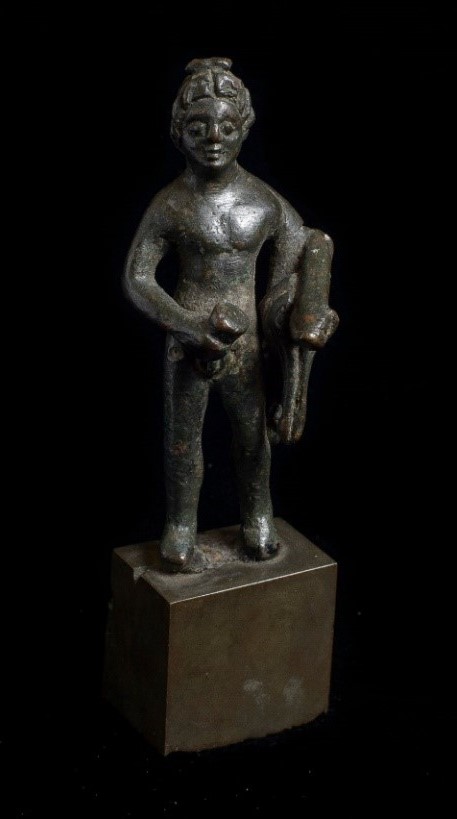
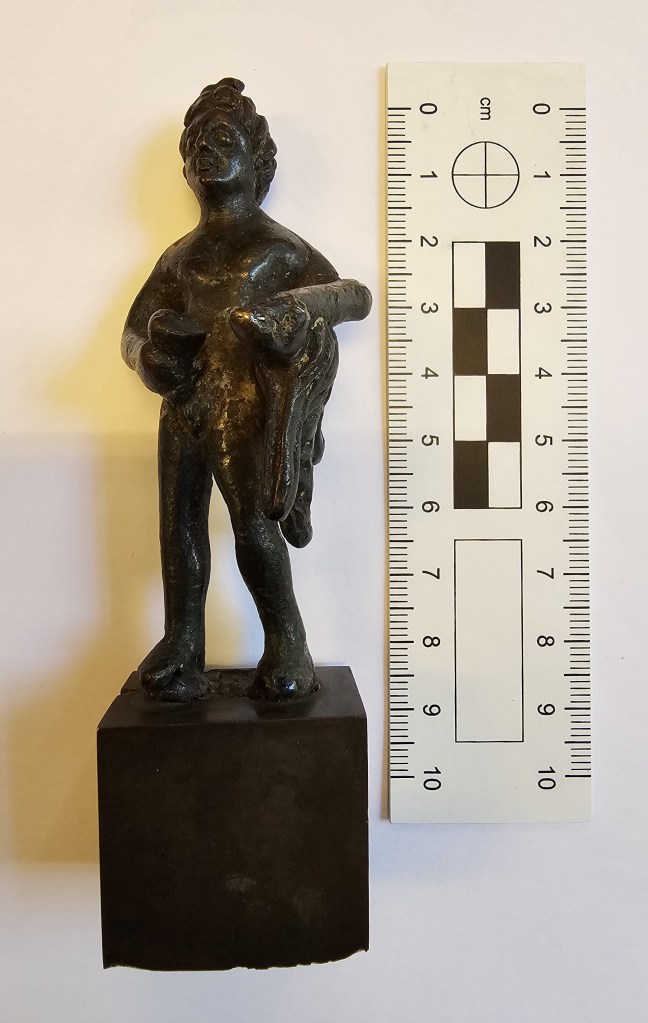
In Price’s words: ‘a beautiful bronze statuette of Hercules, 3¼ inches high, complete with club, lion’s skin, etc. I saw its legs sticking out of the river bank at the bottom of my garden, where the current had probably dislodged it. It most likely belonged to a Roman villa in the neighbourhood, and is one of the familiar household gods or lares which were kept ‘for luck.’ (Price 1942, 52).
A description of the finding by his brother-in-law, Robert Knight – in an interview given by his nephew Nigel to Richard Morris in 2005 – is a little more circumspect:
‘When Connie, Robert and his wife had disembarked, Price, as if stung by a wasp, jumped out of the boat and into the cold river. He began paddling around the landing stage, at the bottom of his garden, and after a few seconds of displacing water, fished out the statuette, much to the amazement of Robert Knight. However, Robert immediately suspected that all was not what it seemed and, right up until his death, believed Harry had bought the piece either in London or locally, or indeed had cast it himself, then planted the statuette where he had supposedly found it in the river’ (Morris 2006, 28).
Price of course went straight to the local press and a story about his find appeared in the West Sussex Gazette and in the Sussex Daily News shortly after (Morris 2006, 29; Senate House accession number HPF/3B/1/25). One of Price’s antiquarian colleagues was Charles Reginald Haines, a classics scholar, leading light in Sussex Archaeological Society and Fellow of the Society of Antiquaries of London. Haines, thinking that Price should exhibit his incredible find, put Price in touch with Richard Garraway-Rice.
The find was shown at a meeting of the Society of Antiquaries on Thursday 14th April 1909, and subsequently featured in the Proceedings of that year (Fig. 33) (SoA 1909, 361). That the item was the last on the Agenda for that evening’s business may, however, be telling.

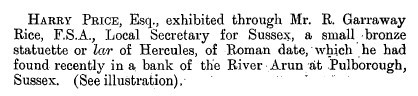
Price, now an established antiquarian of note – and using his 1881 copy of A.D. Dean’s A Roman History of West Sussex – gave lectures on Roman Pulborough from 1909. During his lecture, Baggallay supplied a range of Roman antiquities to view, which Price – unsurprisingly – alluded to as being from his own collection.
Described in an editorial of the Sussex Daily News as having ‘an extensive knowledge of antiquities’ (Morris 2006, 27), the West Sussex Gazette made mention of Price’s own hoard of coins, ‘discovered over a period of years’ (West Sussex Gazette, 28/12/1909). The coins had, of course, been purchased, rather than found.
Price had by now also managed to obtain himself a regular antiquities column in both the West Sussex Gazette and the Southern Weekly News and a quick succession of new ‘finds’ were now made by Price. A perfect bronze axe head and an extremely rare flint dagger (reported in Sussex Notes and Queries in 1940) were found by Price on the Downs at Parham and, closer to home, a carved bone and silver ingot were also discovered near Park Mount, Pulborough (Fig. 34). The carved bone and ingot are of particular relevance to this paper – and the mystery of the ‘Pulborough Area’ torc.
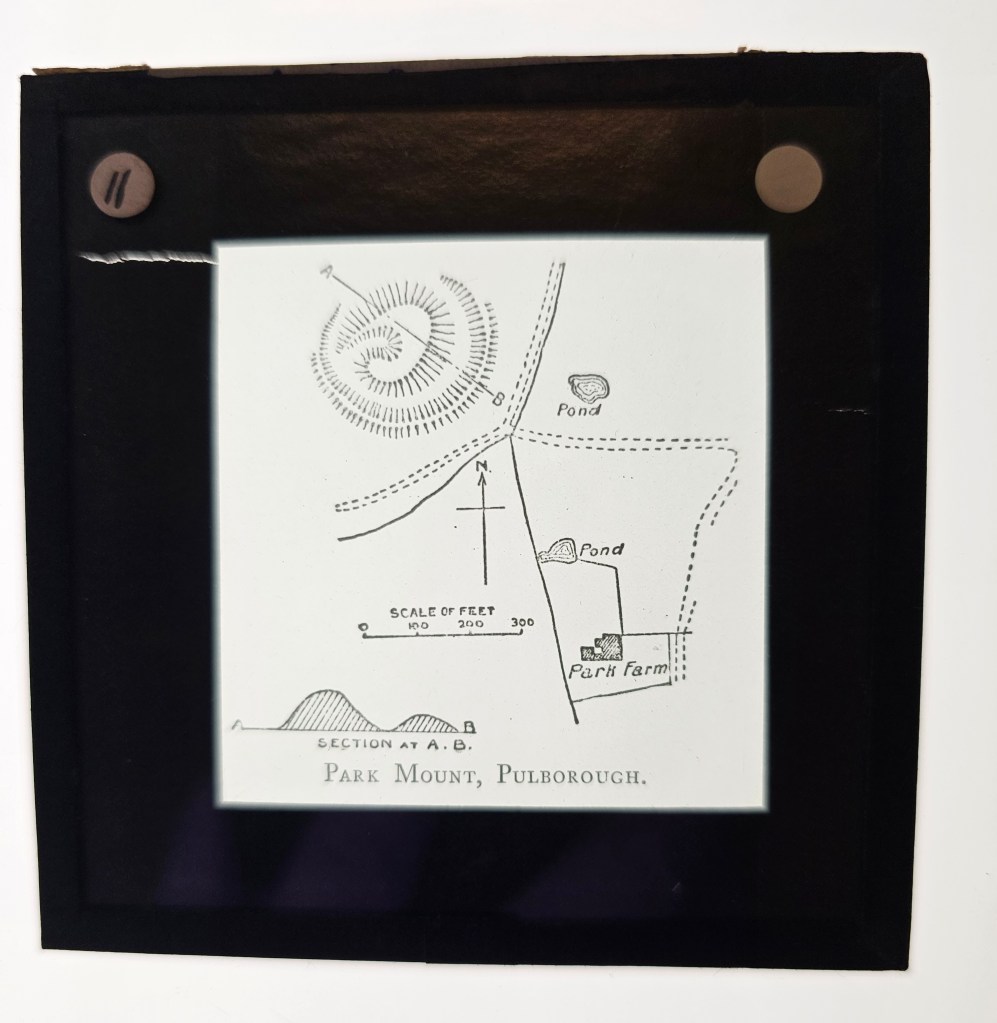
Measuring 6 inches long, by 1.5 inches wide, the bone was decorated with runic characters, an undulating wave and two semi-circular lines (Fig. 35). In Price’s words:
‘Of still greater antiquity is the inscribed bone that I found after a field had been newly ploughed. It is inscribed with eight characters, probably Runic. The bone appears to be a portion of a rib of an ox, and in addition to the characters has two semi-circular lines deeply engraved on it. It has been suggested that one of these curves represents the contour of the South Downs (near where it was found) and the other, a bend of the River Arun, close by. In addition, there is a triangular mark or Greek delta, which may represent the mound or camp where the bone was found. If this theory is correct, we have quite the earliest pictorial representation ever made of Sussex scenery’ (Price 1942, 53).
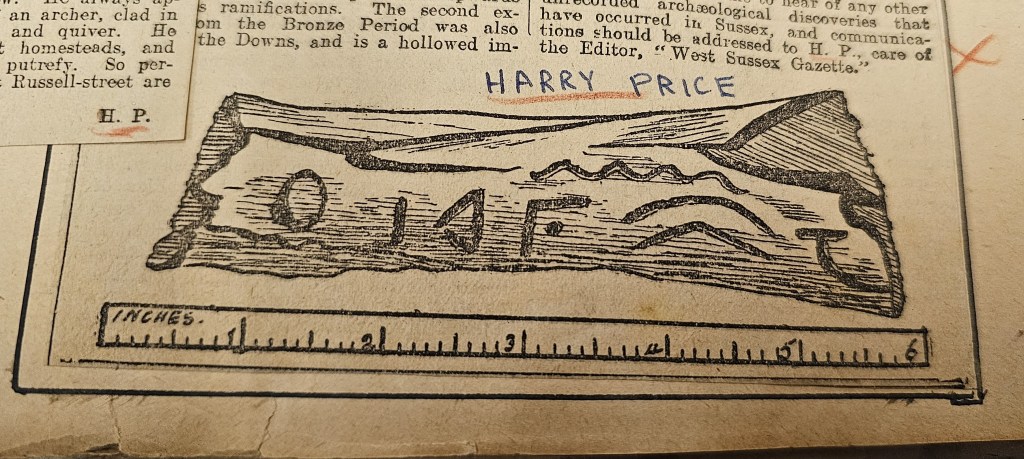
The bone was duly sent to the British Museum and, serendipitously, they responded within a fortnight, just in time for Price’s next newspaper column on 1st July: ‘they believe the bone is some form of magical rite and in fact the carved characters are cabalistic. Of course there is a great deal of magic associated with this area so our friends at Russell Square could be right’ (West Sussex Gazette, 1st July 1909). There is no mention of who Price consulted, and any such supposed response should, coming from Price, be treated with caution.
Also in 1909, Price ‘found’ the artefact that would cause his downfall in the archaeological community. Again, ‘the mound or camp’ of Price’s inscribed bone was the location of his new find: a Roman silver ingot (Senate House accession number: HPI/6/3/6). The ingot was rectangular in form, and had a cast inscription, apparently of Honorius, on the upper surface. Again Price had an extremely rare and nationally important find (Fig. 36).
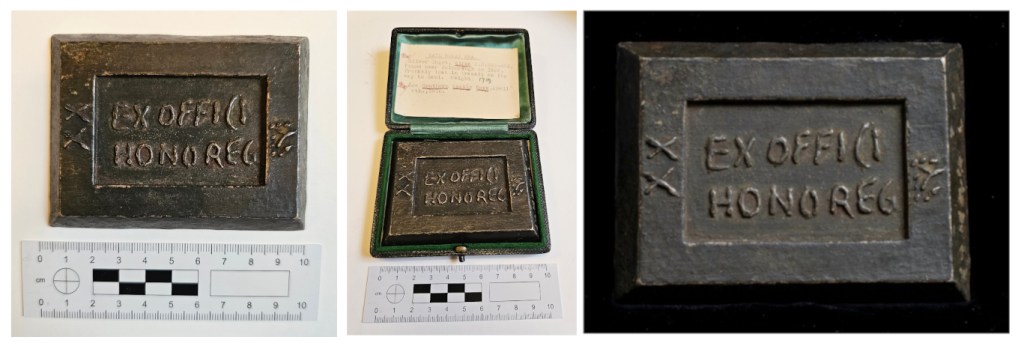
In Price’s words: ‘The most interesting thing I discovered was a perfect specimen of a Roman silver ingot which I picked up in 1909 on the surface of a ploughed field on top of Park Mount, Pulborough. This ‘mound,’ or high hill, is artificial, and was constructed by the Romans west of the present railway in order to guard the great military Stane Street that ran from Londinium to Regnum (Chichester). An armed camp or mansio was stationed there.
The ingot, weighing one and a half Roman pounds (seventeen ounces avoirdupois), is an oblong measuring 3 inches by 2 inches, and is half an inch thick. On a sunken label are the words: Ex Offici Hono Reg. The inscription means perhaps that the ingot was ‘from the workshop of Honorius or Honorinus.’ It was probably lost in transit on its way to Bosham or Chichester harbours, en route to Rome to be turned into money. Its date is between 395 and 423 A.D.’ (Price 1942, 52).
Price’s Roman ingot, only the third to ever have been found, and the first of this shape immediately caused a sensation within his friendship group. Haines supported Price’s theory and held his own lectures on the ingot (Morris 2006, 31).
However, there was soon suspicion raised about the ingot. In 1902, Charles Dawson (later of Piltdown Man forgery fame) had discovered two stamped tiles (British Museum accession number 1908,0613.1) at Pevensey Castle in East Sussex. The tiles carried an inscription ‘Hon Aug Andria’ which dated the final phase of the fort to the time of the Emperor Honorius in the late 4th/early 5th centuries AD. Publishing his findings in 1907 – in the same Proceedings of the Society of Antiquaries that Price so coveted – it is interesting that the ingot inscription date is comparable.
Dawson had been clever enough to make his find convincing with an accurate Latin inscription and plausible findspot. So convincing in fact that the tiles were only proved to be fake in the early 1970s (Russell 2003, 102). Price, however, hadn’t used the correct Latin and, what is more, at 471g in weight, his silver ingot appears to have been composed mainly of lead! Interestingly, the discovery of the find only came to light through a piece in the West Sussex Gazette on Thursday 6th January 1910. Reporting on a lecture on Roman Pulborough – given by Price on 28th December 1909 – the ingot was mentioned for the first time. As was Price’s supposed central involvement in the Borough Roman villa excavations at Pulborough (Fig. 37):
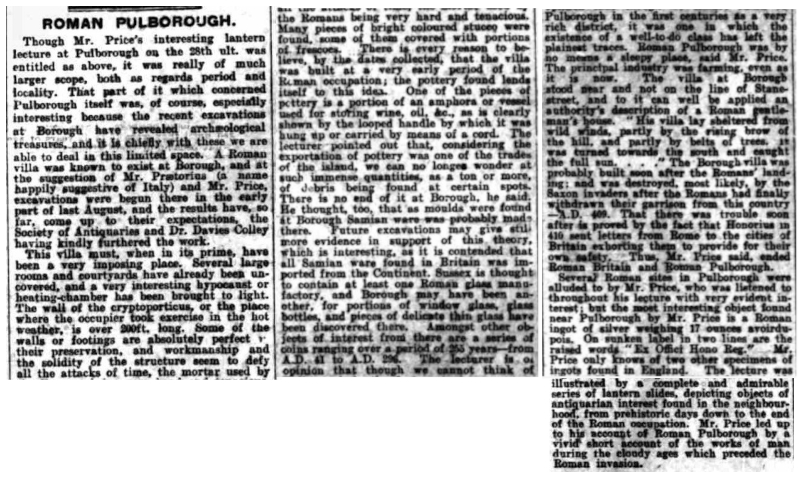
In the end this article proved to be Price’s downfall. In the letters page of the following week’s paper, on Thursday 13th January, a swift rebuttal of Price’s claims regarding his involvement in the Borough villa excavations was given by no less than the President of the Society of Antiquaries, Sir Charles Read. Read was also Keeper of British and Mediaeval Antiquities and Ethnography at the British Museum (Fig. 38).

In the following week, Price responded (Fig. 39):
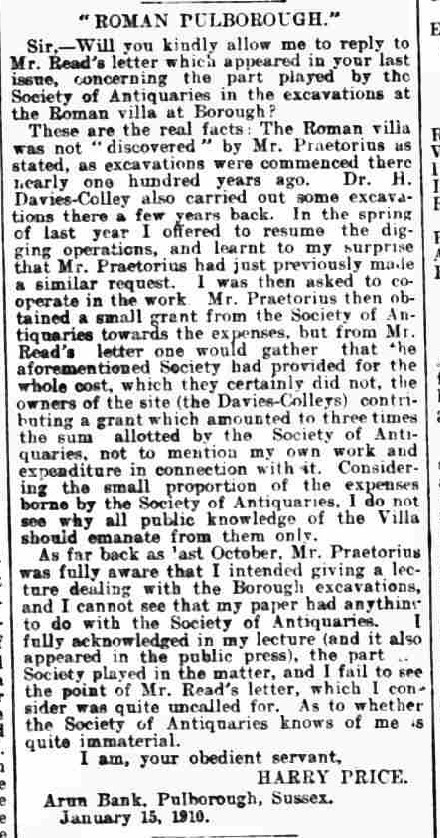
However, by this point it appears that it was too late: Price had been found out. On Thursday 10th March 1910, Charles Praetorius reported the findings from his excavations at the Borough Roman villa in Pulborough (Praetorius 1911) at a meeting of the Society of Antiquaries in London. In remarks following, the noted Roman scholar, Professor Francis Haverfield commented that Price’s ingot was undoubtedly ‘an inferior copy’ (Praetorius 2011, 129) and metal specialist Professor William Gowland ‘concurred’ (Fig. 40):
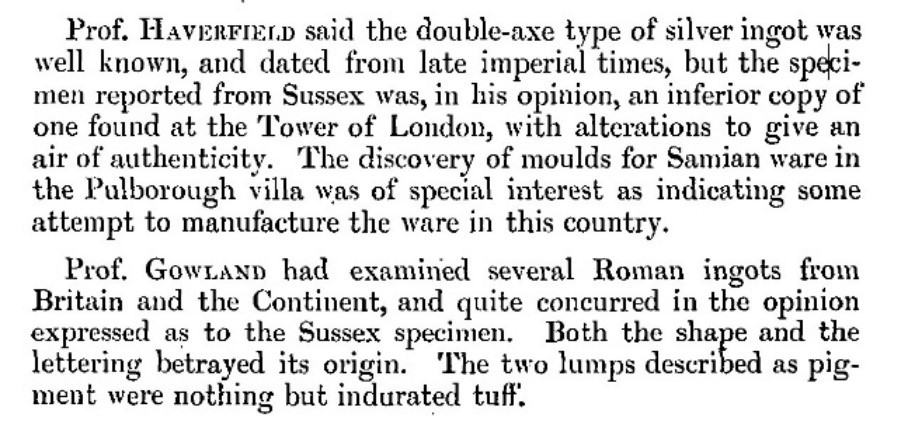
Price’s game was up. Price lost his coveted newspaper columns and his friend Haines’ archaeological integrity was finished, forcing him to resign from a number of organisations. Price also lost several friends. Of course Price being Price, this was not quite the end of his archaeological endeavours and he continued to give lectures until 1911, those lectures now apparently based on Dawson’s work at Sussex castles! (Morris 2006, 33). There is, however, a footnote to Price’s archaeological shenanigans.
Iron Age coins
In 1923, Price had loaned his coin collection to St Mary’s Church, Pulborough for an exhibition. However, all did not end well:
‘What finally put an end to my serious numismatic activities was the fact that I had a fine and rare collection of the ancient gold coins of the Sussex princes…stolen from Pulborough church. The coins included those of Tincommius, Verica, and others. Some were unique…It was during this year that I placed my collection of Sussex coins on loan for exhibition in our local church. The coins included traders’ tokens, Anglo-Saxon pieces struck at Sussex mints, the pre-Roman gold coins I have mentioned, medallions, etc. On September 26, 1923, a telegram was handed to me in London saying that the gold coins in the church had been stolen – probably by a collector, as visitors were allowed to go in and out of the church as they pleased. They were never recovered. All the satisfaction I received was a polite note from the Church Council expressing their ‘sincere regret’ for my loss. I received no compensation. If the loss had occurred anywhere except in my own village, I would have taken drastic action in the matter. It was an unfortunate business. My book on the Sussex coins remains unfinished to this day, as I lost all interest in it’. (Price 1942, 51).
Within the Harry Price archive, a document in HPA/4/7 (Fig. 41) gives a further clue as to what may have happened. This Metropolitan police report details the fifteen gold coins stolen from Pulborough church: ten staters, four quarter staters and a ‘globule à la croix’/bullet coin. With staters weighing approximately 4.5g-6.5g, quarter staters 1g-2g and ‘globule à la croix’ coins weighing c.6.5g, it is possible to say that the likely weight of all fifteen lost coins would be between 50.5g-70.5g. The ‘Pulborough Area’ torc weighs 57.54g.
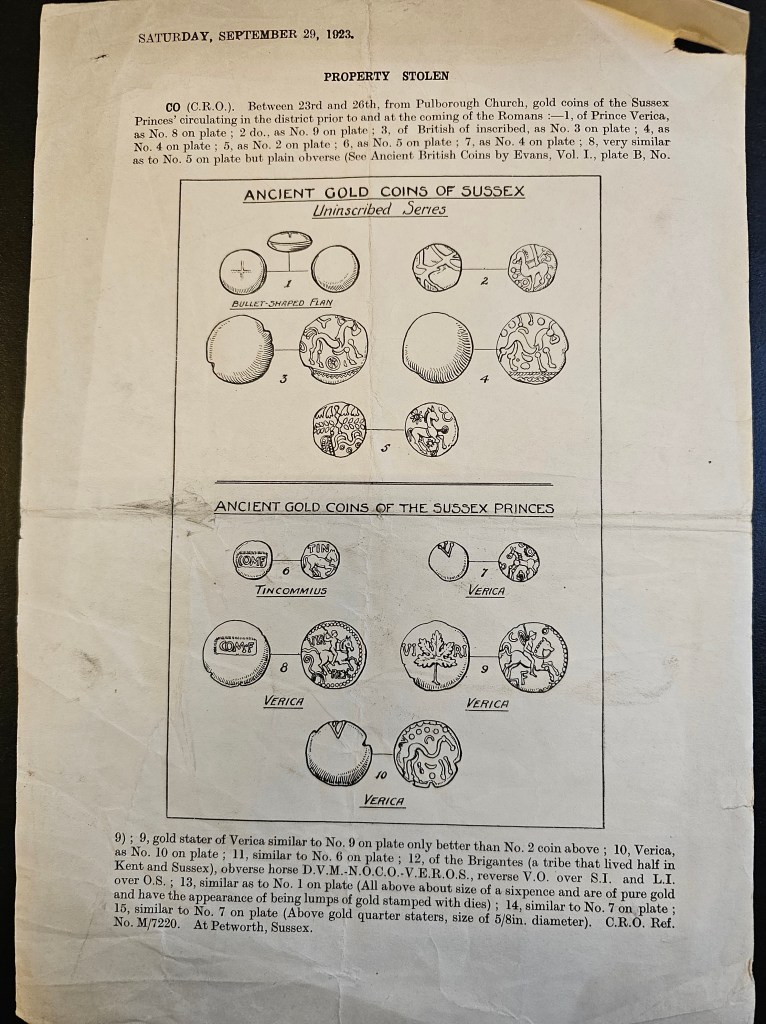
A scan of the Harry Price archive also shows, under HPI/6/3/1, three surviving gold Iron Age coins which were transferred to Senate House when Price died. These three coins – quarter staters, two of Verica and one of Tincommius – are the same as those coins described in Numbers 11, 14 and 15 in the crime report above (Fig. 41). As such, it is difficult not to assume that we may have found the source of the alloy used to make the torc and that, perhaps, there were a few coins left after the making of the half-torc.
Harry Price and the ‘Pulborough Area’ torc
In the early 20th century, with the backdrop of the increased interest in archaeological matters and the Archaeological Revival in full swing, Harry Price lived in Pulborough and forged archaeological finds. Each one was rare and nationally important and – if real – would have changed the face of British archaeology at the time. The majority of his finds were made in Pulborough itself, close to his home and surrounds. The necessity of keeping the findspot of the ‘Pulborough Area’ torc confidential does not allow the authors to disclose the precise locale, but we can say that the torc was found within 500m of two of his other ‘finds’, and close to footpaths almost certainly used by Price. As Morris states: ‘whenever Price went for a walk with his black Labrador or with a friend he would invariably find a lost treasure’ (2006, 28).
But was Harry Price up to this challenge? We know he was capable of casting, owned a well-appointed workshop and appears to have a connection to – or perhaps wished to emulate the findings of – master archaeological forger and his Sussex archaeological contemporary, Charles Dawson. Morris even goes so far as to suggest that, as fellow members of the Sussex Archaeological Society and the Royal Societies Club – who shared patrons and friends – ‘it is absolutely conceivable that Dawson and Price worked together’ (Morris 2006, 32).
An aspect that would suggest this is not the case is that Price’s forgeries were clumsy and easily disproved, whilst Dawson retained his credibility for many years, only being definitively unmasked some 40 years later. However, if Price was responsible for making, or having the ‘Pulborough Area’ torc made – perhaps by a jeweller working in the Revival style of applied wire decoration – then we should maybe not judge all his forgeries as quite as clumsy as the lead ‘silver ingot’.
We do not know if Price knew Dawson was a forger but, if he did, perhaps this is where he got his ideas from. Both Price and Dawson forged bone items (Russell 2003, 86), and both created Roman statuettes at around the same time: Price’s in bronze and Dawson’s in iron (Russell 2003, 61). There is also the Honorius connection in Price’s ingot and Dawson’s tiles. From what we know about Price, he was – if nothing else – extremely able to unmask fraud, later succeeding in exposing a number of psychic frauds in his career in that field. Perhaps he recognised a fellow fraudster in Dawson. Perhaps they even worked together, a joke at the expense of the antiquarians from the Society of Antiquaries and the British Museum, who had quietly sneered at the findings of both men.
What we do know is that Harry Price was well read, widely travelled in France and Germany and that he mixed in antiquarian circles. His library, now held at Senate House, University of London, contains several books of archaeological finds. Price was also not averse to forging finds from different periods and had collections of gold coins from the Iron Age, which could provide an authentic material to make a torc from. He would also have likely known about the Waldalgesheim and Marnian torcs and may even have seen the Meung-sur-Loire torc during his many visits to the Gold Ornament Room in the British Museum (Southern Weekly News, 16th April 1910: Senate House accession number HBF/3B/1/93).
No matter what, we cannot ignore the resemblance of the ‘Pulborough Area’ torc – with its applied wires and pastiche of Iron Age torcs – to Revival pieces of the period. We cannot ignore its clumsy manufacture and, most tellingly, the intentionally abraded terminal face. Maybe the torc was designed to be yet another of Price’s spectacular finds. Perhaps, unlike the planted Arun river bank statuette, when he went back to make his find he could not locate the torc – gold is heavy and the torc piece is small – in the boggy ground. However, unless further work identifies a ‘smoking gun’ of evidence, it is likely we will never know for sure.
The importance of the ‘Pulborough Area’ torc
Although the ‘Pulborough Area’ torc may not be Iron Age, this does not make it any less interesting, or important, archaeologically. As a rare example of a Revival period interpretation of an Iron Age torc, it can offer us an insight into the history of archaeological thought and its understanding in wider society during the Victorian/Edwardian period. Archaeological forgery is also a little explored topic, and the ‘Pulborough Area’ torc potentially adds to the limited corpus of study material. The suggestion that several such forgeries were made in Sussex, during the same time period – but by different people – also needs to be examined.
Despite the research that still needs to be done (see Next steps below), we believe that we have made a sufficient case to suggest that the torc is not Iron Age, but made during the Revival period of the later 19th and earlier 20th centuries, probably by – or for – Harry Price, who buried it in a Pulborough field. We can only speculate as to why Harry Price made the torc, nor will we know precisely why the torc was never recovered – although it seems likely that Price probably never meant it to be lost but that, for whatever reason, he could not locate the torc again. Future research will, however, help to clarify further details of this wonderful find: an important addition to the story of Sussex archaeology.
Next steps
Although the torc is suspicious, there are several further stages of investigation – both scientific and archival – which have the potential to further shed light on this torc and its provenance. The archival work is ongoing and we will be aiming to undertake the other aspects in due course.
Scientific
- The torc exhibits different colours of gold – which indicate possible differences in the alloy content – and also areas of discolouration. The bulbed collar with ‘beaded’ decoration (and possibly the terminal cone) appear to have been cast, whereas the tubular neck sections appear to be sheet metal. It would be of interest to learn if the cast section was composed of the same alloy as the sheet metal sections, and if the alloys of the sheet metal sections are consistent with each other. For similar reasons, the different sections of wire used in the torc should be examined. X-ray Fluorescence would give a good indication, especially if there are trace elements that could indicate whether the alloys are consistent with those used in the Iron Age.
- The torc also exhibits large quantities of solder that spread out from where the wire decorations are joined. Since this is uncharacteristic of Iron Age torcs, it would be informative to analyze the alloy content of the solder, again to check if the solder is consistent with that used in the Iron Age.
- The spiral markings on the wire may not be the result of twisting the wire, as some markings are inconsistent and appear not to continue around the full circumference of the wire. Microscopic examination or the use of SEM would be useful to see if the diagonal depressions are the result of twisting metal to manufacture wire, or if they are diagonal gouges that do not continue around the circumference of the wire.
- Several points of the torc exhibit regular fine abrasion, particularly on the terminal face. Close examination of the abrasion under magnification could shed light on whether it is the result of modern or ancient abrasive techniques, or of the burial environment.
Archival
- Examination of the Harry Price archive, especially the papers that refer to his antiquarian pursuits will be necessary to see whether there is mention of, or perhaps even photographs of, torcs. Checking of the antiquarian related volumes and correspondence within his library could show whether he was aware of, or could have seen, the French and German torcs mentioned in the text above.
- A further aspect of the archival research would be to examine the relationship between Price and Charles Dawson, and the wider Sussex archaeological community at the time. It is thought there is correspondence between Dawson and Price within the archive, and this should be checked.
- An examination of the ingot and statuette would also be desirable to explore which techniques were used in their manufacture, and whether there are comparable techniques seen in the ‘Pulborough Area’ torc.
- If this torc was made from a gold alloy with an Iron Age/Roman composition, Price’s coin collection could be a source of material. The coins now preserved in the Price archive in Senate House could be checked, both against the quantities mentioned in Price’s paperwork and also examined to establish any similarities in alloy composition.
Acknowledgements
Our thanks go to Emma O’Connor, Leanne O’Boyle and the Sussex Archaeological Society for allowing us to examine the torc. To Colchester Museum for alerting us to Evelyn Gibson’s costume and for allowing us to reproduce the images. To Charles Harrowell, Emily Chu, Christos Fotelis and the staff in Special Collections, Senate House Library for their assistance in tracking down correspondence in Harry’s archive and for alerting us to the locations of other elements of Price’s archive. Thanks also go to Sophia Adams and the British Museum for providing the Treasure Report. Thanks are also due to the detectorist, for finding the torc and reporting it.
We would also like to thank Cat Rees, Kayt Hawkins, Kel Barrass, Lisa Brown, Duncan Mackay and Robert Chapple – who read this paper before publication – for their generous insights, thoughts and guidance. However, all errors and omissions remain the authors’ own.
A final thanks must go to Harry Price, who made researching this paper a source of huge entertainment. We tried really hard to fit Gef the Talking Mongoose, the supposed Albatross glider experiments, the Borley Rectory hauntings, his attempts to turn a goat into a prince in Nazi Germany, the Martian telegrams and Harry’s World War One munitions works into this paper, but we really couldn’t – if you have some spare time, do Google ‘Harry Price’: we guarantee you won’t be disappointed!
Tess Machling, Roland Williamson & Giovanna Fregni, September 2023
References
Adams, S. 2021. Treasure report for HM Coroner for Pulborough Area torc, 2019 T560. British Museum.
Armbruster, B & Guerra, M. F. 2012. Annular gold ornaments from western Gaul: Archaeometallurgical aspects of the Lasgraȉsses ensemble, Tarn, France (3rd century BC). Historical Metallurgy 46 (2), 55–65
Auerbach, J. A. & Hoffenberg, P. H (eds). 2008. Britain, the empire, and the world at the Great Exhibition of 1851. Ashgate, Aldershot.
Bartie, A., Fleming, L., Freeman, M., Hutton, A., & Readman, P. 2020. Restaging the Past. UCL Press, London.
Berthelot, M. 1888. Collection des anciens alchimistes grecs. G. Steinheil, Paris.
Bushe Fox, J.P. 1915. Excavations at Hengistbury Head, Hampshire in 1911-12. Society of Antiquaries of London.
Clarke, R.R. 1951. A Celtic torc terminal from North Creake, Norfolk. Archaeological Journal 106, 59–61
Craddock, P. 2009. Scientific Investigation of Copies, Fakes and Forgeries. Elsevier, Oxford.
Echt, R., Marx, M., Megaw, V., Thiele, W.-R., Van Impe, L. and Verhart, L. 2011. An Iron Age gold torc from Heerlen (prov. Limburg/NL). Archäologisches Korrespondenzblatt. 31. 31-49
Eluère, C. 1987. Celtic gold torcs. Gold Bulletin 20, 22–37.
Hall, T.H. 1978. Search for Harry Price. Duckworth, London
Holt A. 1887. Fancy dresses described, or what to wear at fancy balls. Debenham & Freebody, London.
Hunter, F. 2018. The Blair Drummond (UK) hoard: Regional styles and international connections in the later Iron Age. In Schwab, R; Milcent, P-Y; Armbruster, B & Pernicka, E (eds), Early Iron Age Gold in Celtic Europe: Science, technology and Archaeometry. Proceedings of the International Congress held in Toulouse, France, 11-14 March 2015, 431-440. Verlag Marie Leidorf GmbH, Rahden
Ireland, A. 1992. The Finding of the ‘Clonmacnoise’ Gold Torcs. Proceedings of the Royal Irish Academy, 92C, 4, 123-146.
Jacobstahl, P. 1969. Early Celtic Art. Clarendon Press, Oxford.
Joachim, H-E. 1995. Waldalgesheim: Das Grab einer keltischen Furstin (Kataloge des Rheinischen Landesmuseums Bonn) Rheinland-Verlag in Kommission bei R. Habelt.
Joffroy, R. 1969. Le torque de Mailly-le-Camp (Aube). In Monuments et mémoires de la Fondation Eugène Piot, 56, 45-59.
Johnson, E. 1901. Illustrated supplement to the descriptive catalogue published by Edmond Johnson of fac-simile reproductions of Irish antique art metal work : specially manufactured for exhibition at the World’s Fair, Chicago, 1893; the International Exposition, Paris, 1900; and the International Exhibition, Glasgow, 1901; and as supplied to the principal museums of America, Great Britain, and the Continent / Dublin, Ireland 1901. Dublin
Jope, M. 2000. Early Celtic Art in the British Isles. Oxford University Press, Oxford.
Kurz, S & Wahl, J. 2005. Zur Fortsetzung der Grabungen in der Heuneburg-Außensiedlung auf Markung Ertingen-Binzwangen, Kreis Biberach. Archäologische Ausgrabungen in Baden-Württemberg. 2005, 78-82.
La Niece, S. 2009. Forgeries and public collections. ArchéoSciences, 33. 329-333.
Machling, T. 2022. Pattern and purpose: a new story about the creation of the Snettisham Great torc. Available online [Accessed 16/8/23].
Machling T & Williamson R. 2019. ‘Damn clever metal bashers’: The thoughts and insights of 21st century goldsmiths, silversmiths and jewellers regarding Iron Age gold torus torcs. In C. Gosden, H. Chittock, C. Nimura & P. Hommel (eds), Art in the Eurasian Iron Age: Context, connections, and scale. (Oxford). Available online [Accessed 16/8/23]
Machling, T. & Williamson, R. 2020. ‘Investigating the manufacturing technology of later Iron Age torus torcs’. Historical Metallurgy. 52, 2 (for 2018), 83-95. Available online [Accessed 16/8/23]
Machling, T. & Williamson, R. 2023. Beyond Snettisham: a reassessment of gold alloy torcs from Iron Age Britain and Ireland. Pre-print. Available online [Accessed 16/8/23].
Meeks, N. 1998. A Greek gold necklace: A case of dual identity. In D. Williams (ed) The Art of the Greek Goldsmith. British Museum Press, London, 127–138.
Morris, R. 2006. Harry Price: The psychic detective. Sutton
Oddy, W.A. 1977. The production of gold wire in antiquity. Gold Bulletin. 10, 3. 79-87.
Ogden, J.M. (1994). The technology of Medieval jewelry. In D.A. Scott, J. Podany & B. B. Considine (eds) Ancient & historic metals: conservation and scientific research. Proceedings of a Symposium Organized by the J. Paul Getty Museum and the Getty Conservation Institute, November 1991
Praetorius, C. 1911. Report on the villa at Borough Farm, Pulborough. Proceedings of the Society of Antiquaries of London. 23, 121–9.
Price, H. 1942. Search for Truth: My Life for Psychical Research. Collins, London
Raftery, B. 1983. A catalogue of Irish Iron Age antiquities. Druckerei Kempkes, Marburg.
Reims. 2023. Buffer torque. Available online [Accessed 16/8/23].
Russell, M. 2003. Piltdown Man: The secret life of Charles Dawson &the world’s greatest archaeological hoax. Tempus.
SAS. 2023. Appeal to secure Iron Age gold torc for Lewes museum launched. Available online [Accessed 16/8/23].
SoA. 1909. Proceedings of a meeting held Thursday 14th January, 1909. Proceedings of the Society of Antiquaries.
Schild, M. 1881. Characters suitable for fancy costume balls. Samuel Miller, London.
Soros, S. W. & Walker, S. 2004. Castellani and Italian archaeological jewelry. Yale University Press.
Stead, I.M. 1991. The Snettisham treasure: Excavations in 1990. Antiquity 65, 447–64
Talking humanities. 2016. A silver ingot and figure of Hercules, both claimed as Roman, HPI/5/6. Available online [Accessed 16/8/23]
Thornton, A. 2015 Exhibition Season: Annual Archaeological Exhibitions in London, 1880s-1930s. Bulletin of the History of Archaeology, 25: 2, 1-18
Whitfield, N. 1990. Round wire in the Early Middle Ages. Jewellery Studies. 4, 13-28.
Wyss, R. 1975. Der Schatzfund von Erstfeld: frühkeltischer Goldschmuck aus den Zentralalpen. Archäologische Forschungen. Gesellschaft für das Schweizerische Landesmuseum.
 The Big Book of Torcs
Hugely enjoyable and fascinating read – all that glitters is not gold! Well done for putting this wonderful piece of research together. You have all made some extremely important inroads and insights to looking at the whole area of fake artefacts which, as you say, seems to be little explored in archaeological research. Masses of potential to look at relationship between antiquity and fads and fashions. Your detective work is exemplary a bit like Fake or Fortune. Hope it gets a wide readership
LikeLike
Thank you! ❤️
LikeLike
Dear Tess, will this appear in print? (a late middle-aged archaeologist writes). I came upon it while reading about the BM’s ‘Archaeological Revival’ torc from Belgium (using that as an example of crossing the chaîne opératoire and object biographies approaches, for a paper – on the latter – in progress), and am very impressed.
LikeLike
Hi Colin, this will be the only version – image rights cost and length mean it could never be formally published, sadly. One of the reasons we set up this website was so we could write freely with all the necessary images. Thank you for your kind comments, Tess
LikeLike
Understood. I’ll link to your piece properly in my (unillustrated, so cheap to publish) paper.
LikeLiked by 1 person